Roman Villa Borg

The Roman Villa Borg is a reconstructed Roman villa located near the village of Borg in Saarland, Germany. At the end of the 19th century, a local school teacher discovered the ruins of a grand Roman countryside villa (villa rustica) which consisted of three wings covering an area of more than 7.5 hectares. The complex was excavated in the late 1980s, and a plan to reconstruct an authentic representation of the buildings as they originally appeared in the 2nd and 3rd centuries AD began in 1994. The project was completed in 2008, although further excavation is still underway.

Coordinates: 49° 29′ 47″ N, 6° 27′ 29″ E

The site consisted of an agricultural facility, including a large palatial residence or pars urbana and a pars rustica or economic area. The reconstruction of the Roman villa rustica was based on the local findings and excavation work at similar sites in the Saar region, such as the villa at Echternach in Luxembourg. The reconstructed buildings now stand on the Roman foundation walls, revealing their probable appearance in the 2nd to 3rd centuries AD. Today, the archaeological park functions as an open-air museum and provides a detailed impression of what life was like back then in the countryside.

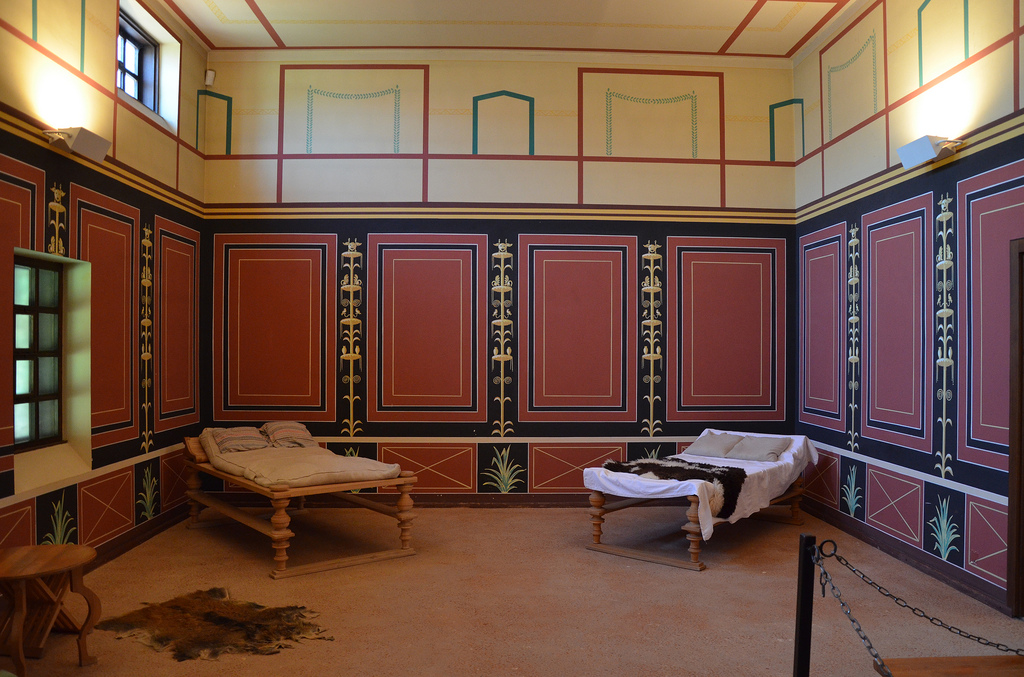
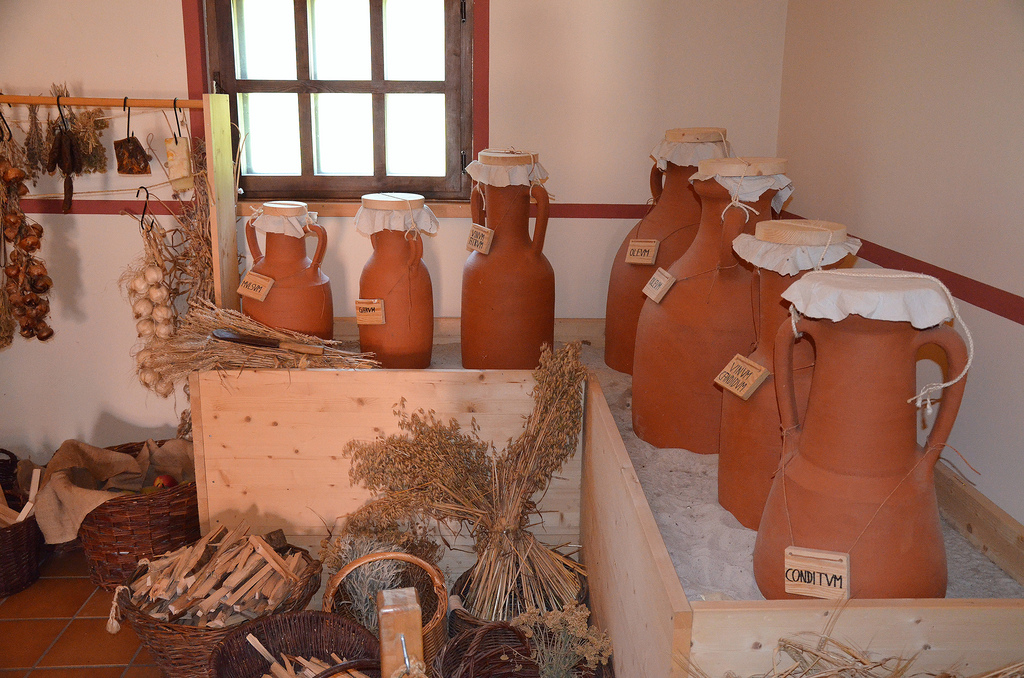
The reconstructed buildings comprise the baths, which are fully functional and consist of a frigidarium (cold bath), caldarium (hot bath) and tepidarium (tempered bath) together with latrines and a dressing room (apodyterium); the main building with large reception hall and several adjacent rooms in which the most important finds from the site and replicas (see here) are displayed; a Roman kitchen; a residential building.

A tavern in one of the wings, which was not part of the original villa, serves food and drinks based on ancient Roman recipes. The Villa Borg also produces its own Roman bread, which you can buy at the tavern. The bread is baked inside the reconstructed Roman kitchen (culina).

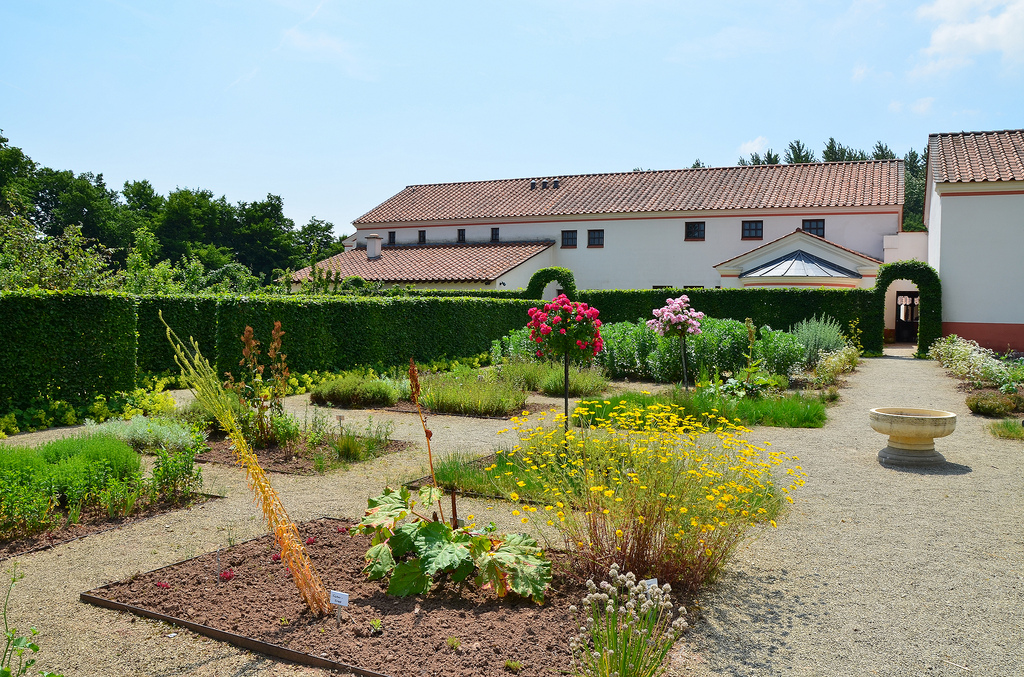
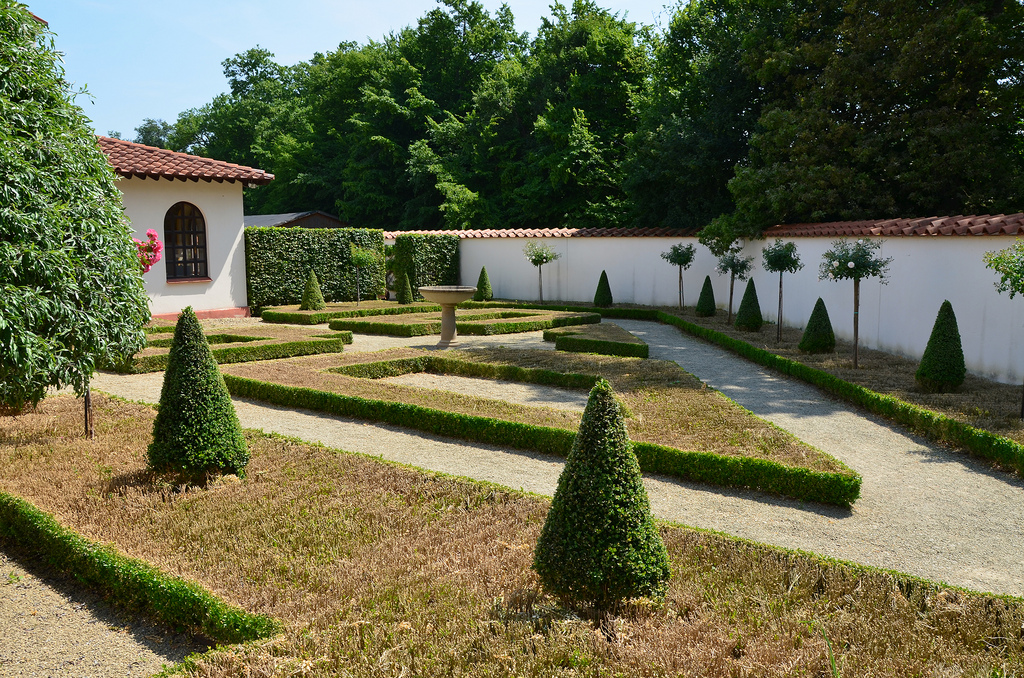
In 2000 the villa complex was expanded in the wake of the EU project “Gardens without Limits“. Six gardens were created on the complex site: the courtyard garden, the herb garden, the rose room, the fruit garden, the vegetable garden and the flower garden. The fruits, vegetables and herbs are used to prepare the Roman and regional dishes in the Tavern.

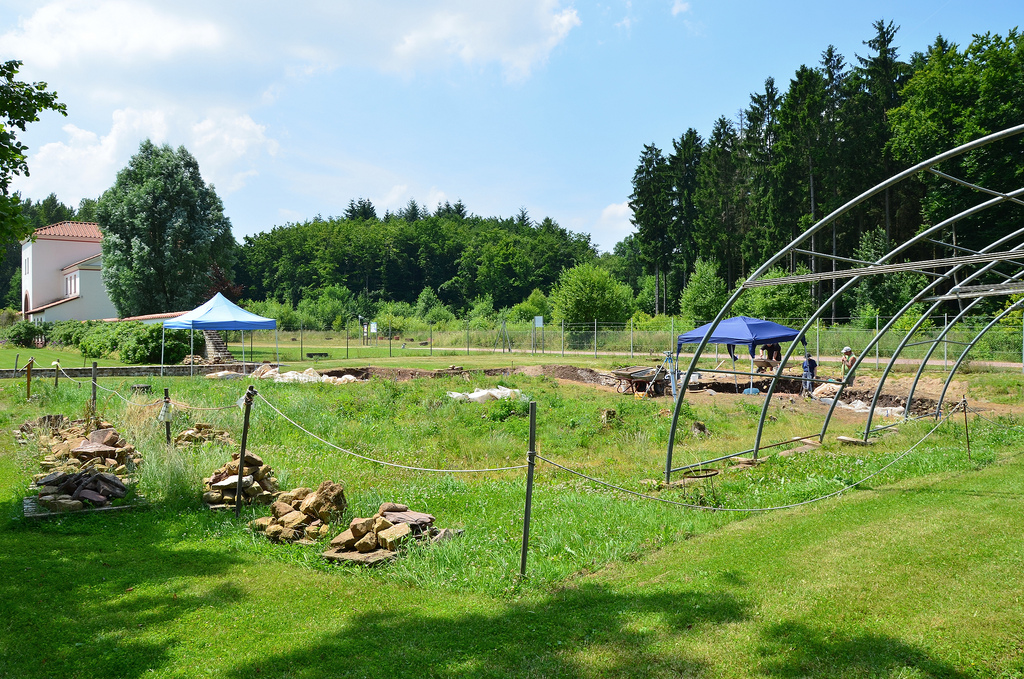
Only the pars dominica, the residential area exclusive to the master (dominus) and his family, has been excavated. Excavation work is currently being carried out in the area of the pars rustica, the space reserved for servants and workers of the farm.

PORTFOLIO

The reconstructed Gatehouse through which visitors enter the site of the Roman Villa Borg.
The interior of the Gatehouse has been designed to meet contemporary requirements and accommodates the ticket office, museum shop and administrative offices.
The interior of the Gatehouse has been designed to meet
contemporary requirements and accommodates the ticket
office, museum shop and administrative offices.
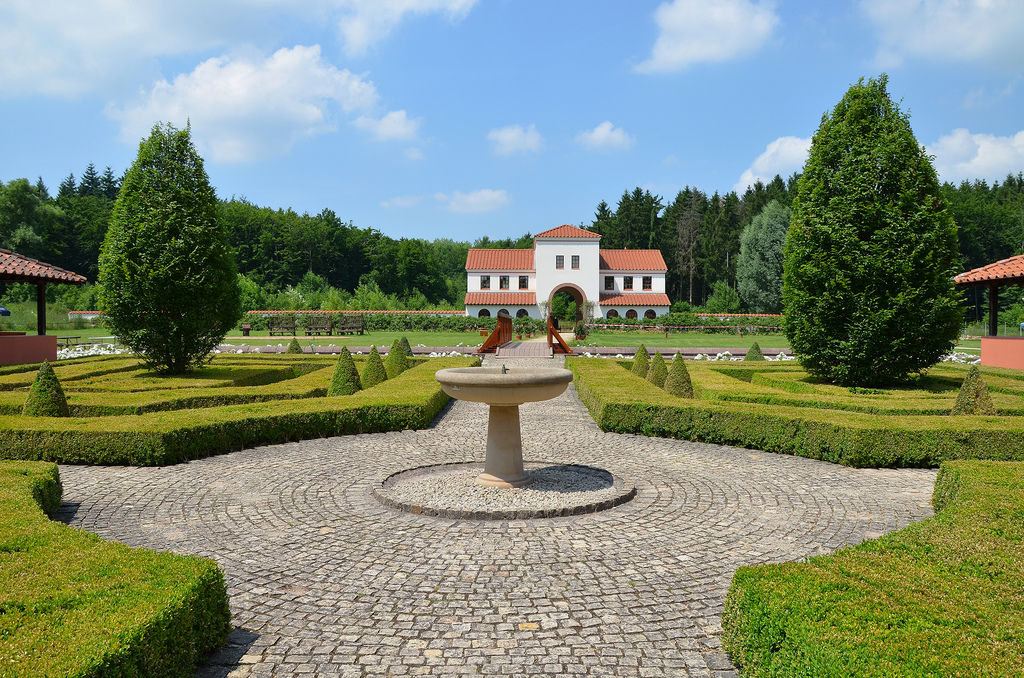
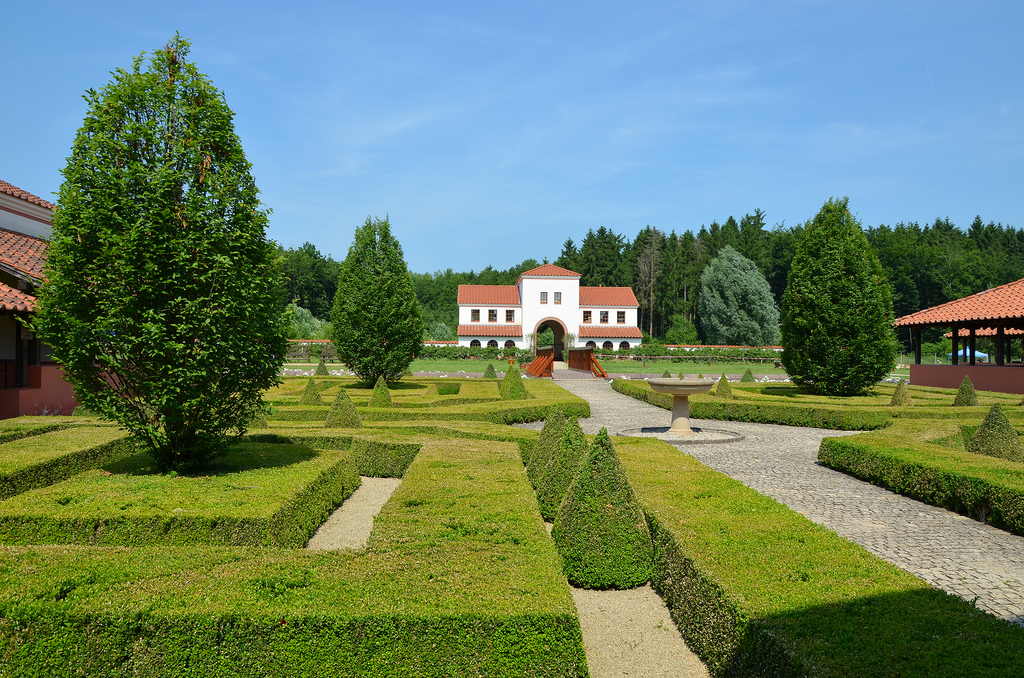
The courtyard garden with the Gatehouse in the background.
Manor house, bath and Taverne (right); living and working quarters (left.
The Manor house and its courtyard garden.
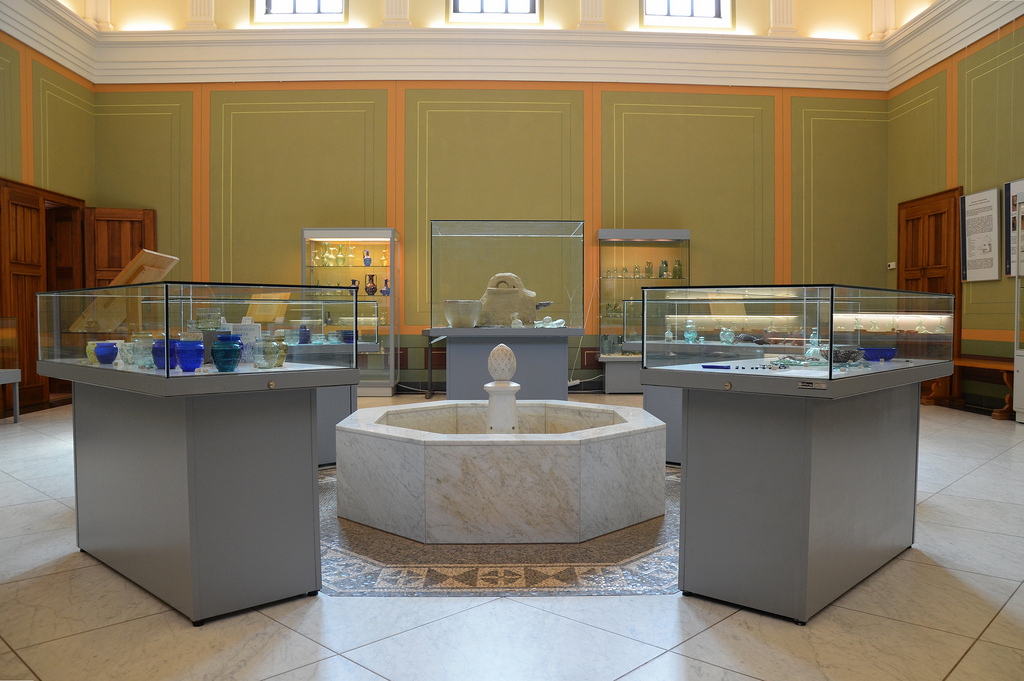
The reconstructed manor hall (atrium) used as a museum.
The reconstructed manor hall (atrium) is used as a museum.
The reconstructed manor hall (atrium) used as a museum.
The reconstructed manor hall (atrium) is used as a museum. From February to July 2013, an exhibition on Roman glass (CIRCUS BEAKERS & RIBBED BOWLS ROMAN GLASSMAKERS Mark Taylor & David Hill – work show 1989-2012) was held in the reception hall. Several dozen glass vessels found at the Villa Borg site were displayed alongside hundreds of glasses reconstructions made by Mark Taylor & David Hill.
Furniture reproductions, stools, tables, cupboards exhibited in the adjacent rooms.
Furniture reproductions, stools, tables, and cupboards are exhibited in the adjacent rooms.
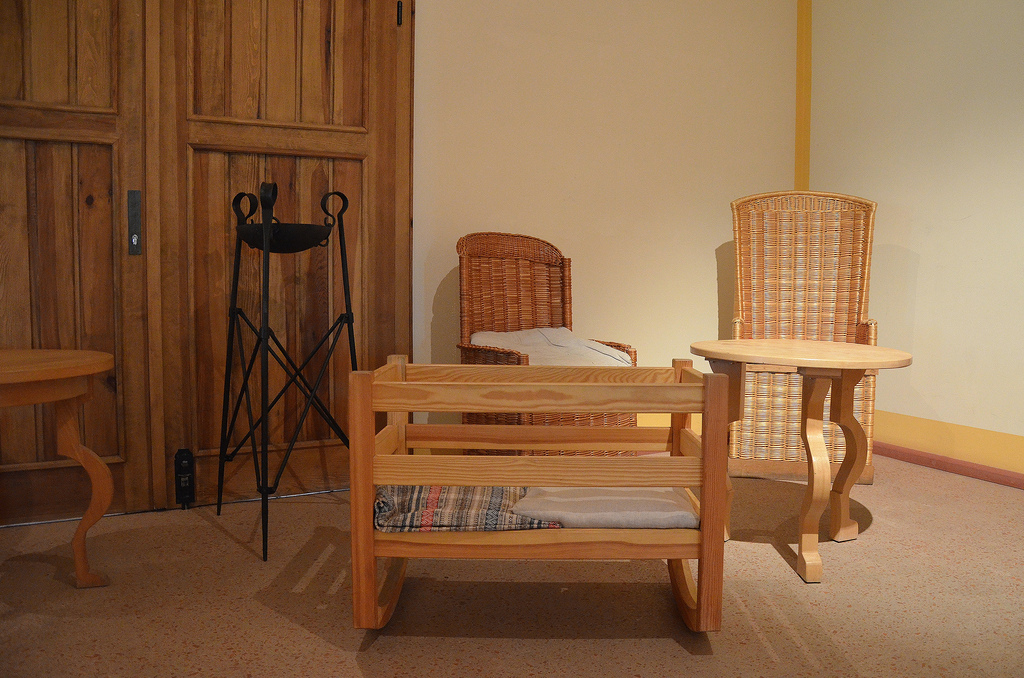
Furniture reproductions including a Roman cradle based on the one found in Herculaneum.
Furniture reproductions include a Roman cradle based on the one found in Herculaneum in the house of Marcus Pilius Primigenius Granianus.
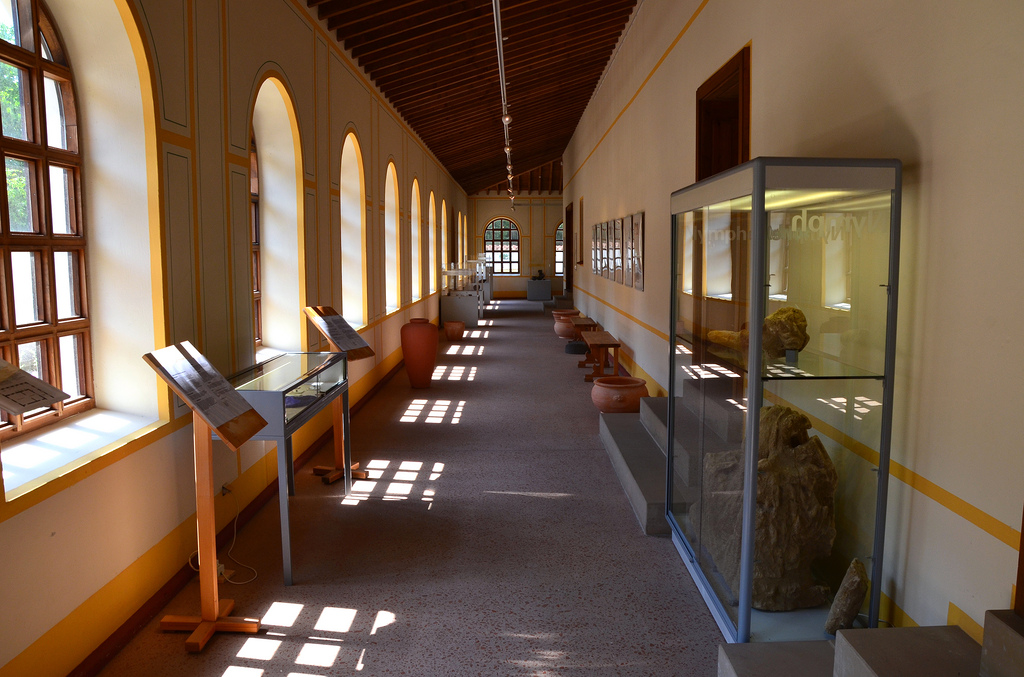
The exhibition area.
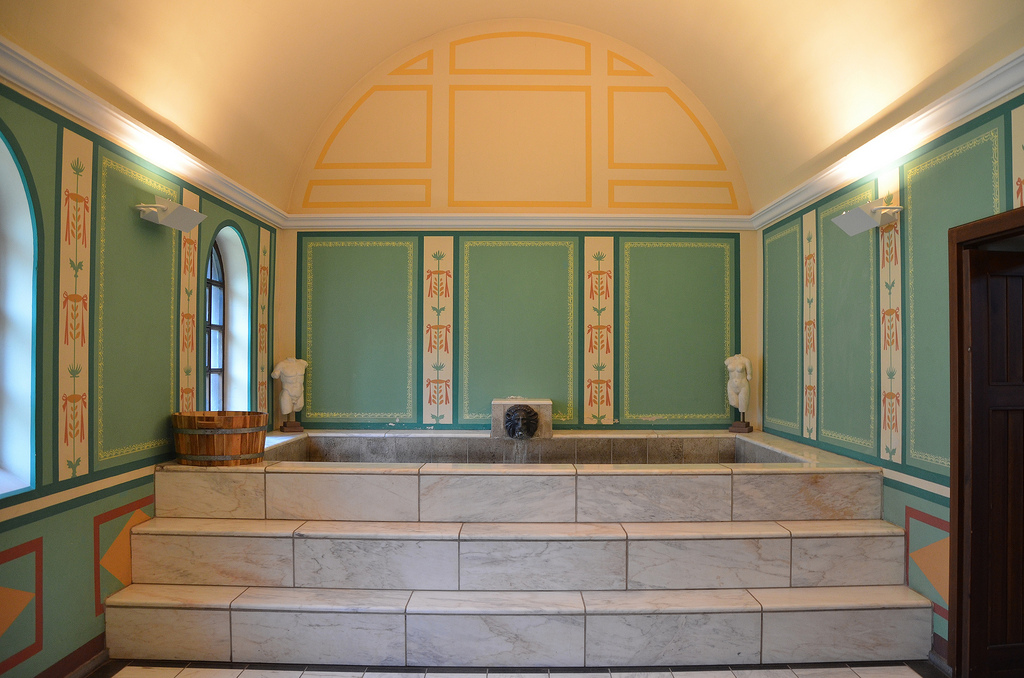
The complex also includes a fully functioning Roman bath. The baths have been rebuilt in their original way and give an indication of how important the bathing culture was in the Roman Empire.
The complex also includes a fully functioning Roman bath. The baths have been rebuilt in their original way and indicate how important the bathing culture was in the Roman Empire.
The reconstructed frigidarium (cold bath).
The reconstructed caldarium, a vaulted room containing a hot bath.
The reconstructed caldarium is a vaulted room containing a hot bath.
Next to the caldarium and in line with ancient bathing customs is the reconstructed laconicum, the dry sweating room of the Roman thermae. The resting room was raised to a higher temperature and had no bath in it.
The reconstructed laconicum, the dry sweating room of the Roman thermae. The resting room was raised to a higher temperature and had no bath in it.
The reconstructed laconicum (resting room).
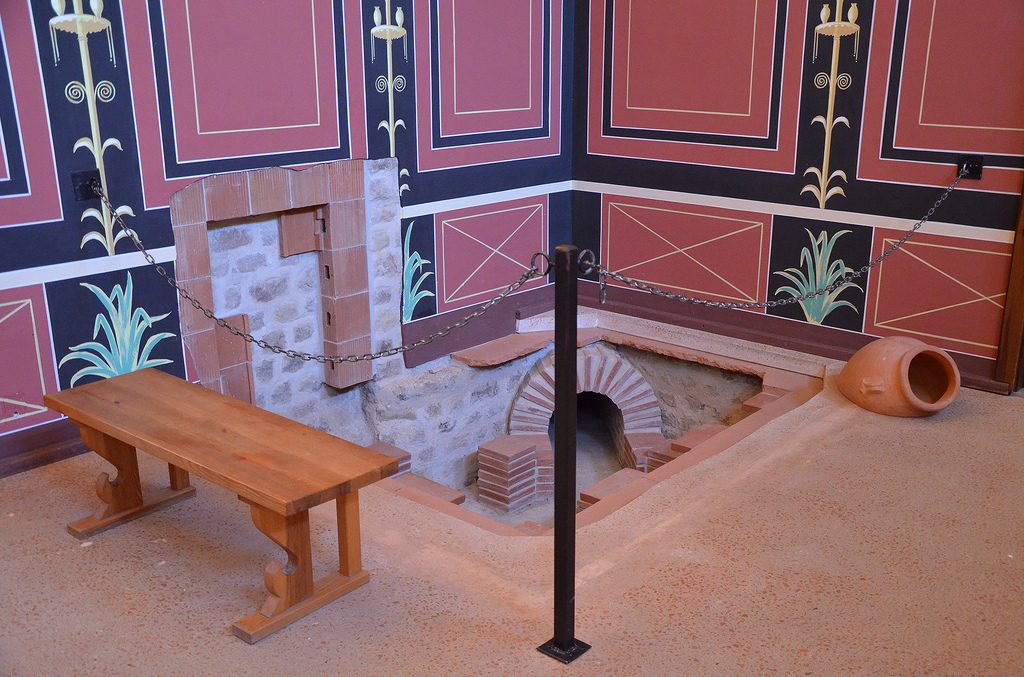
The reconstructed hypocaust in the resting room next to the baths.
The reconstructed hypocaust in the resting room.
The reconstructed lararium, the sacred place of the house, and a statue of Clio, the muse of history and and a reconstructed lararium, a shrine to the guardian spirits of the Roman household (Lar Familiaris).
The medium-warm room of the baths contains a statue of Clio, the Muse of history and a reconstructed lararium, a shrine to the guardian spirits of the Roman household (Lar Familiaris).
The reconstructed latrines.
The reconstructed Roman kitchen (culina). The Villa Borg produces its own Roman bread which you can buy at the tavern. The bread is baked inside the reconstructed kitchen.
The reconstructed Roman kitchen (culina). The Villa Borg produces its own Roman bread, which you can buy at the tavern. The bread is baked inside the reconstructed kitchen.
The reconstructed Roman kitchen (culina).
The flower garden.
The flower and herb garden. The gardens were designed as authentically as possible based on pollen analysis and relevant literature.
The plant garden.
The plant garden.
The rose garden.
The rose garden.
The rose garden.
The rose garden.
A tavern in one of the wings which was not part of the original villa serves food and drinks based on ancient Roman recipes.
The tavern in one of the wings serves food and drinks based on ancient Roman recipes.
Excavation work at the Roman Villa Borg.
Excavation work at the Villa Borg.
Roman Villa Borg.
Roman Villa Borg.

The Saarland and Mosel Valley’s ancient Roman heritage has a lot to offer to tourists and scholars alike. More than 120 antique sights along the Moselle and the Saar rivers, the Saarland and Luxembourg are testaments to the Gallo-Roman era north of the Alps (further information here).

Visiting the Roman Villa Borg: The villa is open from Tuesday to Sunday from 10am to 6pm from April to October and from 11am to 4pm from February to March and November. The site is closed on Mondays and in December and January.

Website: http://www.villa-borg.de

Eleusis

Located in West Attica, approximately 17 kilometres from Athens, ancient Eleusis overlooks the bay of Elefsina and the island of Salamis. It was the location of a very important religious centre where the Eleusinian Mysteries took place every year in honour of the goddess Demeter.

Coordinates: 38° 2′ 29.58″ N 23° 32′ 19.94″ E

The settlement of Eleusis was founded on the slopes of a hill in the Middle Helladic period (ca. 1900 BC). Successive settlements were established on the summit of the hill from the 16th century BC onwards, where the first temple of Demeter was built in the 15th century BC. According to the Homeric Hymn to Demeter, the cult of Demeter was introduced during the reign of the legendary King Celeus.

According to Greek mythology, the goddess Demeter (in the guise of an old woman) received a hospitable welcome from King Celeus at Eleusis while searching for her daughter Kore (Persephone), who had been abducted by Hades. In return, Demeter taught the Eleusinians her secret mysteries. After Kore was returned from the underworld, Demeter made the land fertile again and taught Triptolemos, the son of King Celeus, how to cultivate the earth. He then spread the knowledge throughout Greece.

This is the largest and most important votive relief found at Eleusis. It represents the Eleusinian deities in a scene of mysterious rituel. On the left Demeter, clad in a peplos and holding a scepter in her left hand, offers ears of wheat to Triptolemos, son of Eleusinian king Keleos, to bestow on mankind. On the right Persephone, clad in a chiton and mantle and holding a torch, blesses Triptolemos with her right hand. This relief, dating to c. 440-430 BCE, was apparently famous in antiquity and was copied in the Roman period. (Archaeological Museum of Athens, Greece)
The great Eleusinian relief. On the left, Demeter offers ears of wheat to Triptolemos, son of Eleusinian king Keleos, to bestow on mankind. On the right, Persephone blesses Triptolemos with her right hand.

The cult of Demeter originally started as a local cult but acquired a panhellenic character in the 7th century BC when the Eleusinian Mysteries were established as one of the most important Athenian festivals. The ceremonies were held twice a year. There were two major stages to the rituals known as the “Lesser Mysteries”, held each spring, and the “Greater Mysteries”, held during September and October. The continuity of Demeter’s cult is attested until Roman times by the erection of successive temples on the east side of the hill. Hadrian, himself an initiate, began a major building programme with the creation of the Panhellenion.

The sanctuary in its final stages in the 2nd and 3rd centuries AD is what the visitor sees today. The site’s finds are housed in the Eleusis Museum and the National Archaeological Museum of Athens.

Model of the Sanctuary of Eleusis.

PORTFOLIO

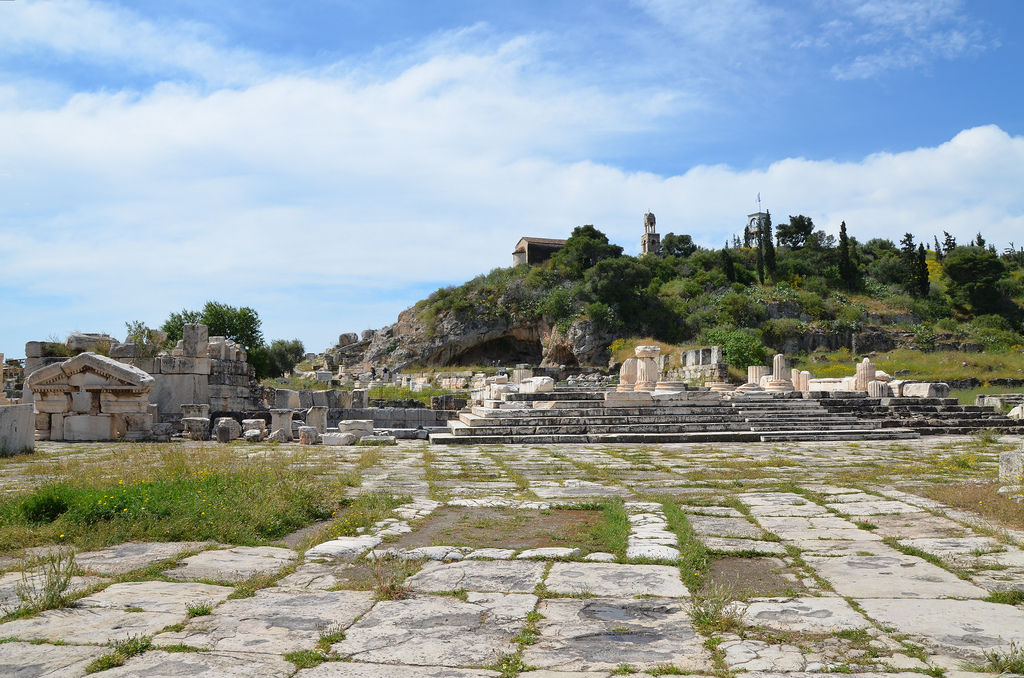
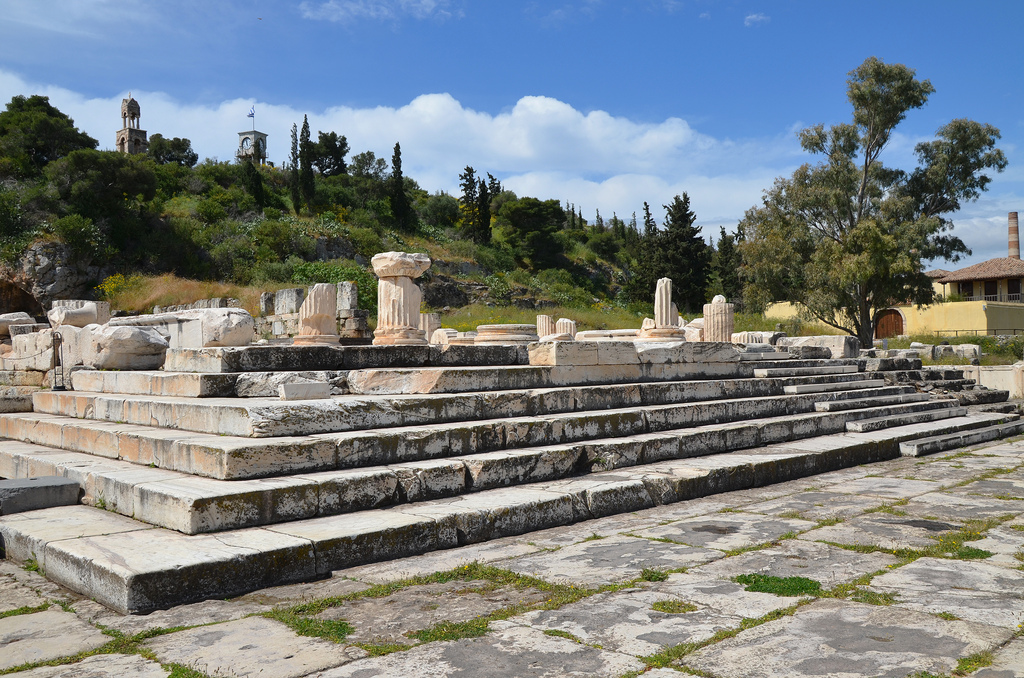
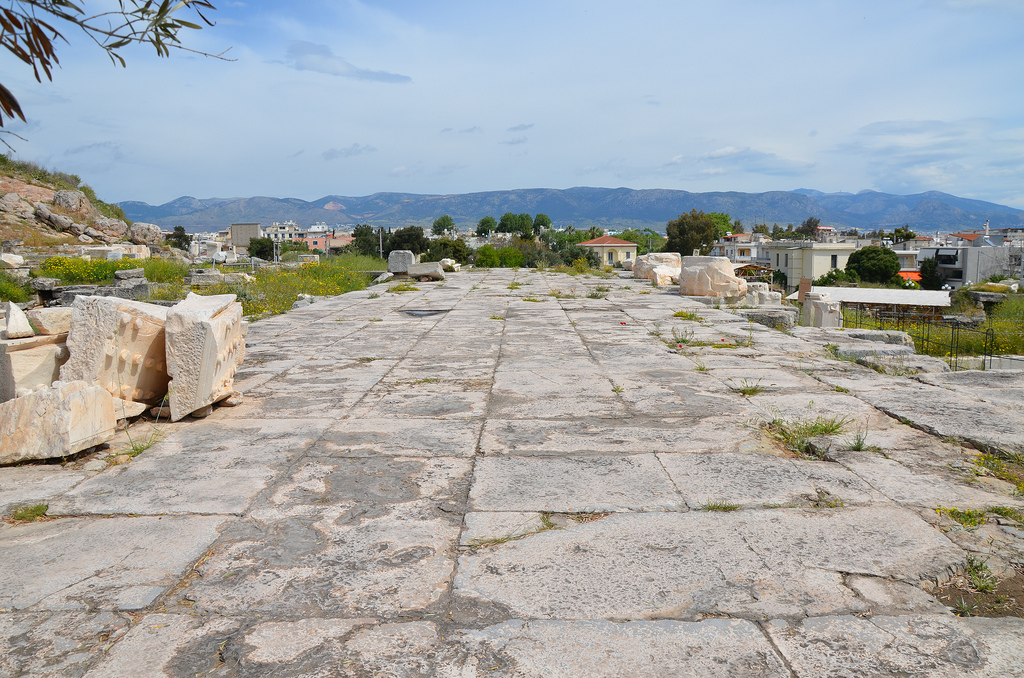
The entrance square to the sanctuary, the steps lead up to the Greater Propylaia.
The entrance square to the sanctuary dates to the Roman period and is paved with large rectangular marble slabs. The steps lead up to the Greater Propylaia.
Preserved bottom of a fountain, a harmonious marble building with six columns on the facade.
The court was flanked by stoas and a fountain, a harmonious marble building 11 metres in length with six columns on the facade. It was probably built during the reign of Hadrian. Behind the fountain stand the remains of the Eastern Triumphal Arch.
The remains of the Eastern Triumphal Arch built by Antoninus Pius outside the Sanctuary of Demeter and Kore.
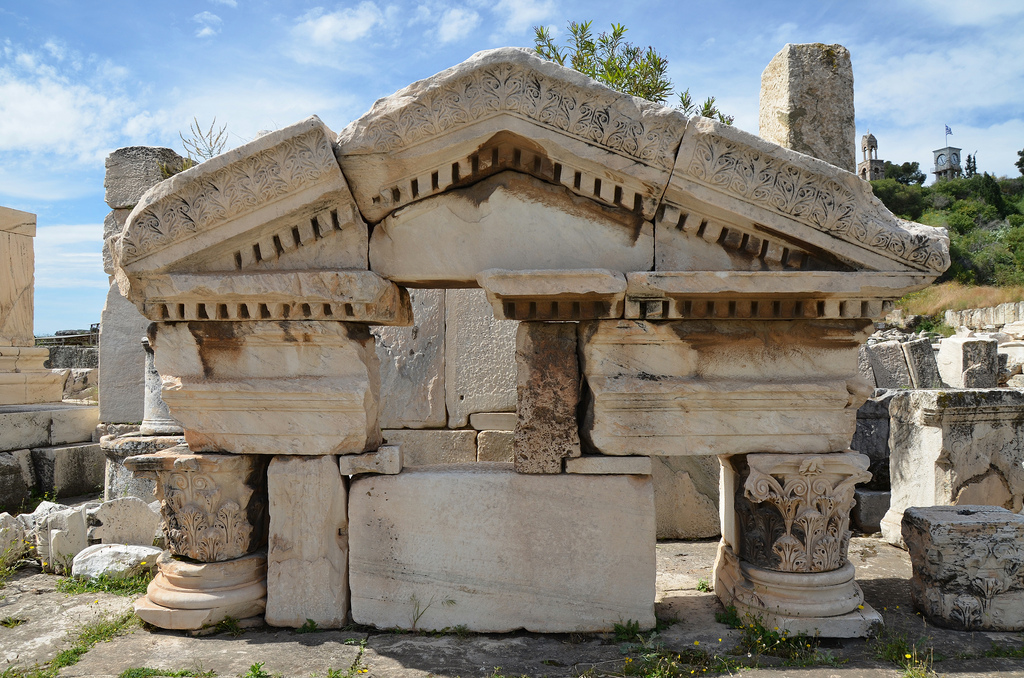
The Eastern Triumphal Arch was built in Pentelic marble by Antoninus Pius or Marcus Aurelius. It was modelled on the Arch of Hadrian in Athens, like its twin at the west end of the Sanctuary.
Partial reconstruction of the Eastern Triumphal Arch built by Antoninus Pius.
Partial reconstruction of the Eastern Triumphal Arch. Inscriptions revealed that the arches were dedicated to the two Goddesses (Demeter and Persephone) and the emperor Hadrian.
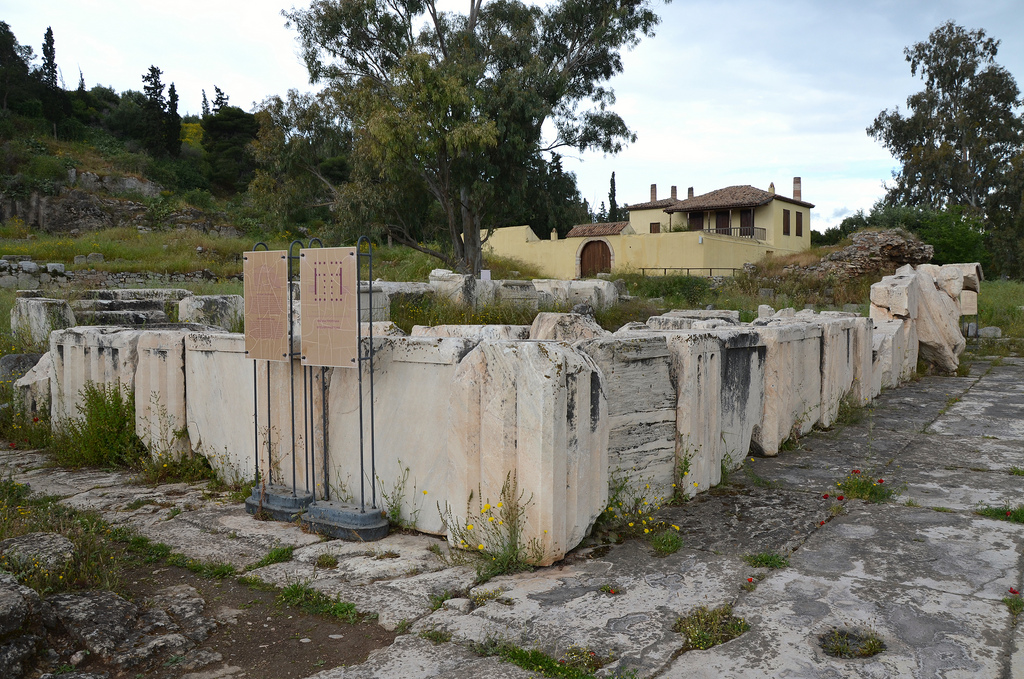
The foundations of the Western Triumphal Arch marking the end of the road from Megara.
The foundations of the Western Triumphal Arch mark the end of the road from Megara. It was a single wide arch with a second storey of columns and an entablature above it.
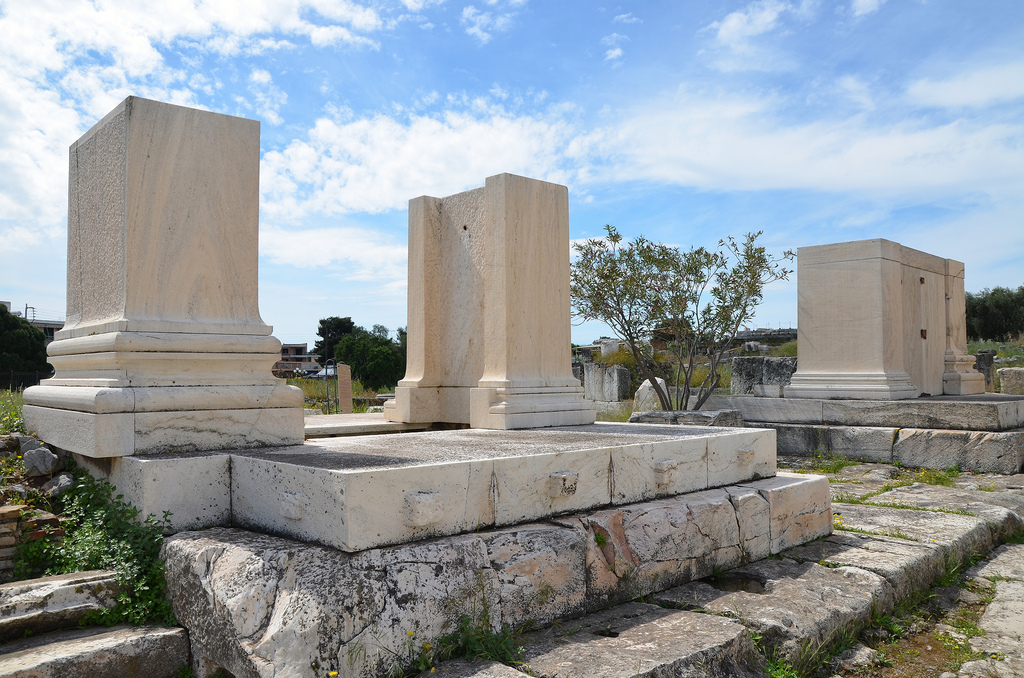
On the paved court stands the high podium, made of Roman concrete, of the Temple of Artemis of the Portals and Father Poseidon. Built of Pentelic marble before the reign of Marcus Aurelius, it had a front and rear portico with Doric columns.
The remains of the Temple of Artemis Propylaia and Poseidon Pater standing on the paved court on a high podium. Built of Pentelic marble during the reign of Marcus Aurelius, it had a front and rear portico with Doric columns.
The Greater Propylaea, a monumental gate probably built by Marcus Aurelius on the same site as an earlier gate from the time of Kimon, ca. 170 AD - ca. 180 AD, Eleusis
The Greater Propylaea, a monumental gate probably built by Marcus Aurelius on the same site as an earlier gate from the time of Kimon. It formed the main entrance to the sanctuary.
The Greater Propylaea was a close copy of the Propylaea of the Acropolis in Athens, consisting of two porches, each with a facade of six Doric columns.
The architectural elements that formed the Greater Propylaea, a monumental gate probably built by Marcus Aurelius.
The architectural elements (triglyphs and metopes) formed the Greater Propylaea, a monumental gate probably built by Marcus Aurelius.
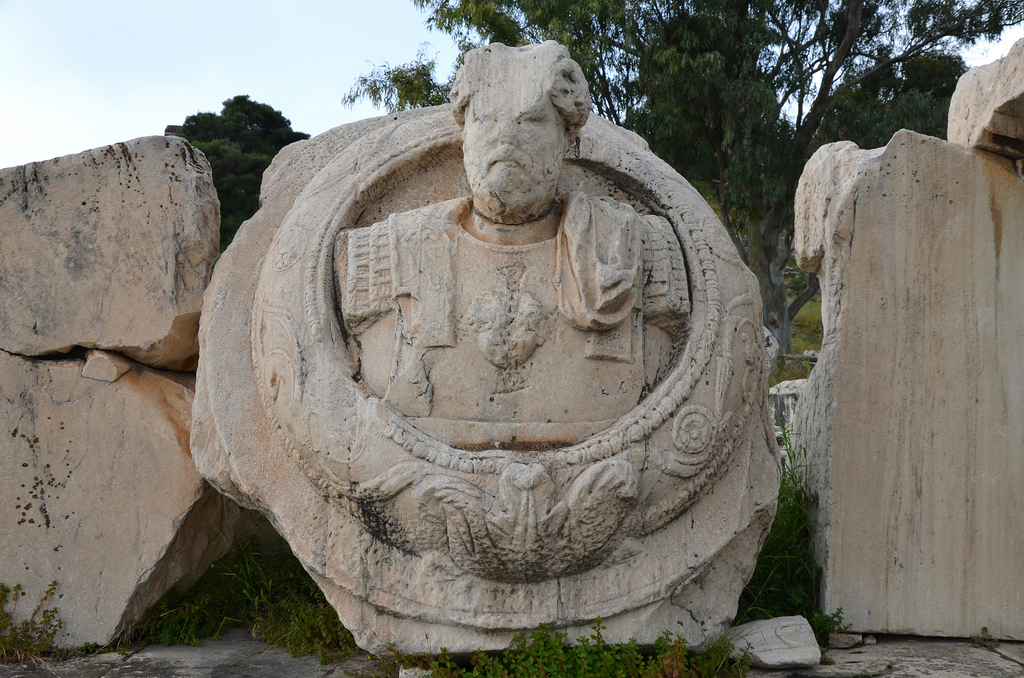
This cuirassed bust of an emperor was installed at the centre of the pediment of the Greater Propylaea. Although the face is badly damaged, it is thought to be a portrait of the emperor Marcus Aurelius who built the Greater Propylaea.
This cuirassed bust of an emperor was installed at the centre of the pediment of the Greater Propylaea.
Although the face is badly damaged, it is considered a portrait of the emperor Marcus Aurelius, who built the Greater Propylaea.
The Lesser Propylaea, a small gateway to the Sanctuary of Demeter and Kore built ca. 60 BC - ca. 10 BC, Eleusis
The Lesser Propylaea is a small gateway to the Sanctuary built by Appius Claudius Pulcher in 54 BC.
The entablature of the Lesser Propylaea had an Ionic architrave, on which is cut the Latin dedicatory inscription, and a frieze of triglyphs and metopes embellished with cists, bukrania, and stylized double poppies.
The entablature of the Lesser Propylaea had an Ionic architrave on which was cut the Latin dedicatory inscription and a frieze of triglyphs and metopes embellished with wheat sheaves, bucrania, and stylized double poppies.
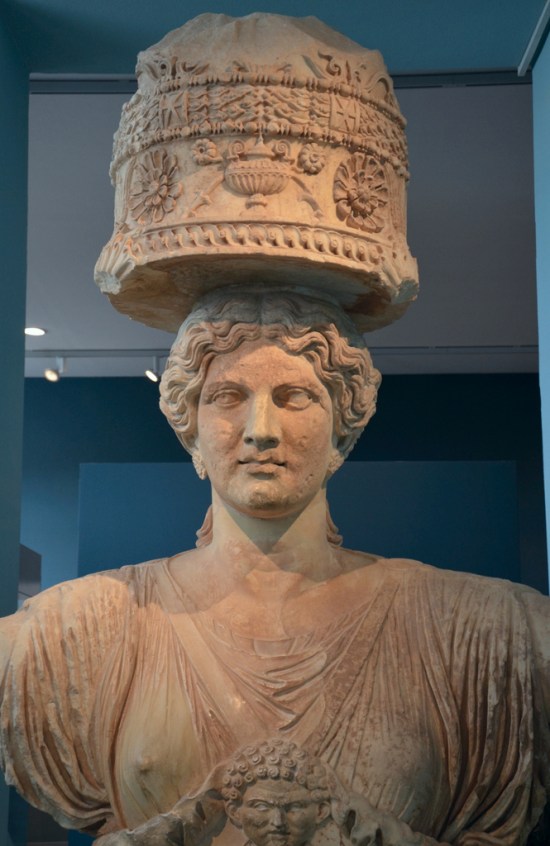
The upper part of one of the caryatids that flanked the Lesser Propylaea of Eleusis, made in Attica in about 50 BC (Eleusis Museum).
The upper part of one of the caryatids flanked the Lesser Propylaea. On its head, it carries the kiste, the sacred chest decorated in relief with the symbols of the Eleusinian cult: ears of wheat, poppies, and rosettes (Eleusis Museum).
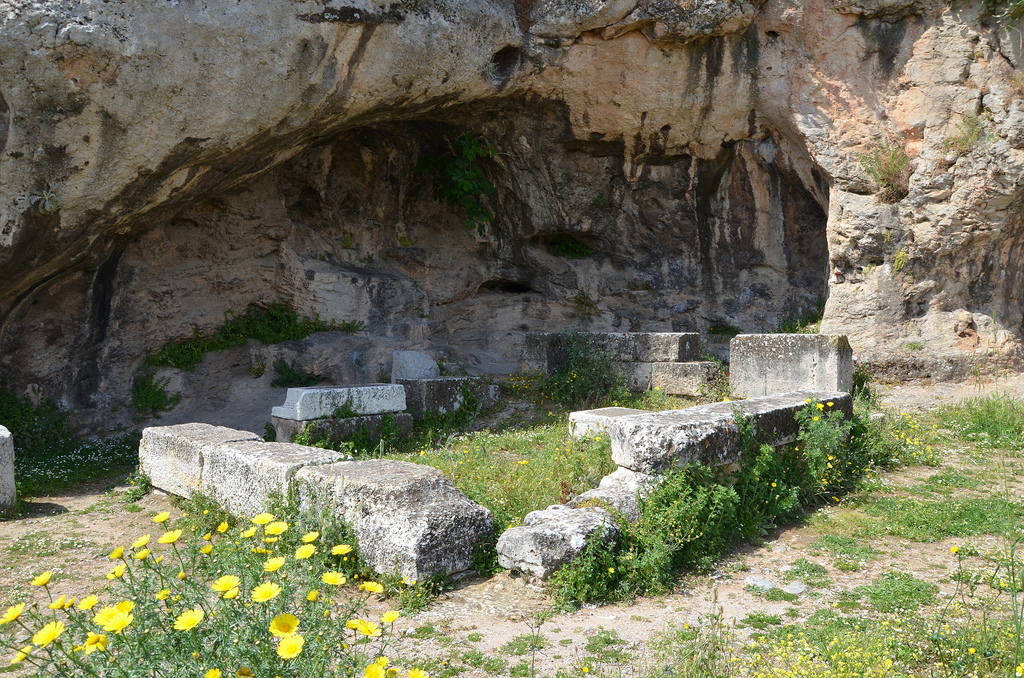
he Plutonion (caverns recalling the entrance to the underworld).
The Sanctuary of Pluto (Hades), god of the Underworld, who abducted Persephone. The cavern recalls the entrance to the underworld. It is situated to the west of the Lesser Propylaea.
The temple of Pluto is Archaic in date but was remodeled on many occasions from the fourth century BC down to Roman times.
The Temple of Pluto is Archaic in date but was remodelled on many occasions from the 4th century BC down to Roman times. It was a small temple with cella and pronaos opening east and a peribolos wall.
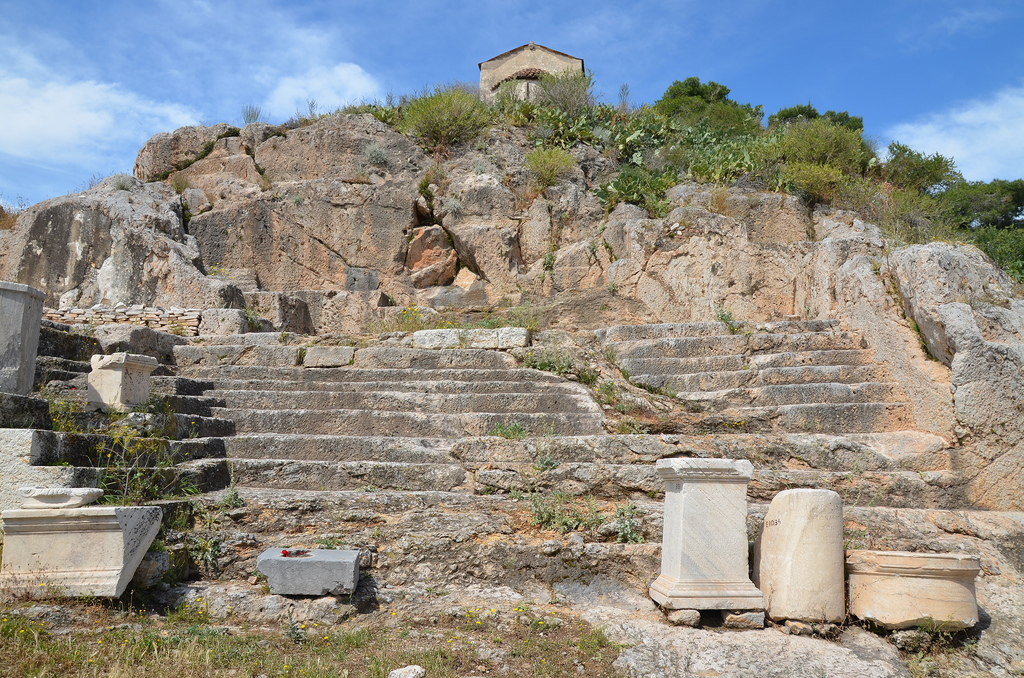
Flight of steps cut into the east side of the rock along the Processional Way.
Overall view of the Telesterion, the
Overall view of the Telesterion, the “place for initiation”. It was the central building of the sanctuary where pilgrims were initiated into the Eleusinian Mysteries.
The Telesterion. It was a large hypostyle hall with seats on all four sides where the faithful sat and watched the rituals. The Hierophantes produced sacred objects and receded texts to covey a positive view of life after death.
Serving as the initiation Hall and Temple for the Eleusinian Mysteries, the Telesterion was a large hypostyle hall with seats on all four sides where the faithful sat and watched the rituals.
The earliest building traces on the site are of a Mycenaean megaron opening east. This was replaced by a Geometric building, and by Solon's time (ca. 600 B.C.) a rectangular hall, probably columned, running southwest-northeast had been built to accommodate a larger number of participants.
The earliest building traces on the site of the Telesterion are of a Mycenaean megaron opening east. By Solon’s time (ca. 600 BC), a rectangular hall, probably columned, running southwest-northeast, had been built to accommodate a larger number of participants. This was replaced by a Geometric building.
The Stoa of Philo built by the Eleusinian architect Philo in the mid-4th century BC in the Doric order in order to extend the Telesterion by the addition of a semi-open space.
The Stoa of Philo was built by the Eleusinian architect Philo in the mid-4th century BC in the Doric order to extend the Telesterion by adding a semi-open space.
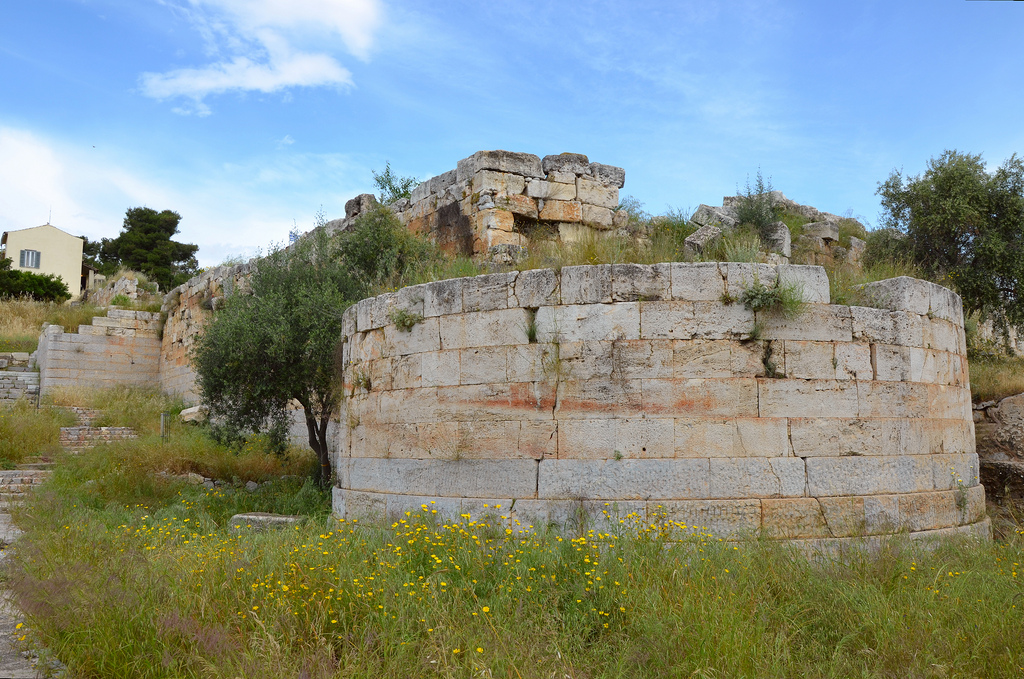
The fortification wall and circular corner-tower dating to the 4th century BC.
The fortification wall and circular corner tower date to the 4th century BC.
Kallichoron Well, according to the myth it was here that Demeter rested as she searched for her daughter Persephone.
Kallichoron Well, according to the myth, it was here that Demeter rested as she searched for her daughter Kore. Here dances to Demeter and Kore were once performed, hence the name meaning Well of the Fair Dances.
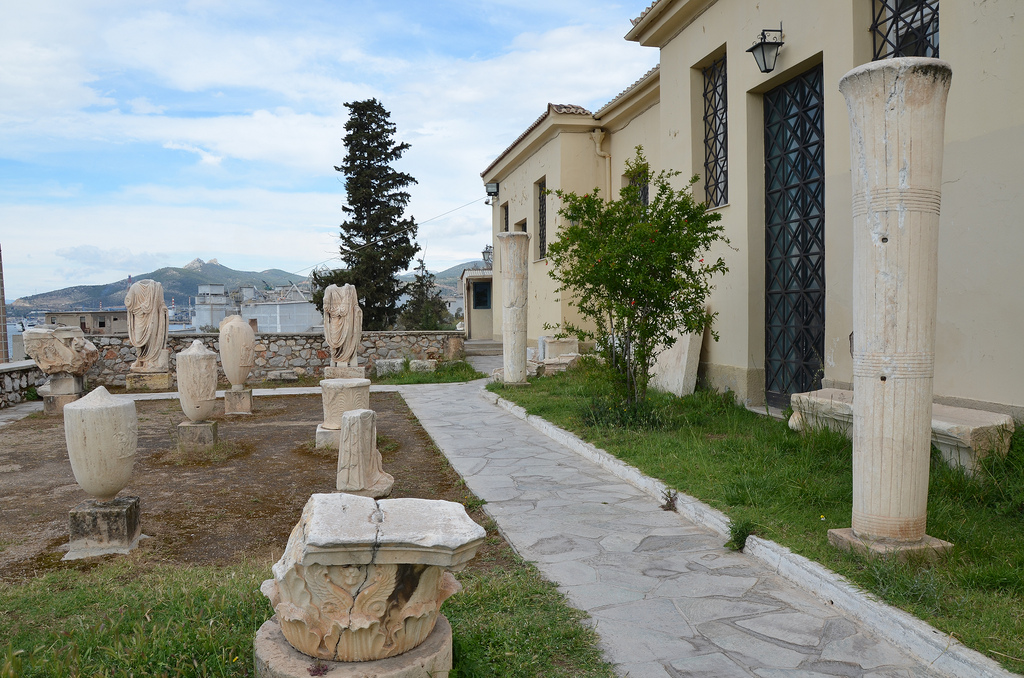
Eleusis Museum
Eleusis Museum
Statue of the deified Antinous represented as Asklepios, found in the outer court of the sanctuary which it apparently adorned, 2nd century AD (Archaeological Museum of Eleusis).
The statue of Antinous, represented as Asklepios, was found in the outer court of the sanctuary, which it apparently adorned. Antinous accompanied Hadrian during his attendance at the annual Eleusinian Mysteries. (Archaeological Museum of Eleusis).

Links:

Sources:

  • Kalliope Preka-Alexandri, Eleusis (Ministry of Culture Archaeological Receipts Fund, 2015)
  • Christopher Mee & Antony Spawforth, Greece: An Oxford Archaeological Guide (Oxford University Press, 2001)