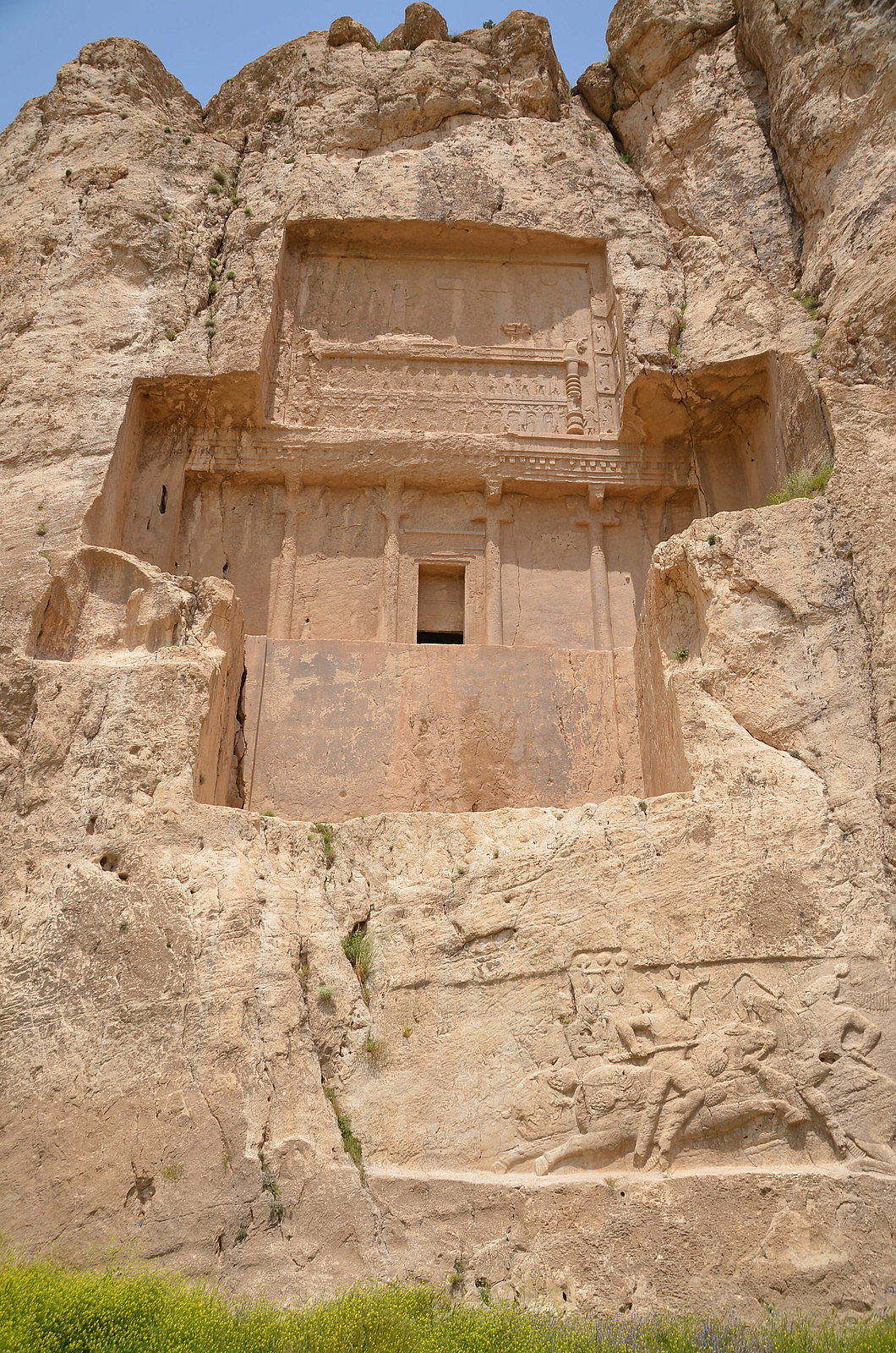
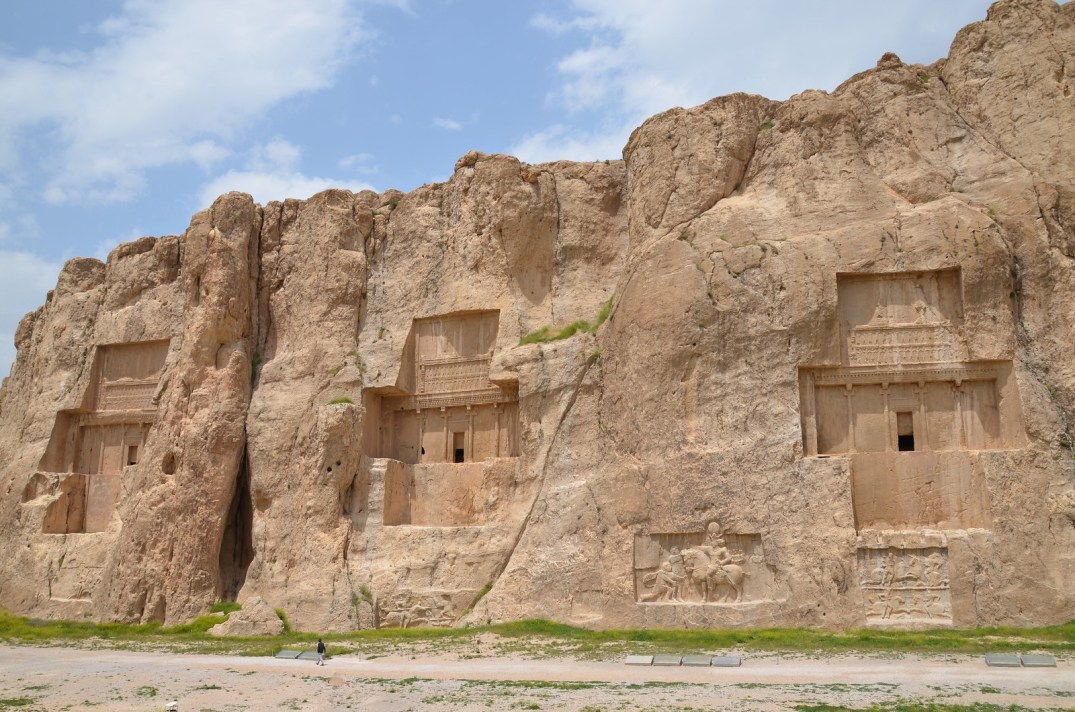
The spectacular rock tombs at Naqsh-e Rostam are located about 6 km northwest of Persepolis in southern Iran. It is one of the most important archaeological sites in Iran and contains monuments of the Elamite, Achaemenid and Sasanian dynasties carved into the rock. The site features four Achaemenid burial tombs believed to be those of Darius I, Xerxes I, Artaxerxes I, and Darius II (Ochus), as well as eight Sasanian reliefs depicting vivid scenes of imperial conquests and royal ceremonies. It also features an Achaemenid stone structure whose original purpose has been discussed for several decades. The Persian name Naqsh-e Rostam, meaning “Pictures of Rostam”, refers to the Sasanian reliefs on the cliff, which were thought to represent the mythical Iranian hero Rostam.
Naqsh-e Rostam was the necropolis of the Achaemenid dynasty, where monumental royal tombs were carved into the native rock at considerable height above ground. Similar to those at Persepolis, the tombs are characterised by their rock-cut façades and simple sepulchral chambers in which the king was buried with his relatives. The oldest tomb has an inscription (known as DNa) that explicitly assigns it to Darius the Great (c. 522-486 BC). The other three tombs are attributed to Xerxes (c. 486-465 BC), Artaxerxes I (c. 465-424 BC) and Darius II (c. 423-404 BC). A fifth unfinished tomb might belong to Artaxerxes III or Darius III (c. 336-330 BC), the last king of the Achaemenid Dynasty. The tombs were looted after the Achaemenid Empire was conquered by Alexander the Great.
I am Darius the great king, king of kings, king of countries containing all kinds of men, king in this great earth far and wide, son of Hystaspes, an Achaemenid, a Persian, son of a Persian, an Aryan, having Aryan lineage.
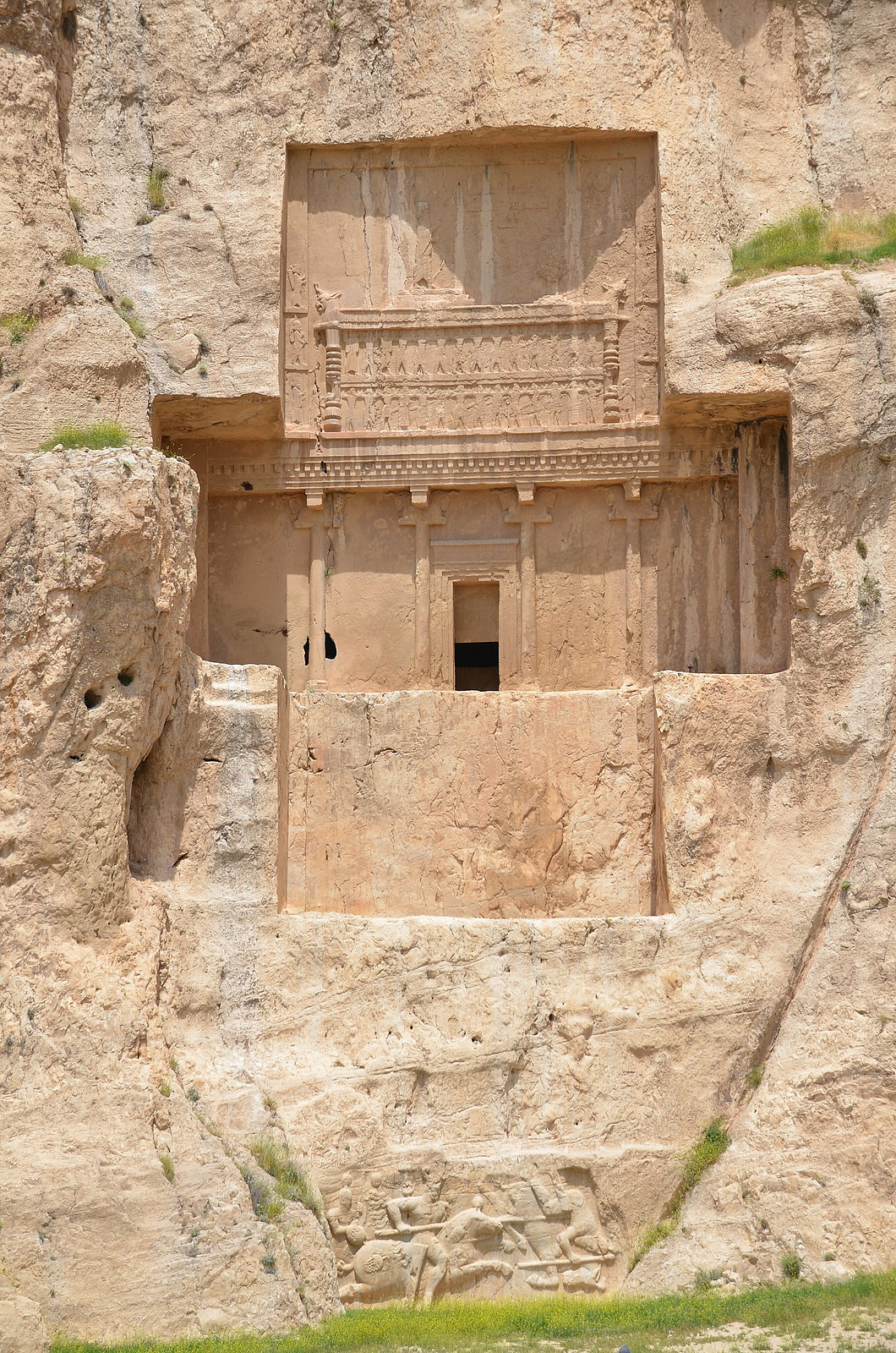
All Achaemenid tombs have similar features. They were carved in the shape of a cross with an access to a small chamber in their centre. The upper register of the façade shows the king standing on a three-stepped platform in front of a blazing fire altar, praying to the supreme god Ahuramazda, whose winged symbol floats above. He is being carried on the shoulders of twenty-eight representatives of different subject nations.
The nationalities mentioned in the DNa inscription are also depicted on the upper registers of all the tombs at Naqsh-e Rostam. One of the best preserved is that of Xerxes I. A.Davey [CC BY 2.0], via Wikimedia CommonsThe middle register, which gives access to the burial chamber, is adorned with four engaged columns with bull protome capitals, an imitation of the façade of a palace (perhaps the residential palace of Darius at Persepolis). The lower register remained undecorated.
The other important Achaemenid monument at Naqsh-e Rostam is the enigmatic tower called Kaʿba-ye Zardošt (‘Cube of Zoroaster’) situated opposite Darius II’s tomb. It is a rectangular-shaped stone structure, built of white limestone blocks. It stands 12.60 metres high on a three-tiered platform, with a thirty-step stairway leading to a single chamber. Controversy over the building’s function persists. Some archaeologists consider the tower a religious edifice, perhaps a fire temple used for igniting and worshipping the holy fire, while others reject this view and think it may have served as a provisional royal tomb until the permanent tombs were completed, or as a treasury and a repository for sacred texts. The monument was later used by the Sasanian king Shapur I (AD 240-270) to record his victories over the Romans (transcription of the full text with English translation here).
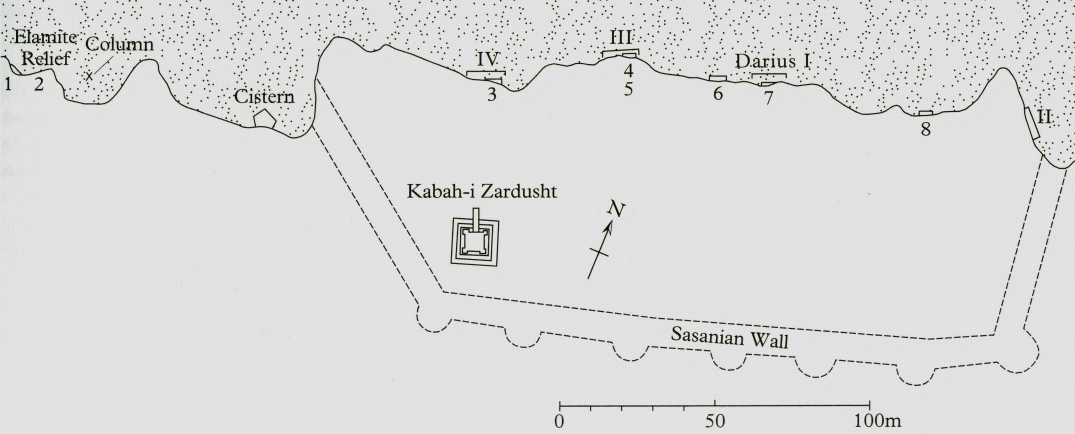
Plan of the site. Achaemenid tomb facades are numbered in Roman numerals. Sasanian reliefs are numbered r-8. (Courtesy U. Seidl)
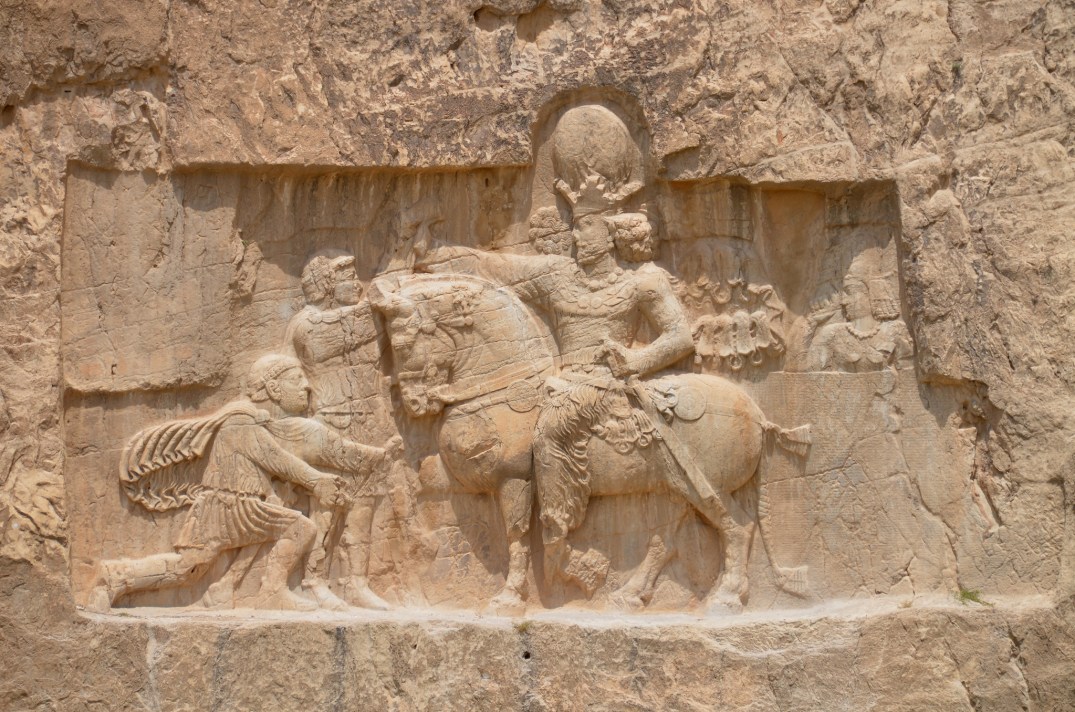
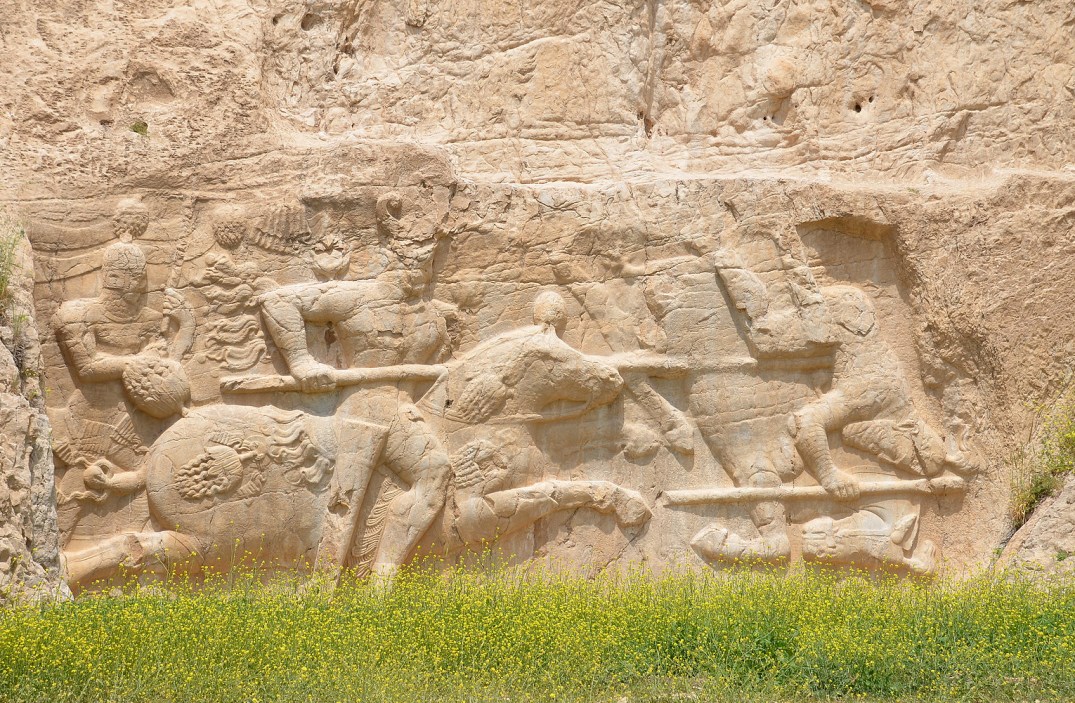
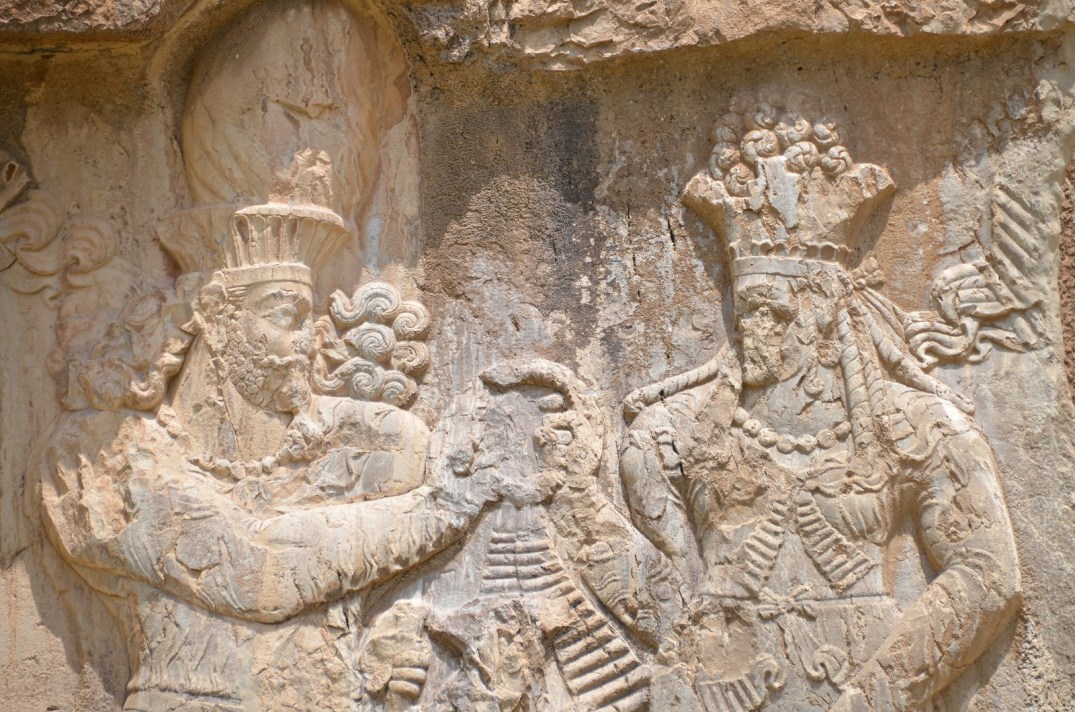
The Sasanian rock reliefs, dating from the 3rd and 4th centuries AD, depict the investiture of Ardashir I, the victories of Shapur I, three scenes of Wahram II, the investiture of Naresh and a relief of Hormizd II. The Sasanians also built a large mud-brick fortification wall that runs around most of the sculptured cliff, with seven semicircular towers strengthening the structure. It is not clear whether the Sassanids had precise information about the Achaemenians, but the fact that they carved reliefs next to the royal tombs of their Achaemenian peers suggests a cultural and political strategy of imitating the past.
The only surviving monument from the Elamite period is a relief that was mostly obliterated when the Sasanian rock relief of Bahram II was carved over it. The remnants of the scene show an attendant standing behind two seated deities, faced presumably by a standing worshiper, and a head with a mural crown. Only the attendant at the right is preserved in its major features. The Elamite carving is believed to have been executed in two periods: the first in the early first millennium BC, the other in about 700 BC.
PORTFOLIO
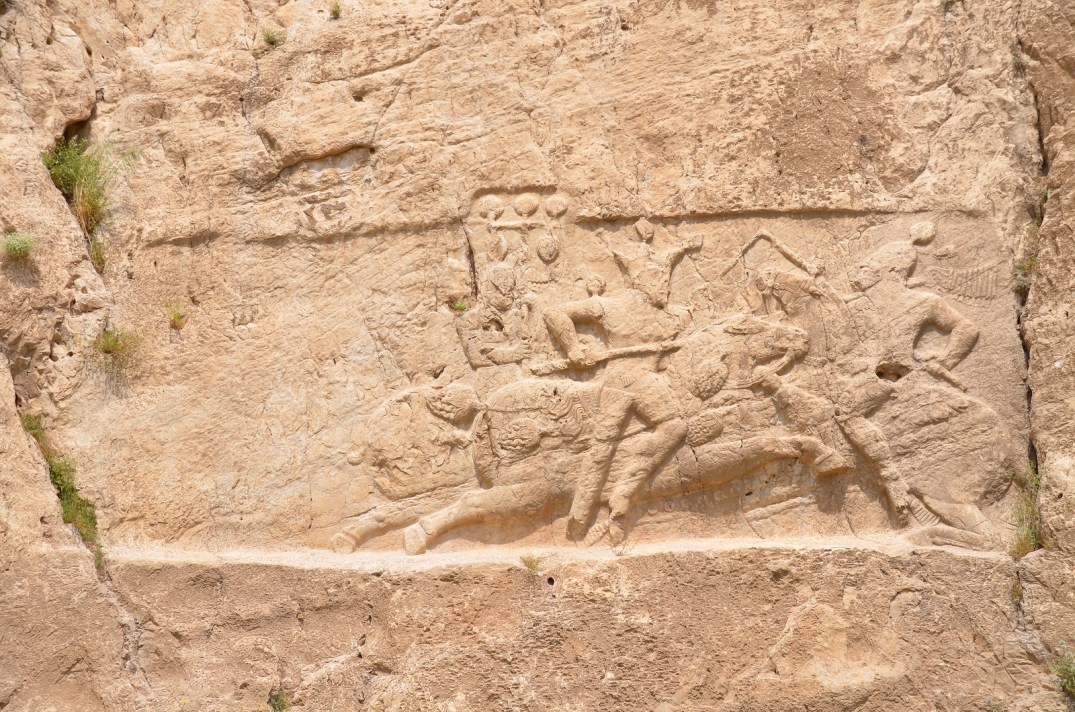
The Tomb of Darius I (right) and Artaxerxes I (left), and four Sasanian rock reliefs. Sasanian rock reliefs from right to left: Equestrian Relief of Bahram II – Relief of Shapur I – Relief of Hormizd II – Relief of Shapur II (damaged)The Tomb of Darius the Great and the Double Equestrian Relief of Bahram II.The upper register of the Tomb of Darius the Great shows the king praying to the supreme god Ahuramazda. An inscription in the top-left corner, known as DNa, commemorates Darius the Great’s conquests and achievements. Like several other inscriptions by Darius, it names the territories controlled by the Achaemenid Empire.The Double Equestrian Relief of Bahram II (AD 276-293), located immediately below the tomb of Darius I the Great. In the upper register, the king appears to be throwing an enemy from his horse. In the lower register, the king is again battling a mounted enemy. Both reliefs depict a dead enemy under the hooves of the king’s horse.This is the most famous of the Sasanian rock reliefs from Naqsh-e Rostam. It depicts the victory of Shapur I over two Roman emperors, Valerian and Philip the Arab.Shapur is represented on horseback wearing royal armour and a crown. His rule was marked by military and political accomplishments in the Caucasus, against the Kushan Empire in the east, and two wars with the Roman Empire.Philip the Arab kneeling in front of the king’s horse, asking for grace.The Achaemenid attributed to Artaxerxes I (r. 465-424 BC). Like the other tombs, the tomb of Artaxerxes I is almost an exact copy of the final resting place of Darius the Great. The Sasanian relief below the tomb commemorates an equestrian victory by King Hormizd II (r. AD 303-309). Immediately above the relief and below the tomb is a badly damaged relief of what appears to be Shapur II (c. AD 309–379), accompanied by courtiers.The equestrian relief of Hormizd II. It depicts Hormizd forcing an enemy (perhaps Papak of Armenia) from his horse.The Achaemenid tomb attributed to Darius II Nothus (r. 423-404 BC). The Sasanian relief below commemorates an equestrian victory by King Bahram II (r. AD 276-293).Sasanian relief depicting king Bahram II battling a mounted Roman enemy. The enemy wears a Roman helmet and may represent the emperor, Carus.View of the Tomb of Darius I (right), Artaxerxes I (middle) and Darius II Nothus (left) and the five Sasanian rock carvings.The Achaemenid tomb attributed to Xerxes, 486-465 BC. The upper register is identical to the relief of Darius’ tomb. As of 2019, conservation and restoration work are underway. The tomb has been exposed to wind, blowing particles, climate change, and other natural erosion.The Sasanian relief depicting the investiture of Narseh, the seventh king of the Sasanian Empire (c. AD 293–303). Narseh was the youngest son of Shapur I. He had served as ruler of the eastern provinces (Sakastan, Sindh and Turan) and held the title of “Great King of Armenia” before becoming shah.In this relief, the king is depicted receiving the ring of kingship from a female figure, frequently identified as the divinity Aredvi Sura Anahita. However, the king is not depicted in a pose expected of a divinity, and it is therefore likely that the woman is a relative, perhaps Queen Shapurdukhtak of Sakastan.View of the Ka’bah-e Zardusht tower and the Achaemenid tomb I attributed to Darius II Nothus.The Ka’bah-e Zardusht tower may have served as a fire temple, a provisional royal tomb, or a treasure house for sacred texts.Sasanian relief depicting the investiture of Ardashir I (r. AD 224-241), the founder of the Sassanid Empire. Ardashir I is seen receiving the ring of power from Ahuramazda, the creator and highest deity of Zoroastrianism. Both men are seated on horses and are crushing defeated enemies: King Artabanus under Ardašir’s horse and the devil Ahriman under Ahuramazda’s horse. Irina Mavritsina / Alamy Stock PhotoThe “Grandee” relief of King Bahram II (276-293). On each side of the king, who is depicted with an oversized sword, figures face the king. On the left, five figures stand, perhaps members of the king’s family. This relief was cut into the rock over an older, Elamite relief (8th century BC). A small figure with a remarkable cap is still visible on the right side of the relief. Westend61 GmbH / Alamy Stock Photo