Herodium

Driving south from Jerusalem, the landscape is dominated by an artificial cone-shaped mountain on which Herod the Great built the fortress-palace he dedicated to himself. Herodium rises 758 metres above sea level with breathtaking views overlooking the Judean Desert as far as the Dead Sea and the mountains of Moab. It is one of the most important and unique building complexes built by Herod and is considered among the most impressive structures of the ancient world.

Coordinates: 31° 39′ 57″ N, 35° 14′ 29″ E

The construction of Herodium began around 25 BC on the location of his victory over his Hasmonean and Parthian enemies in 40 BC. To commemorate the event, the King built one of the largest monarchical complexes of the Roman Empire, which served as a residential palace, an administrative centre and a mausoleum. Herod built many magnificent palaces throughout the Land. These palaces included guest rooms, bathhouses, swimming pools, and luxurious gardens, all decorated in the style of the lavish palaces of Rome. It was at Herodium that Herod entertained Marcus Agrippa, the son-in-law of the emperor Augustus, in 15 BC.

Herod planned the site as a complex of palaces consisting of three parts:

  • 1. The fortified mountain palace; The combination of fortress and palace is a uniquely Herodian innovation, which he repeated on several other sites, including Masada.
  • 2. Lower Herodium, combining a magnificent recreation area, a bathhouse, an administrative centre, and a system of structures to serve during the King’s funeral (including the procession way).
  • 3. The slope on the northern part of the hill where Herod built a vast three-story high mausoleum that could be seen from afar.
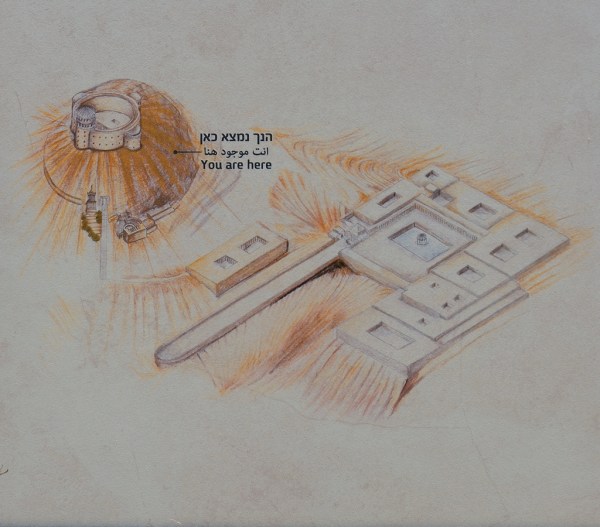
Reconstruction drawing of Greater Herodium from the time of Herod.

The search for Herod’s tomb was one of Israel’s most significant archaeological quests. The historian Josephus wrote that Herod was buried in Herodium, but archaeologists could not locate the tomb until 2007. Finally, after thirty years of searching at the site, the late Prof. Ehud Netzer of the university’s Institute of Archaeology announced that he had found the tomb of Herod. He discovered the remains of a large tomb and opulent coffins on the northern slope of the mountain facing Jerusalem.

Following Herod’s death, his son and heir, Herod Archelaus, continued to reside at Herodium. After Judea became a Roman province, the site served as a centre for Roman prefects. During the Great Jewish Revolt of AD 66, the Zealots captured the fortress but then handed it over without resistance to the Romans following the fall of Jerusalem in AD 70. Fifty years later, Herodium was captured again by the rebels during the Bar Kokhva Revolt. As part of their defence measures, they dug tunnels around the cisterns and hid there. During the Byzantine period, Lower Herodium was rebuilt on top of the ruins and constituted a large village with three churches. The settlement appears to have continued until the 9th century AD, after which the site was abandoned.

Today, Herodium is a national park under the management of the Israel Nature and Parks Authority. An excellent archaeological site complete with a labyrinth of cool underground caves and tunnels, the Park recently opened a small Visitors Center with a lovely film production about King Herod and his funeral procession.

This post is dedicated to the memory of Prof. Ehud Netzer, who died in October 2010 following a fall while preparing an exhibition of the findings for the Israel Museum. The exhibition “The King’s final journey” finally opened in 2013, showing Herod’s impact on the architectural landscape of the Land of Israel. More than 200 objects found at Herodian sites, including Jerusalem, Jericho, Cypros and Herodium, were exhibited for the first time and the King’s reconstructed burial chamber.

PORtFOLIO

The great colonnaded pool (70x46x3m) at Lower Herodium, it held almost 10,000 cubic metres of water and was used as a swimming pool as well as a water reservoir for the irrigation of the adjacent orchards.
The great colonnaded pool (70x46x3m) at Lower Herodium. The pool held almost 10,000 cubic metres of water and was used as a swimming pool and a water reservoir for the irrigation of the adjacent gardens. Lower Herodium covered an area of some 38 acres.
Overview of Lower Herodium from the mountain-palace fortress.
Overview of Lower Herodium from the mountain-palace fortress with the great pool in the middle. To the left of the pool stood the bathhouse, with included an apodyterium (changing room), a large caldarium (hot room) and a frigidarium (cold room). To the right of the pool stood the monumental building, whose function is still unclear.
Reconstruction of a part of the round hot room (caldarium) from Herod's bathhouse at Herodium with remains of the frescoes and flues from the walls of the room and a mosaic floor decorated with scrolls, 1st century BC. Israel Museum, Jerusalem.
Reconstruction of a part of the round hot room (caldarium) from Herod’s bathhouse at Lower Herodium with remains of frescoes and flues from the walls and a mosaic floor decorated with scrolls.
Israel Museum, Jerusalem.
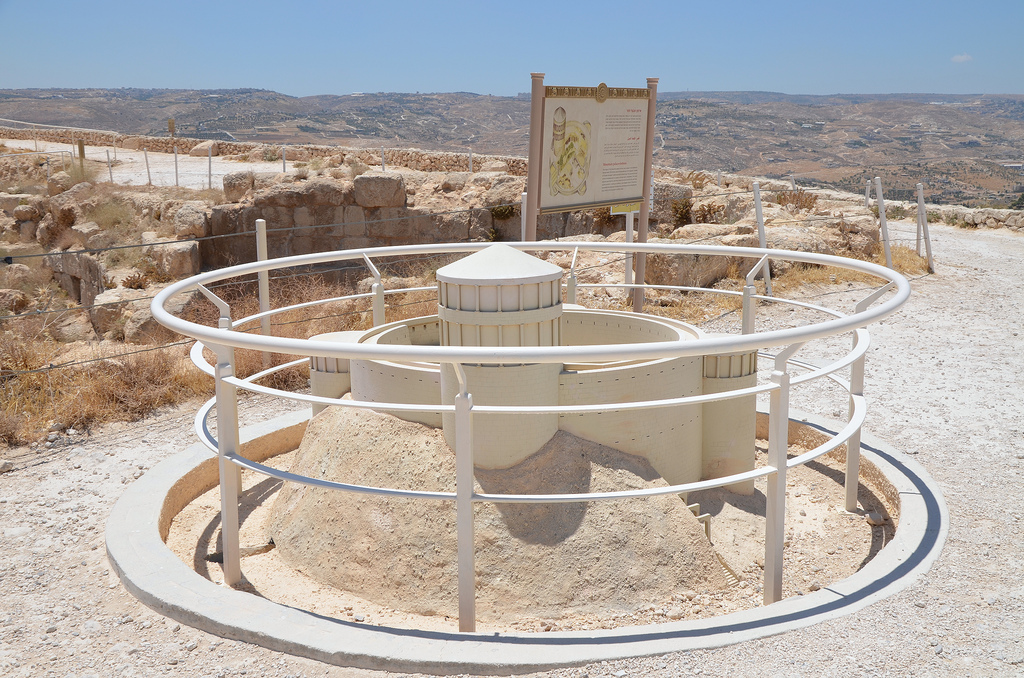
Model of the fortress in Upper Herodium.
Model of the mountain palace-fortress in Upper Herodium.
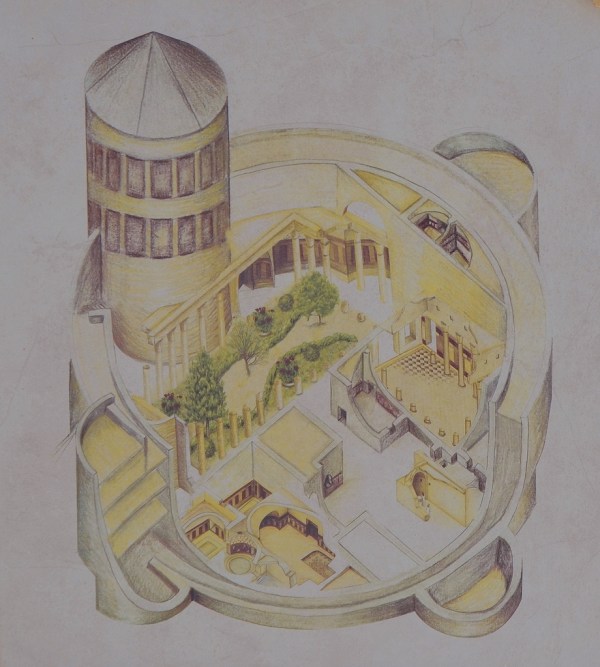
Reconstruction drawing of the mountain palace-fortress. The unusual structure served simultaneously as a palace, a fortress and a monument.
Reconstruction drawing of the mountain palace-fortress. The unusual structure served simultaneously as a palace and a fortress.
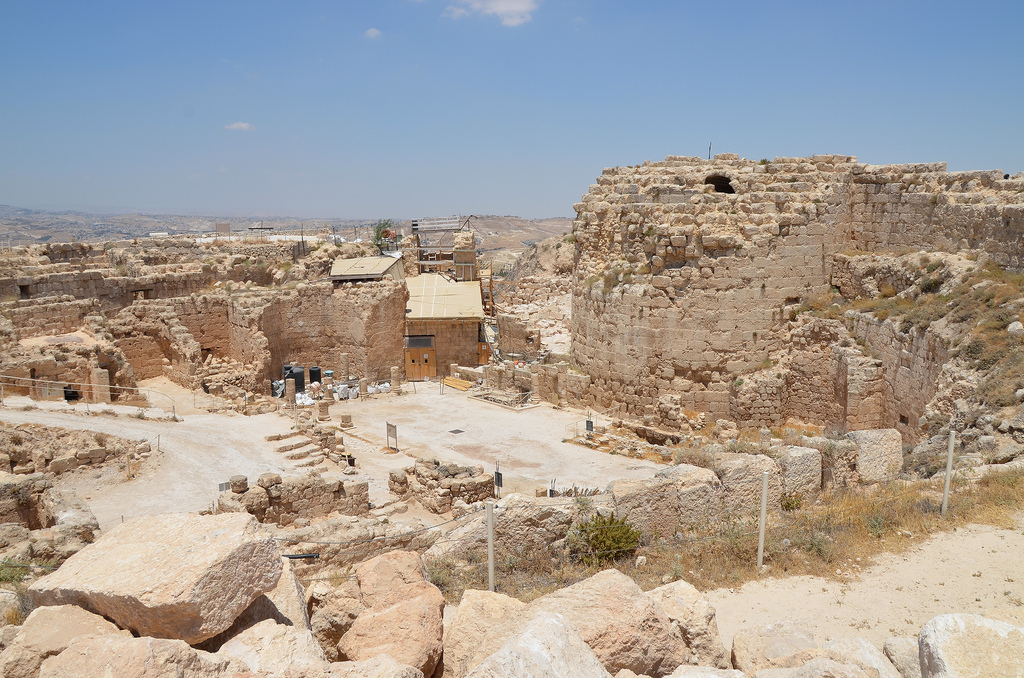
Overview of Upper Herodium surrounded by a double wall and by four towers. The diametre of the structure was 63m while the height was ca. 30m.
Overview of Upper Herodium surrounded by a double wall and by four towers. The structure’s diameter was 63m while the height was 30m.
View of the round eastern towers and the central courtyard surrounded by on three sides by colonnades with Corinthian capitals.
The round eastern towers and the central courtyard are surrounded on three sides by colonnades with Corinthian capitals.
Corinthian capitals decorated with acanthus leaves and volutes.
The palace courtyard.
Reconstruction drawing of the of the palace courtyard surrounded by a roofed colonnade whose columns bore Corinthian capitals. Two large exedrae were built on both sides of the courtyard.
Reconstruction drawing of the palace courtyard surrounded by a roofed colonnade whose columns bore Corinthian capitals. Two large exedrae were built on both sides of the courtyard.
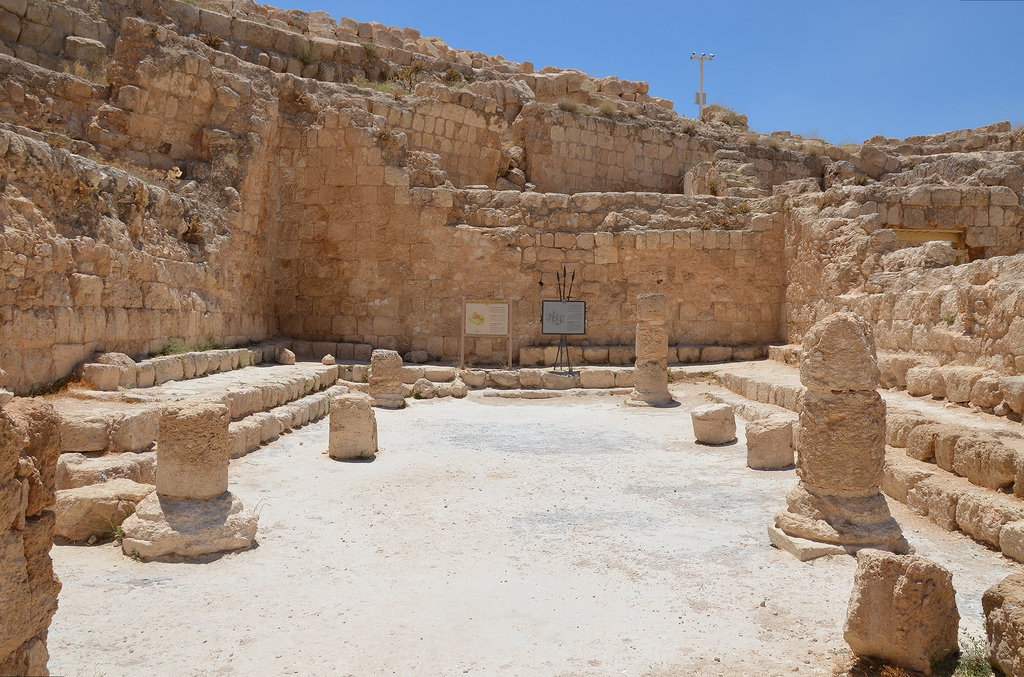
The reception room (triclinium) on the southwestern side of the palace used for banquets. During the Jewish revolts the reception hall was turned into a synagogue and benches were built along its walls.
The reception room (triclinium) on the southwestern side of the palace was used for banquets. During the Jewish revolts, the reception hall was turned into a synagogue and benches were built along its walls.
Mosaic floor from Herod's Palace at Herodium with a rosette at its centre and palmettes and pomegranates in the corners. Israel Museum, Jerusalem.
Mosaic floor from Herod’s Palace at Herodium with a rosette at its centre and palmettes and pomegranates in the corners.
Israel Museum, Jerusalem.
Migveh (ritual bath) and weapons foundry from the time of the Bar Kokhba revolt (132-135 AD).
Migveh (ritual bath) and weapons foundry from the Bar Kokhba revolt (132-135 AD).
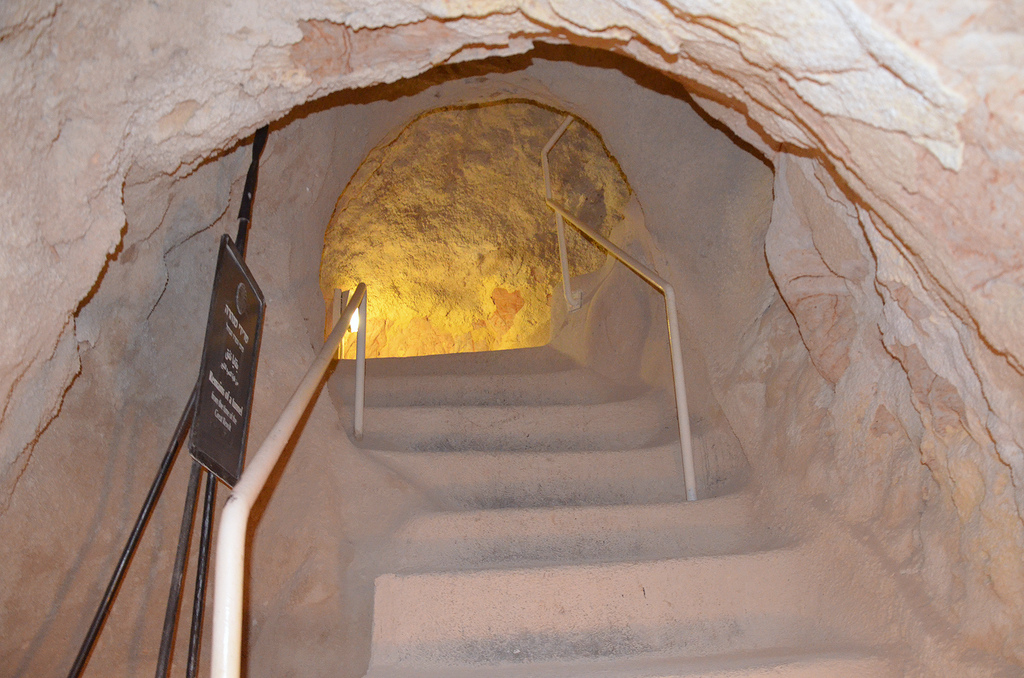
The underground tunnel network.
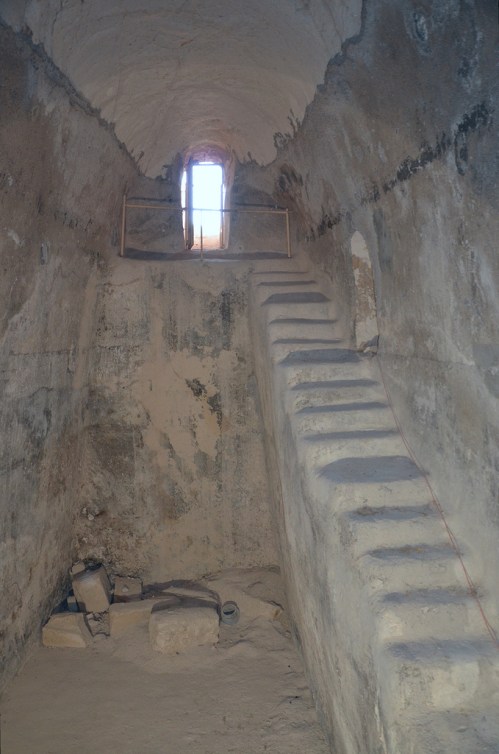
One of the largest water cisterns from Herod's time which collected rainwater from the hill’s slopes. The large stones came from Herod's tomb.
One of the largest water cisterns from Herod’s time collected rainwater from the hill’s slopes. The large stones came from Herod’s tomb.
The underground tunnel network from the Great Jewish Revolt (66–73 AD).
The underground tunnel network from Bar Kokhba's time (132-135 AD).
The underground tunnel network from Bar Kokhba’s time (132-135 AD).
The Monumental Stairways which served the King and his court and any distinguished visitors invited to ascend to the upper complex and later used for Herod’s sumptuous funeral procession.
The Monumental Stairways served the King and his court and any distinguished visitors invited to ascend to the upper complex and later used for Herod’s grand funeral procession. (source)
The royal theatre (under scaffolding in 2016), measuring about 12m in diametre with seating for about 400 located at the west of Herod's mausoleum. At the top was a private chamber for the King and his guests.
The royal theatre (under scaffolding in 2016), measuring about 12m in diameter with seating for about 400, was located west of Herod’s mausoleum. At the top was a private chamber for the King and his guests. (source)
One of the ornate window paintings that adorned the royal room above the theatre. The scene depicts a sea view along with bull, trees, a temple, a palm tree and a boat alluding to the conquest of Egypt by Augustus, 20-15 BC. Israel Museum, Jerusalem.
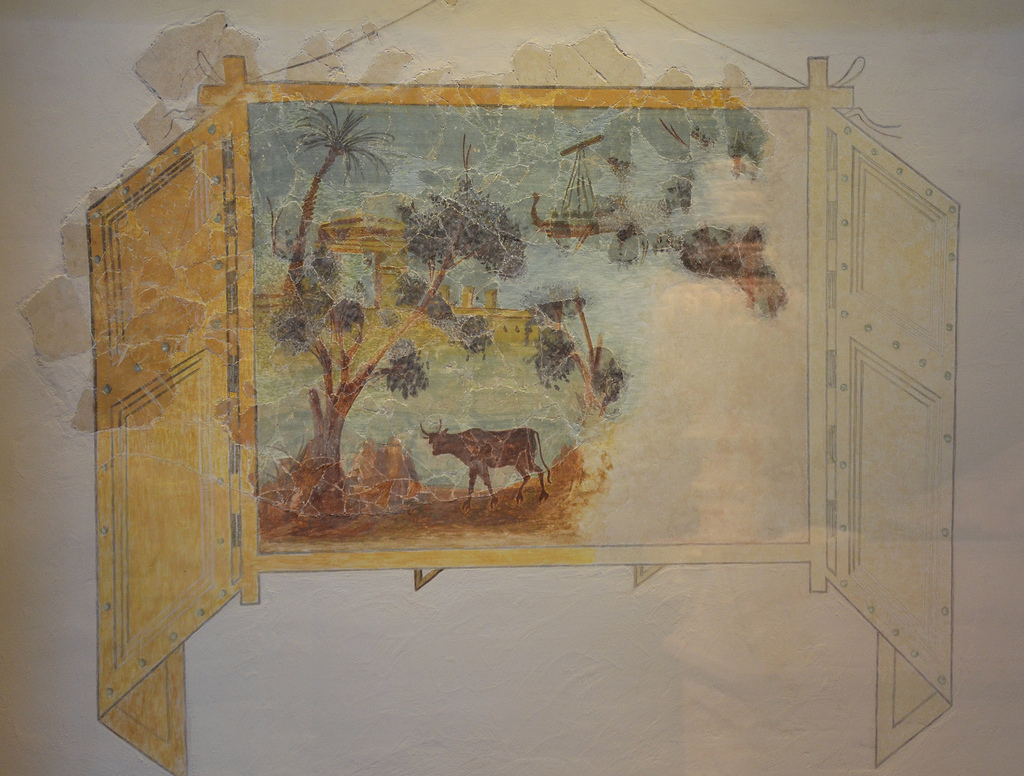
One of the ornate window paintings that adorned the royal room above the theatre. The scene depicts a sea landscape along with a bull, trees, a temple, a palm tree and a boat alluding to the conquest of Egypt by Augustus, 20-15 BC.
Israel Museum, Jerusalem.
Wall painting fragment from that decorated the royal room above the theatre. The scene depicts a naval battle, it may represent the victory of Octavian at Actium, 20-15 BC. Israel Museum, Jerusalen.
A fragment of a wall painting that decorated the royal room above the theatre. The scene depicts a naval battle which may represent the victory of Octavian at Actium, 20-15 BC.
Israel Museum, Jerusalem.
Location and model of Herod's tomb built on the slope of the hill, it was free-standing and three storeys high (25m) and would have been clearly visible from Jerusalem.
Location and model of Herod’s tomb built on the slope of the hill. It was three stories high (25m) and would have been visible from Jerusalem.
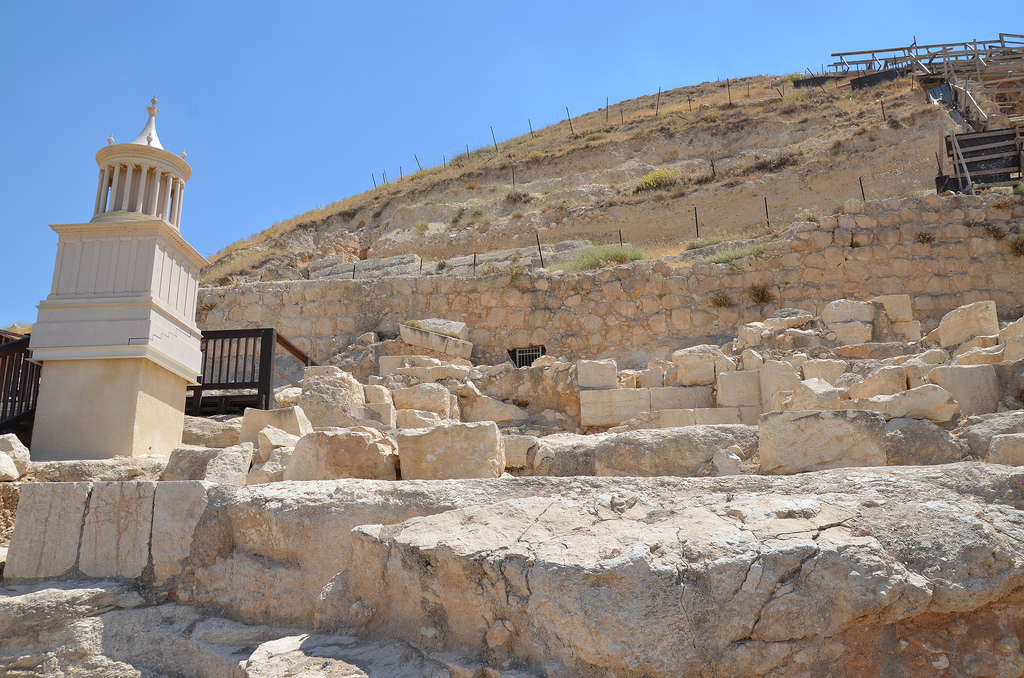
The podium of Herod's mausoleum preserved in situ.
The podium of Herod’s mausoleum is preserved in situ. It was built from hard white limestone, suitable for carving, carried near the site.
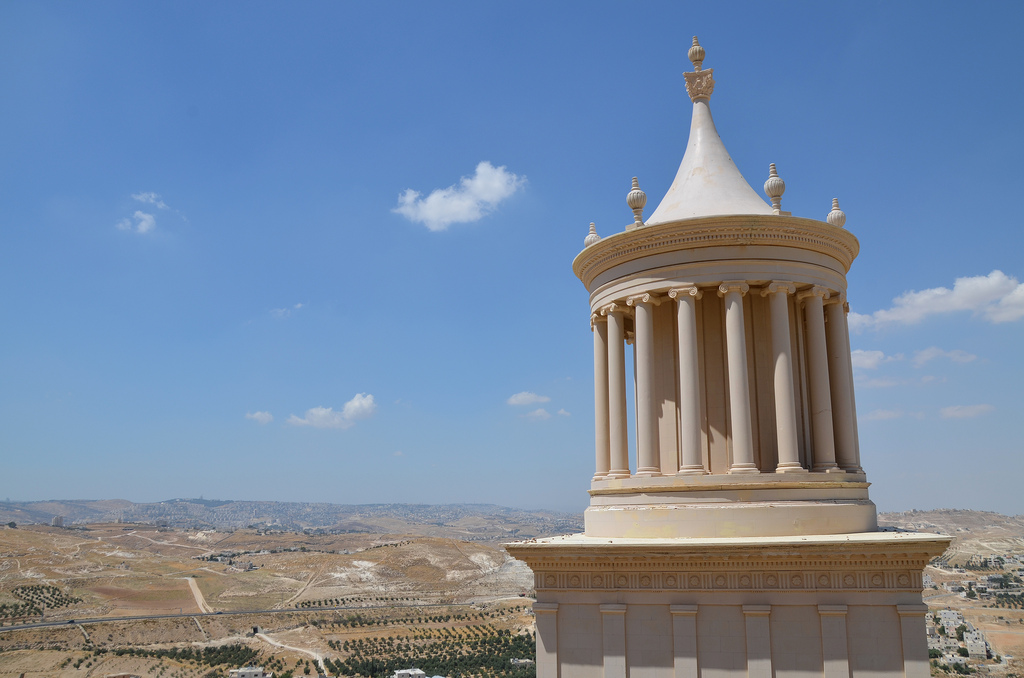
The model of Herod's mausoleum, the first storey was a plinth which supported the second, square one; above this was a circular tholos, which incorporated an internal chamber surrounded by an Ionic colonnade, topped by a dome.
The model of Herod’s mausoleum. The first storey was a plinth which supported the second square one; above this was a circular tholos, which incorporated an internal chamber surrounded by an Ionic colonnade, topped by a dome. (source)
The model of Herod's mausoleum.
The model of Herod’s mausoleum. The roof was a concave cone crowned by a magnificent Corinthian capital with an urn (imitating cinerary urns) above it, while another six urns surrounded the roof’s edge. (source)
Architectural elements from Herod's mausoleum and his sarcophagus. Israel Museum, Jerusalem.
Architectural elements from Herod’s mausoleum and his sarcophagus were carved from reddish limestone.
Israel Museum, Jerusalem.
Rosette on the sarcophagus of Herod the Great which was found in 2007 after 35 years of search. Israel Museum, Jerusalem.
Rosette from the shorter side of Herod’s sarcophagus, which was found in 2007 after 35 years of search.
Israel Museum, Jerusalem.
Panoramic view from the top of the hill towards the Judean desert and the Dead Sea.

Links:

Source:

  • Herod the Great: The King’s Final Journey by Rozenberg, Silvia and Mevorah, David, The Israel Museum, 2013 (buy it here).
Caesarea Maritima

Caesarea Maritima lies on a sandy shore of the Mediterranean, about halfway between Tel Aviv and Haifa. This most fertile area of ancient Judea is the site of one of the most important cities of the Roman World and the capital of the Roman province of Judaea. Caesarea was founded between 22 and 10 BC by Herod the Great (37-4 BC) as an urban centre and harbour on the site of the earlier Strato’s Tower.

Coordinates: 32°30’0”N, 34°53’23”E

Caesarea was first settled by the Phoenicians, who also founded the port cities of Sidon, Tyre and Byblos. In the 4th century BC, the Phoenicians founded Strato’s Tower and used the natural bays and nearby rivers to establish a port that provided all the essential services for the ships and their crews. The city changed hands many times before Roman troops entered Palestine in 63 BC, marching South from Syria under the leadership of Pompey the Great. Some three decades later, Augustus confirmed the client rule of Herod the Great in Palestine and designated him as the “King of the Jews”.

In an ambitious construction project lasting some twelve years, Herod turned Strato’s Tower into the main port of his kingdom. He named the city Caesarea in honour of Augustus. Herod’s building program included broad collonaded streets, a palace, a temple, public buildings, a theatre, a Hippodrome, an amphitheatre and other entertainment facilities. However, Herod’s port never attained the importance he surely hoped for. Caesarea lost its impact as a royal city when it was absorbed into the Roman Empire. The AD 79 eruption of Mount Vesuvius and the AD 115 Antioch earthquake generated tsunami waves that reached the coast, causing significant damage to the harbour. The city reached the height of its prosperity when it became the country’s Byzantine administrative capital from the 4th to the 6th century AD. The city was later abandoned after the Arab conquest in the 8th century AD. Today, it is a large and beautiful national park, as well as a fascinating place to visit while exploring the Holy Land.

PORtFOLIO

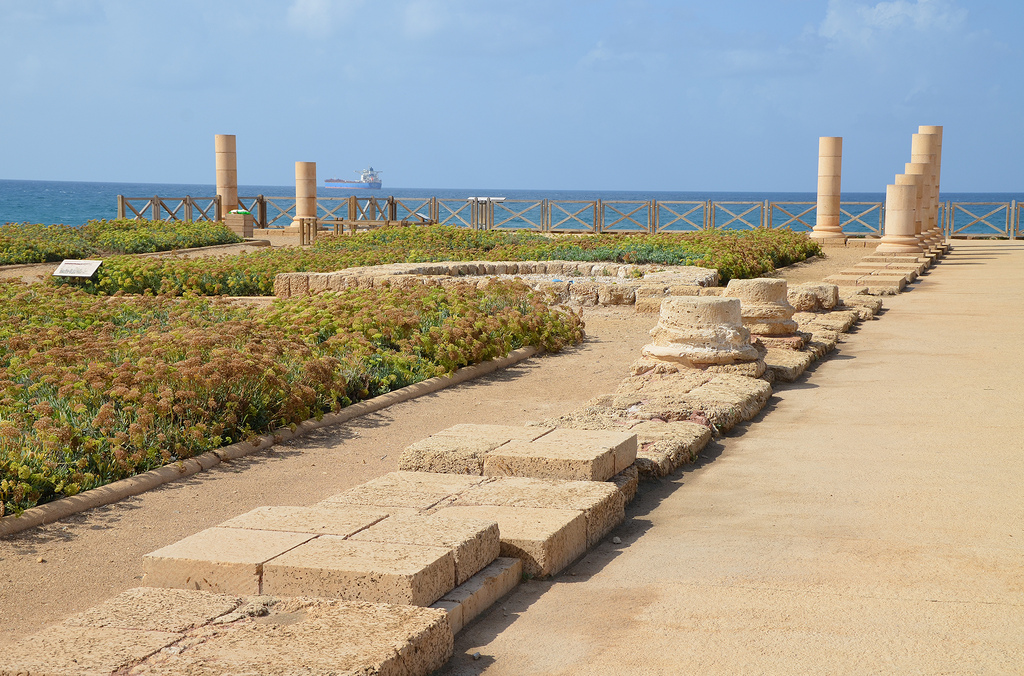
The Promontory Palace of Herod the Great stretching into the sea.
The Promontory Palace of Herod the Great stretches into the sea.
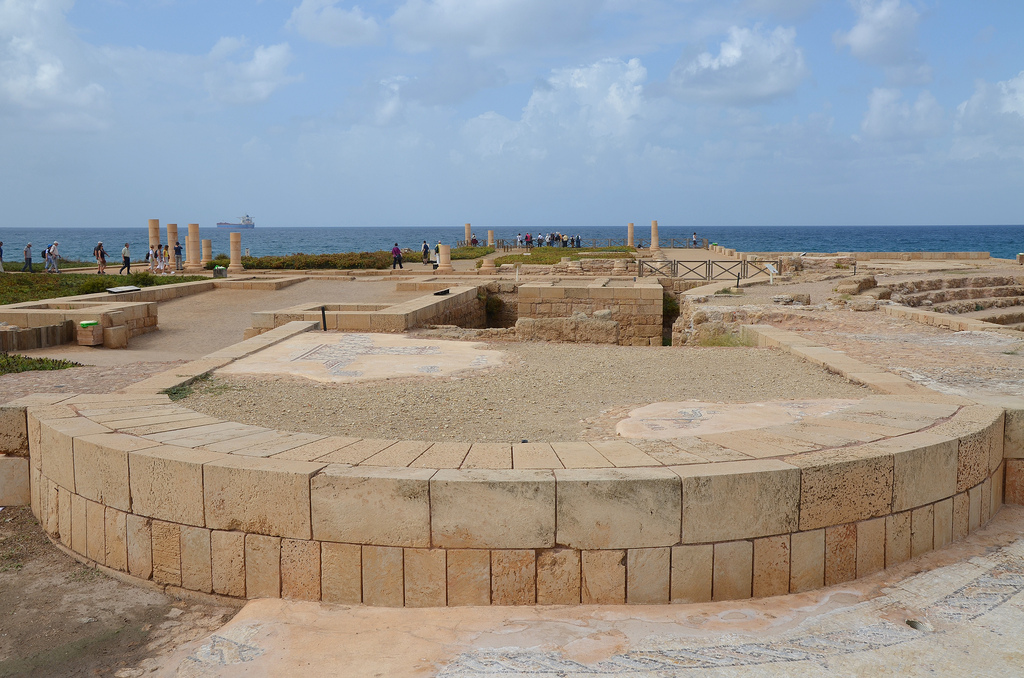
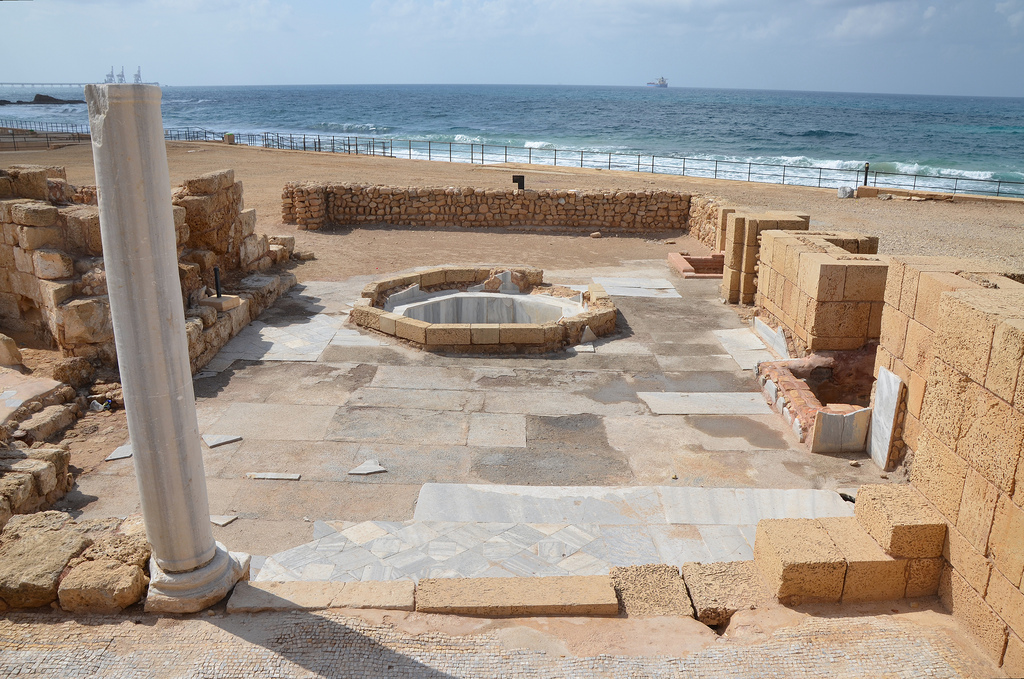
The Lower Terrace of the Promontory Palace of Herod the Great stretching into the sea. It was the private section of the palace.
The Promontory Palace was the private section of the palace.
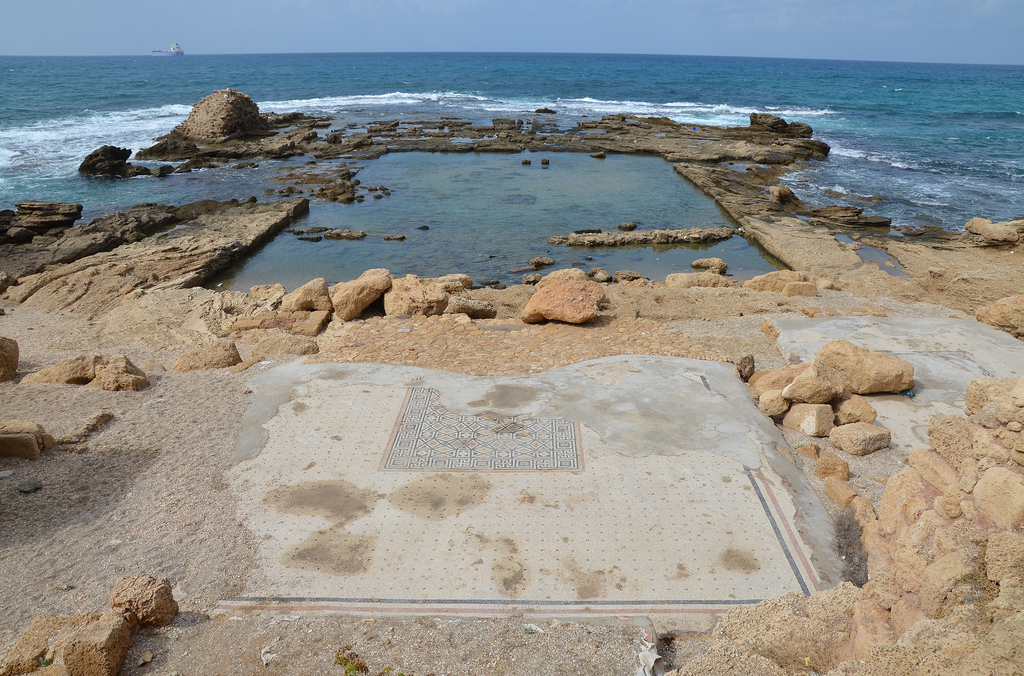
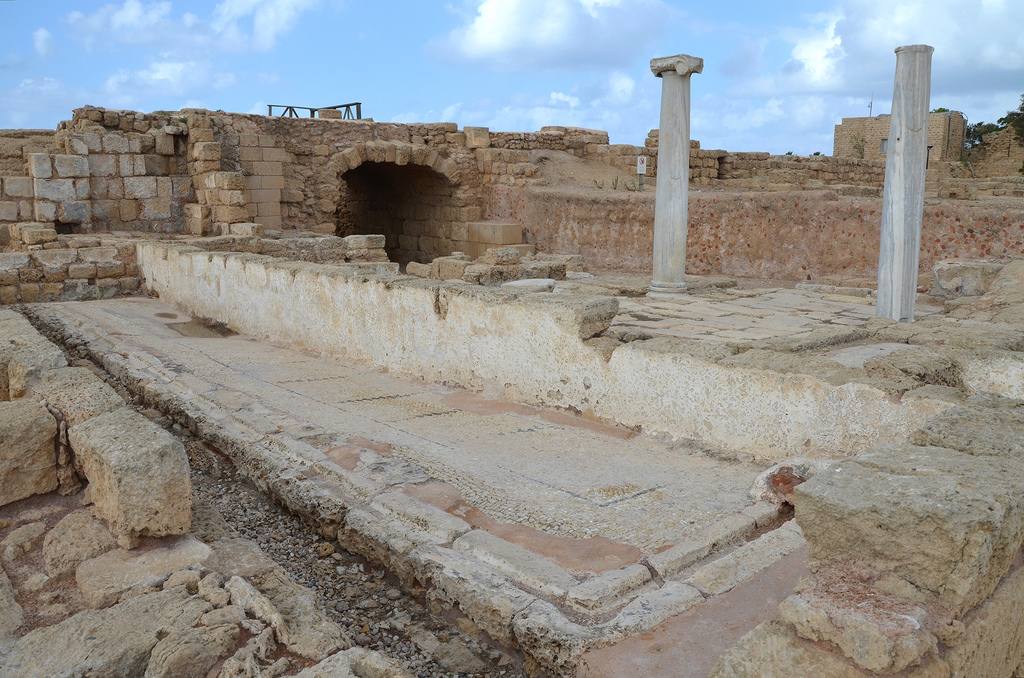
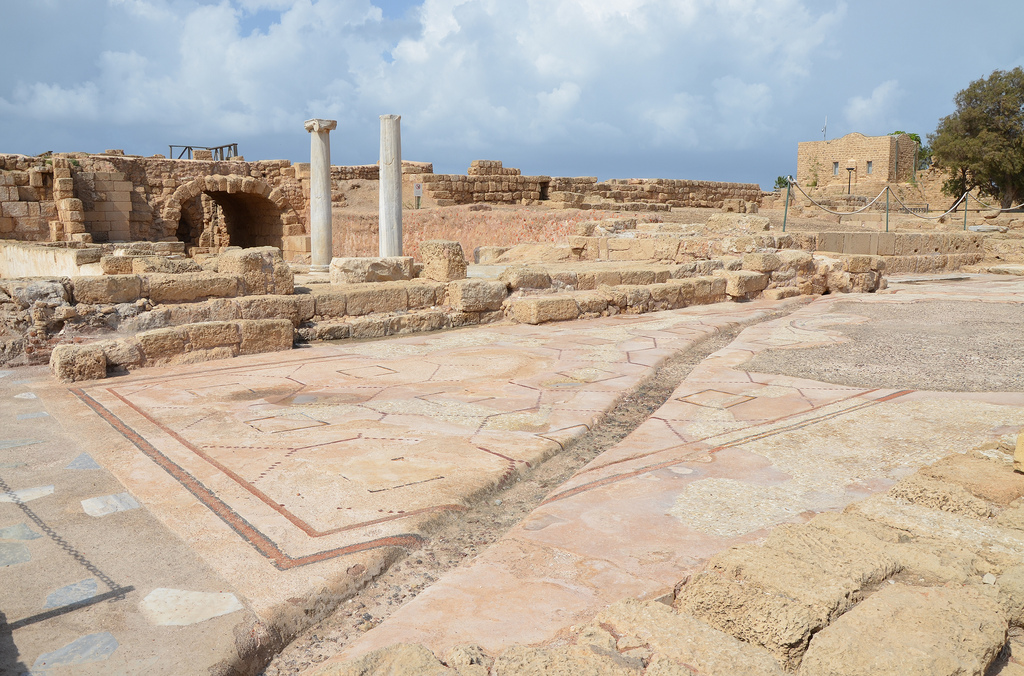
The Lower Terrace of the Promontory Palace of Herod the Great stretching into the sea, the lower wing was built around a pool which was surrounded by four rooms decorated with mosaic floors.
The lower wing of the Lower Terrace of the Promontory Palace was built around a pool, which was surrounded by four rooms decorated with mosaic floors.
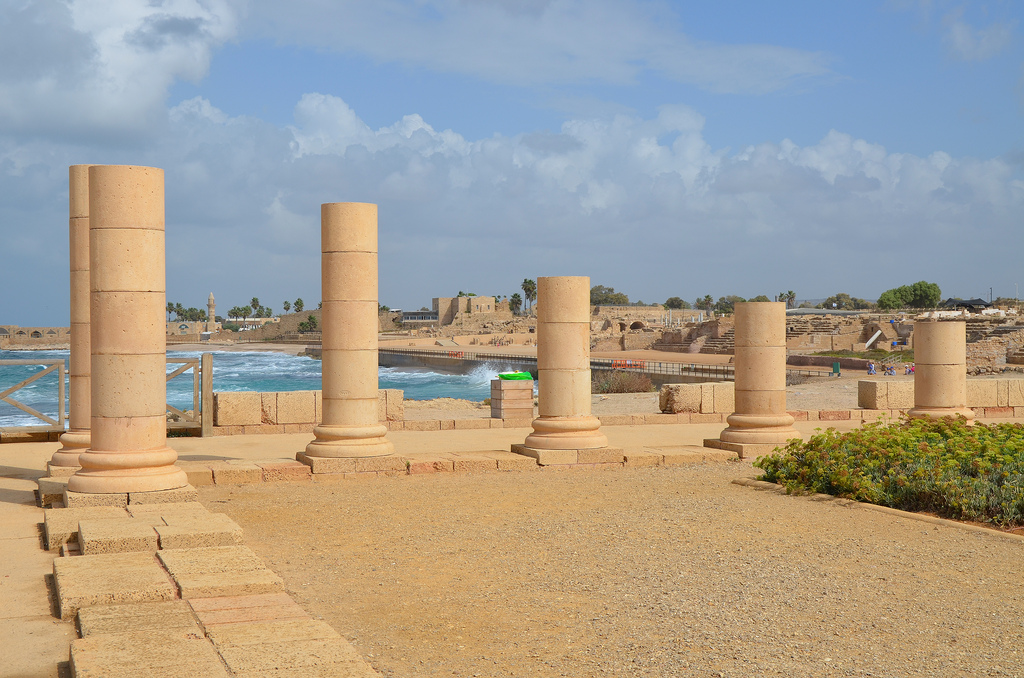
The peristyle of the Upper Terrace of the Promontory Palace of Herod the Great with the Hippodrome in the background.
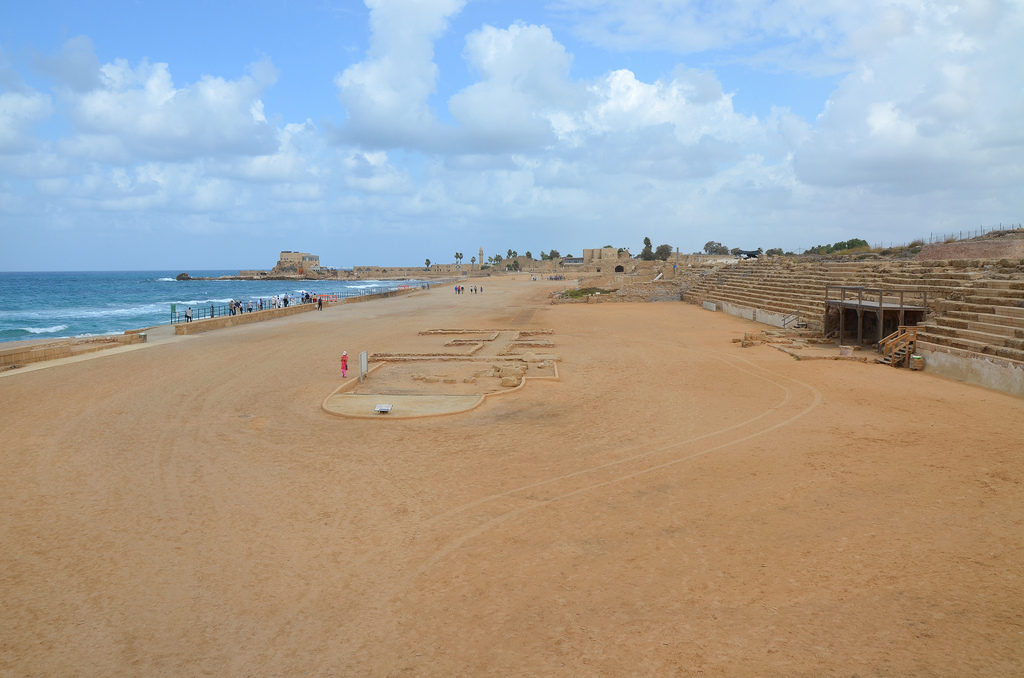
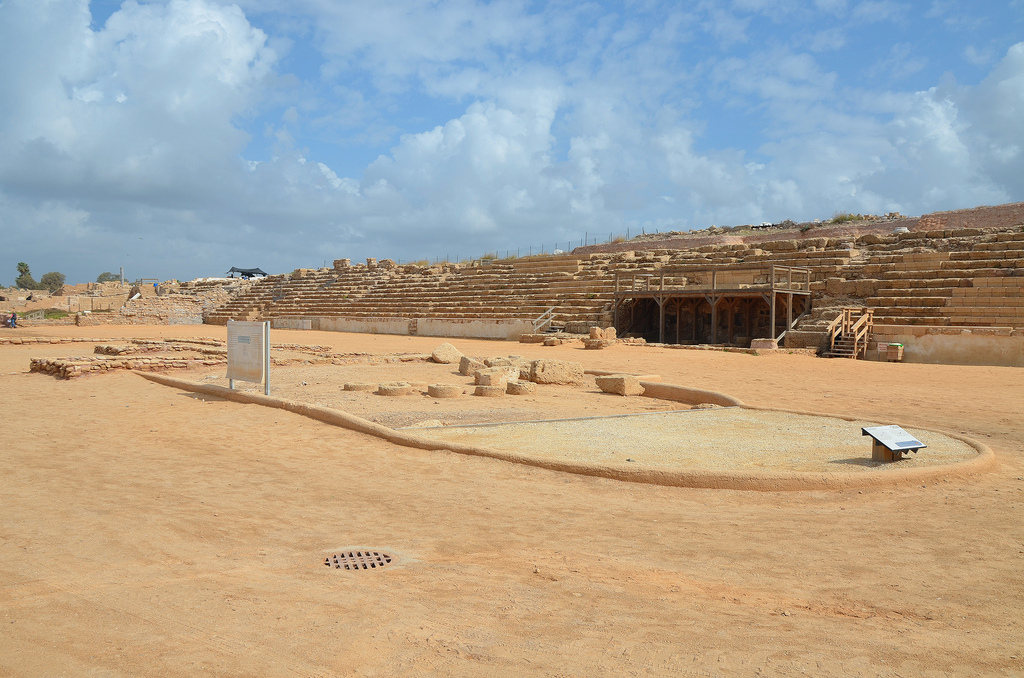
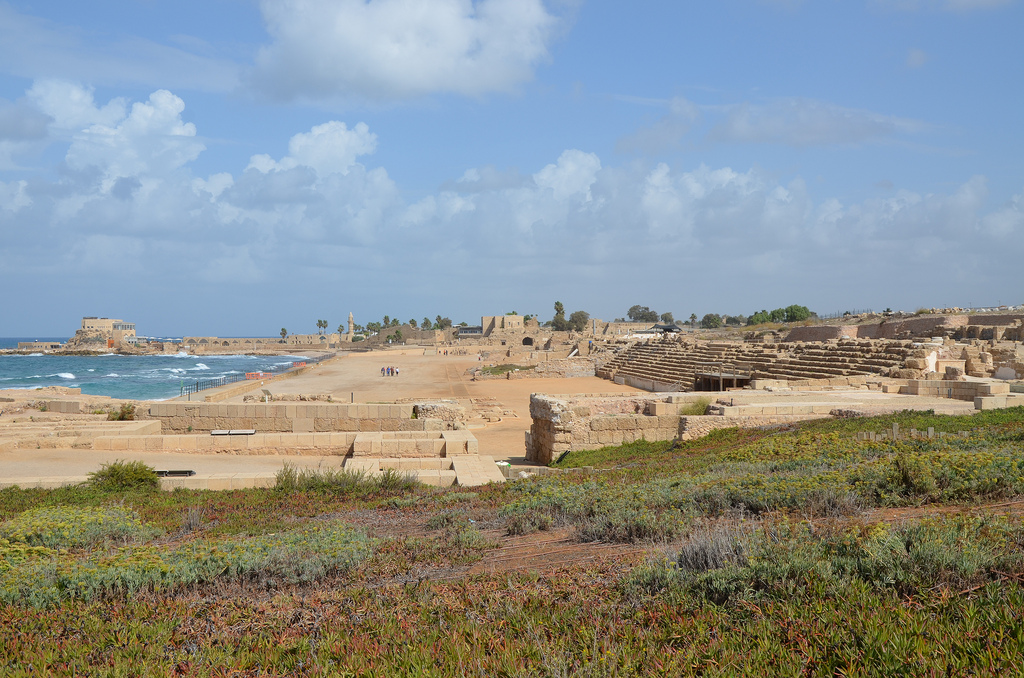
The Hippodrome, built by Herod the Great for the inauguration of the city in 9/10 BC, it was the venue of the Actian Games instituted by King Herod in honor of emperor Augustus and held every 4 years.
The Hippodrome was built by Herod the Great for the inauguration of the city in 9/10 BC. It was the venue of the Actian Games instituted by King Herod in honour of Emperor Augustus, which were held every 4 years.
The Hippodrome was 300 metres long and fifty metres wide and may have had as many as 15,000 seats in Herod's day.
The Hippodrome was 300 metres long and 50 metres wide and may have had as many as 15,000 seats in Herod’s day.
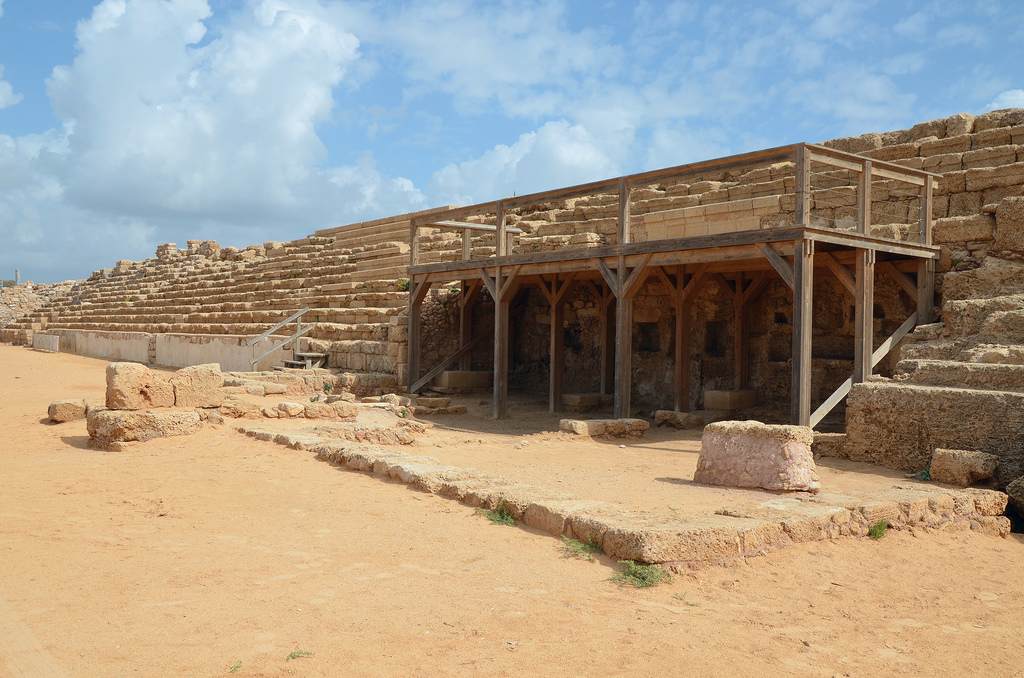
View of the dignitaries' platform in the Hippodrome.
View of the dignitaries’ platform in the Hippodrome.
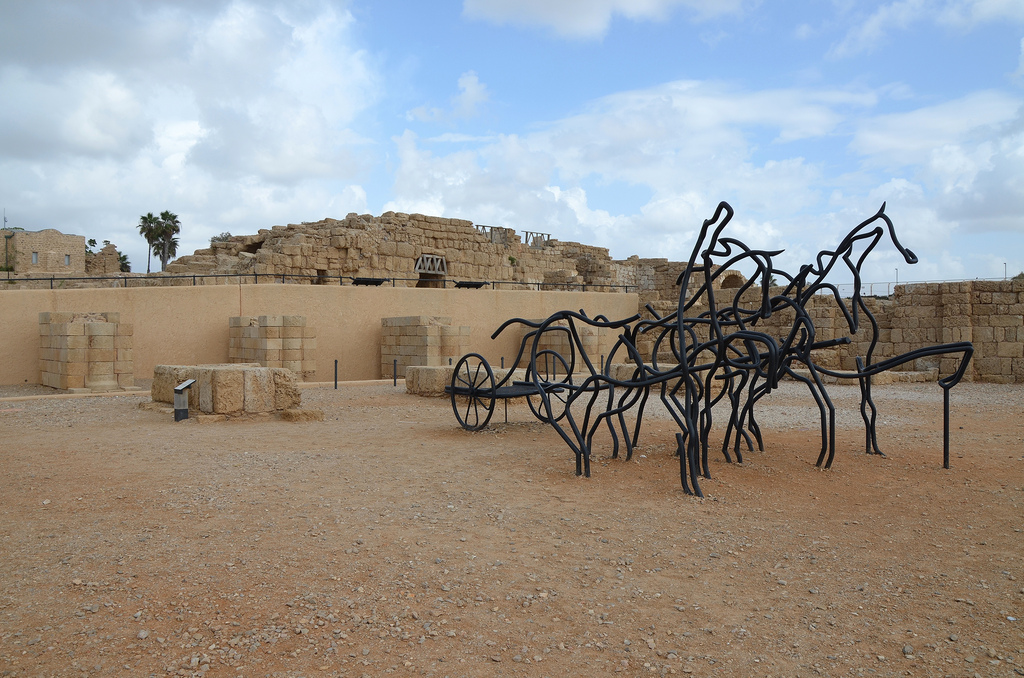
The Hippodrome was intended primarily for horse and chariot competitions. The riders' chariot pulled by two or four horses emerged from compartments on the northern side of the hippodrome.
The Hippodrome was intended primarily for horse and chariot competitions. The riders’ chariot, pulled by two or four horses, emerged from compartments on the northern side of the Hippodrome.
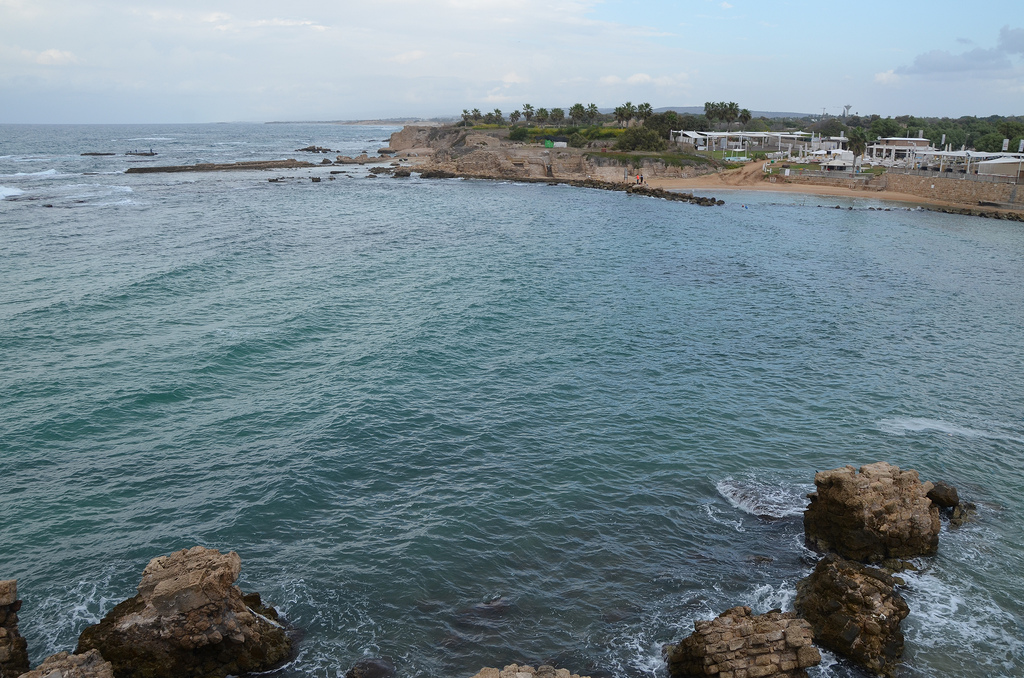
Herod's Royal Harbor known as Sebastos, it was the disembarkation point for visitors to the city.
Herod’s Royal Harbor was known as Sebastos. It was the disembarkation point for visitors to the city.
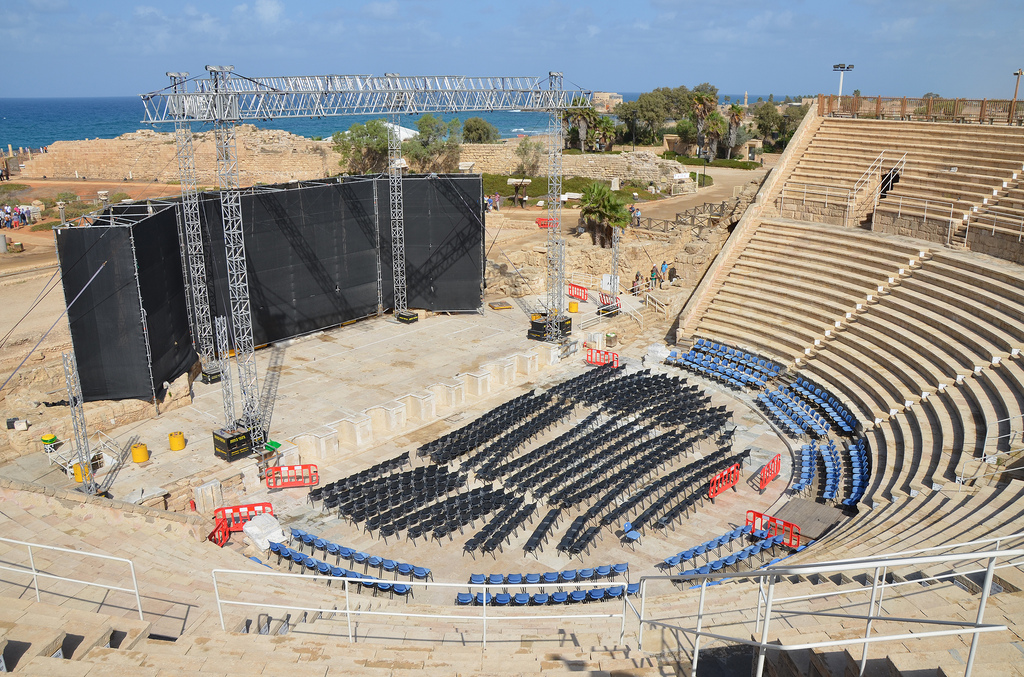
The Theatre constructed by Herod during the first stages of the city's development and renovated in the 2nd century AD, the seating capacity in its final stage was about 4,000. The theatre is still in use today for concerts and shows.
The reconstructed theatre was built by Herod during the first stages of the city’s development and renovated in the 2nd century AD. The seating capacity in its final stage was about 4,000. The theatre is still in use today for concerts and shows.
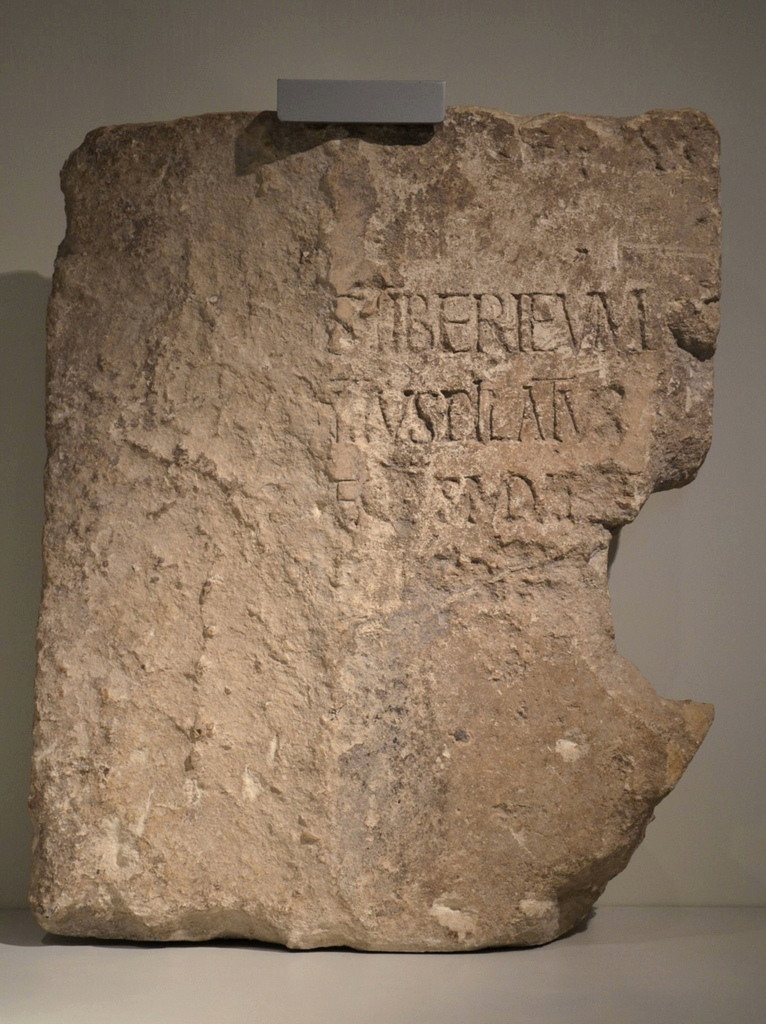
Dedicatory inscription found reused in the staircase of the theatre of Caesarea, the first and only mention of Pontius Pilates' name ever unearthed, 26-36 AD, Israel Museum, Jerusalem It reads: " Pontius Pilate, the Prefect of Judea, has dedicated to the people of Caesarea a temple in honour of Tiberius".
The dedicatory inscription was found reused in the staircase of the theatre of Caesarea. It is the first and only mention of Pontius Pilate’s name ever unearthed (AD 26-36, Israel Museum, Jerusalem)
The inscription reads: ” Pontius Pilate, the Prefect of Judea, has dedicated to the people of Caesarea a temple in honour of Tiberius”.
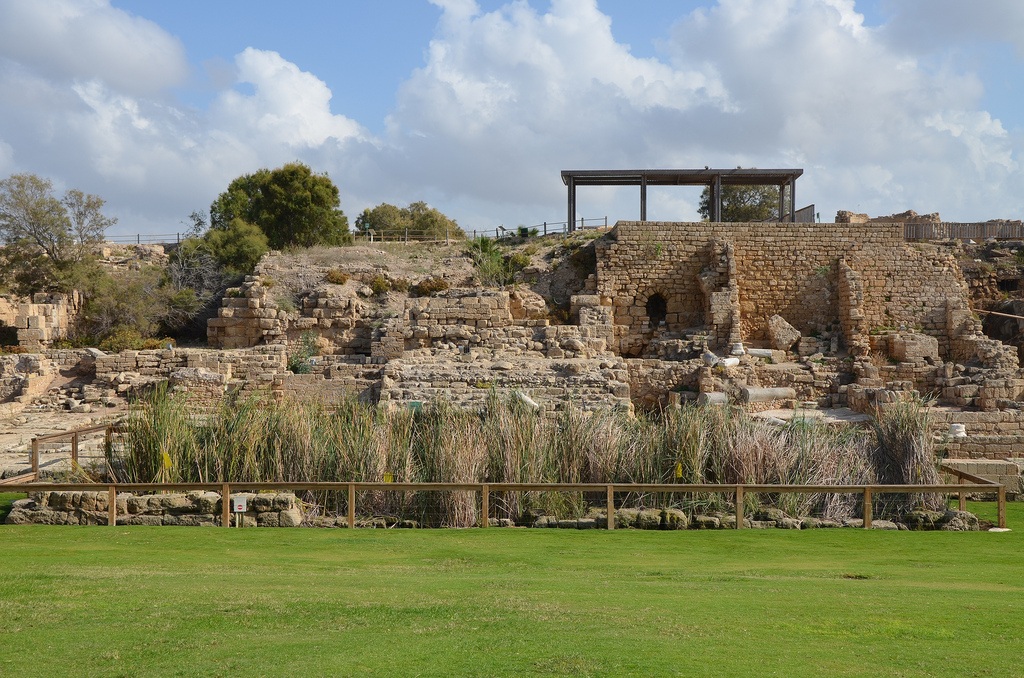
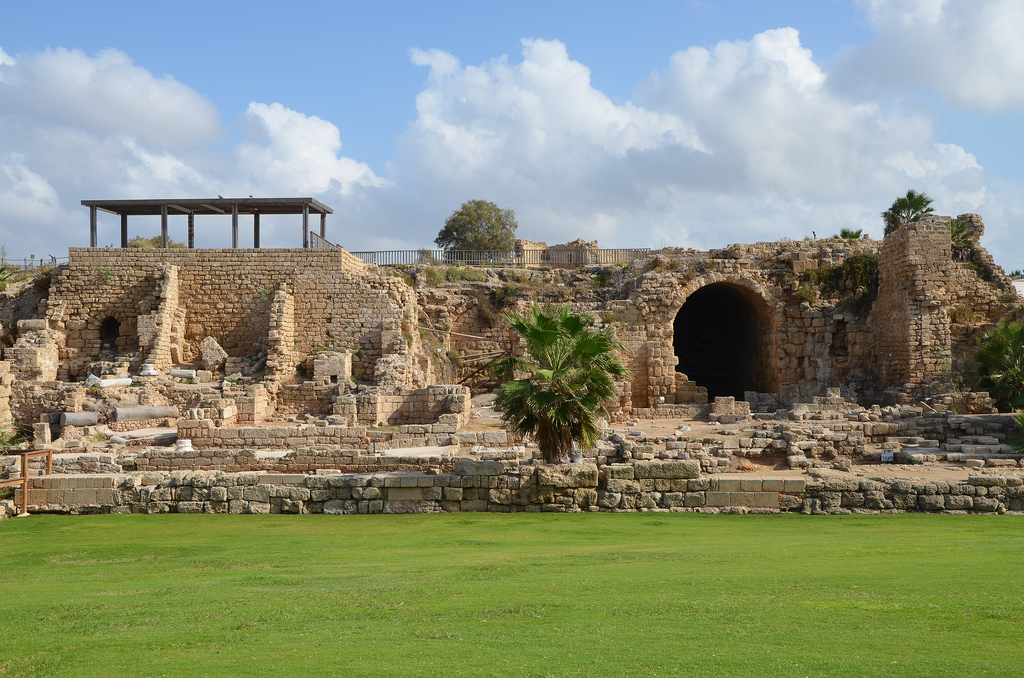
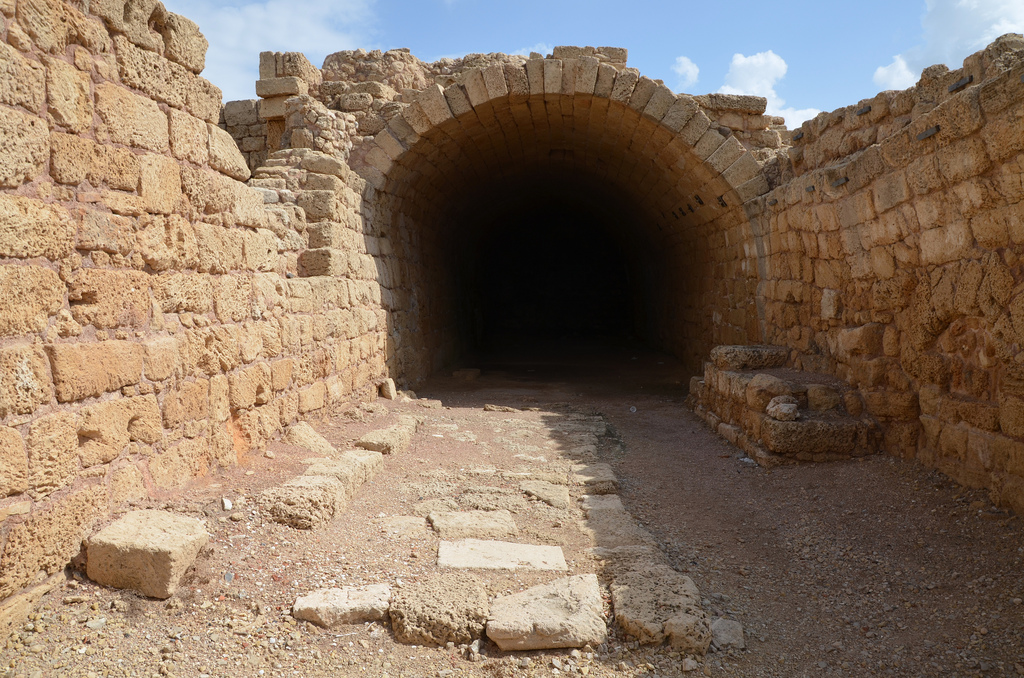
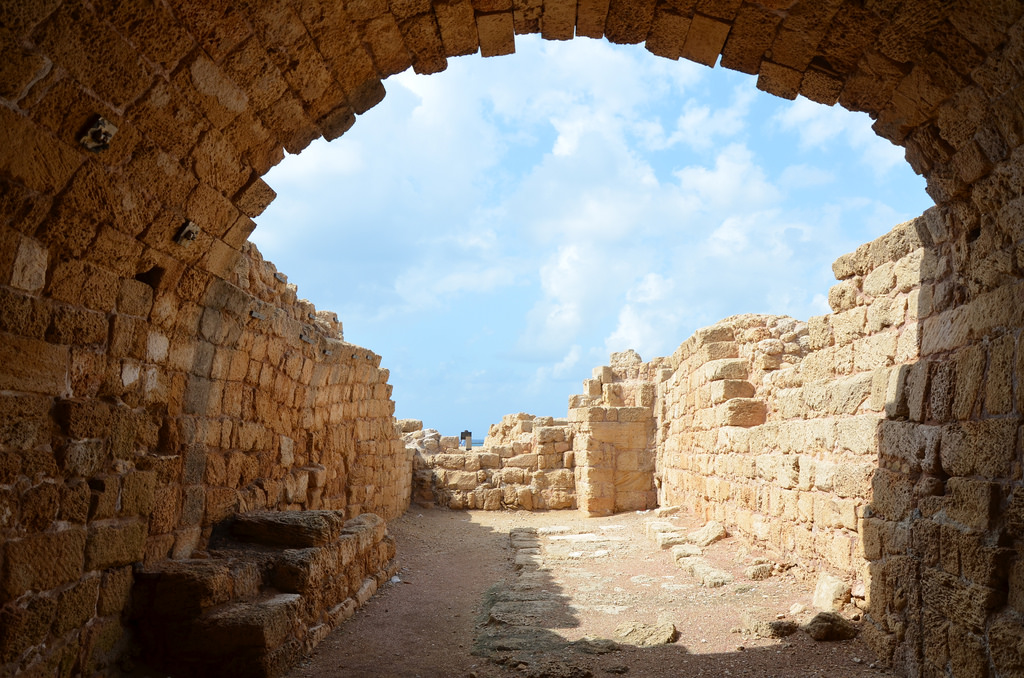
Part of the eastern wharf of the inner harbour with the podium of the Temple of Augustus and a series a vault used as warehouses. The Temple of Augustus was built by Herod and was covered by an octagonal Byzantine church in the 6th century.
Part of the eastern wharf of the inner harbour with the podium of the Temple of Augustus and a series of vaults used as warehouses.
The Temple of Augustus was built by Herod and was covered by an octagonal Byzantine church in the 6th century. Only the huge podium and a series of steps are visible today.
Part of the eastern wharf of the inner harbour with the podium of the Temple of Augustus and a series a vaults used as warehouses.
Part of the eastern wharf of the inner harbour with the podium of the Temple of Augustus and a series of vaults used as warehouses.
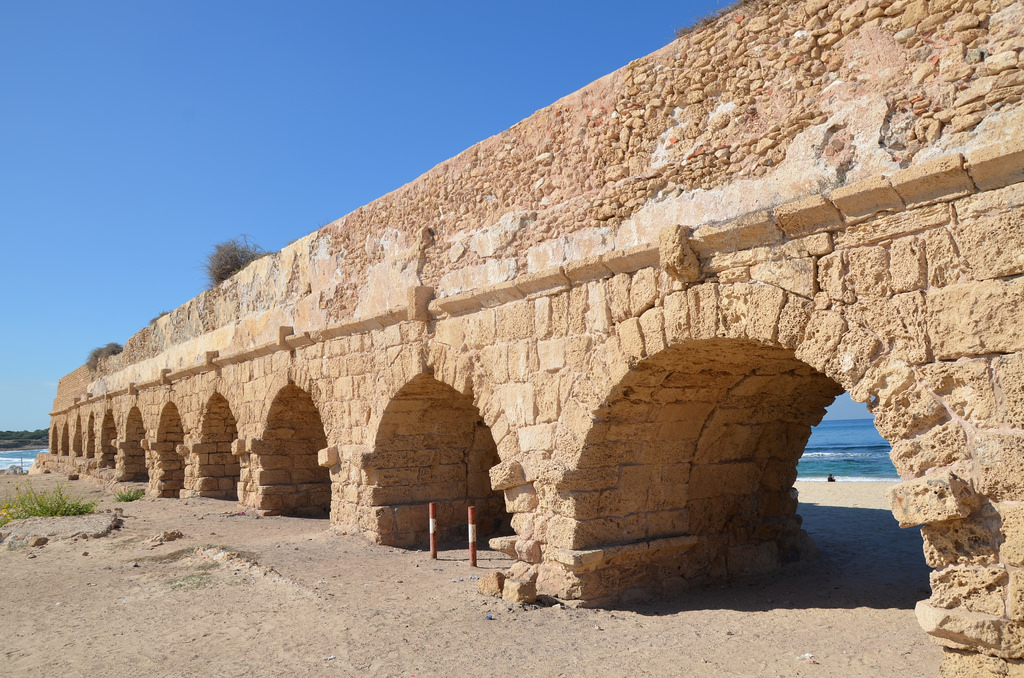
The high level aqueduct of Caesarea built by Herod the Great.
The high-level aqueduct of Caesarea was built by Herod the Great. Caesarea had no reliable source of fresh water when construction on the city began around 22 BC. King Herod commissioned a raised aqueduct to deliver water from the springs near Shuni, 16 kilometres north-east of Caesarea.
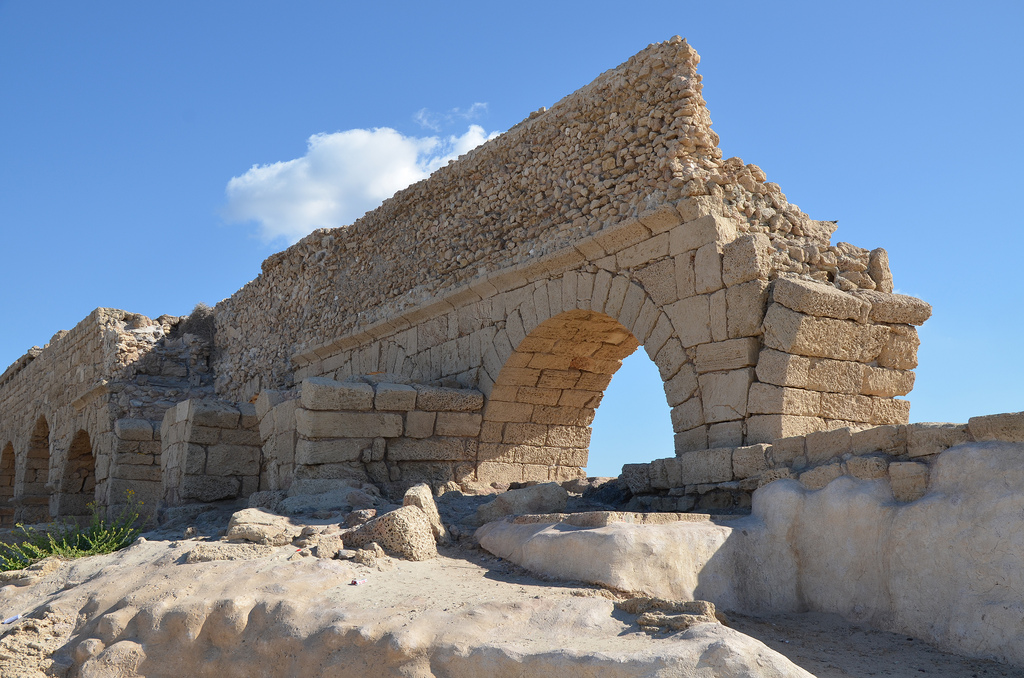
A portion of the high level aqueduct of Caesarea showing the two stages of construction.
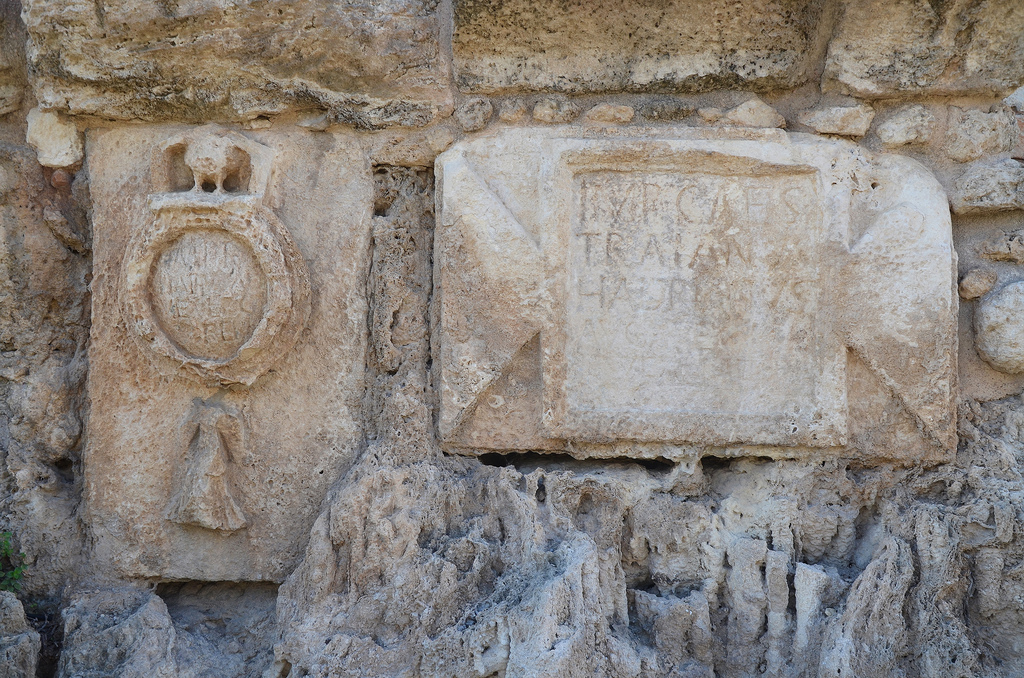
A portion of the high-level aqueduct of Caesarea shows the two stages of construction. When Hadrian visited Caesarea in AD 130 on his grand tour of the eastern part of the Roman Empire, the city’s growth required additional water. Hadrian then commissioned extensive repairs and a new aqueduct to be built. This new section (known as the high-level aqueduct II) was added to the right of the first canal and doubled its capacity.
Dedicatory inscription to Hadrian on the high-level aqueduct of Caesarea at Beit Hanania with the emblem depicting the 10th legion.
Mithraeum, a 1st century grain storage converted into into a Mithraeum during the third century AD.
The Mithraeum, a 1st-century grain storage converted into a Mithraeum during the 3rd century AD.
Mithraeum, a 1st century grain storage converted into into a Mithraeum during the third century AD.
The Mithraeum.
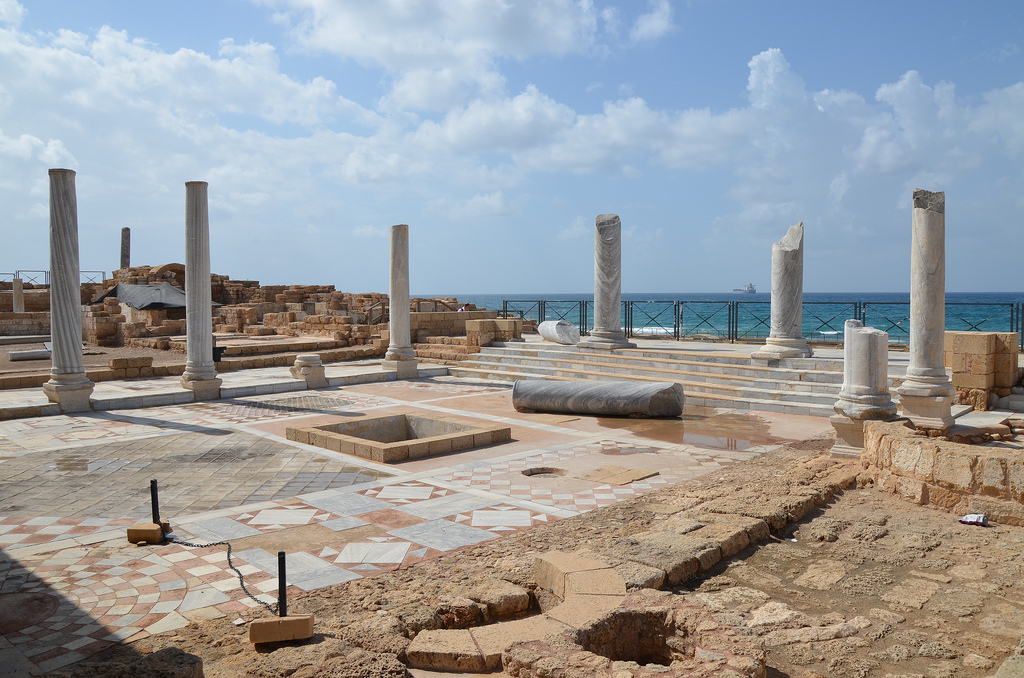
The Byzantine Bathhouse built in the 4th century AD.
The Byzantine Bathhouse was built in the 4th century AD.
The palaestra in the Byzantine Bathhouse built in the 4th century AD. Before bathing clients could exercise in the palaestra.
The palaestra of the Byzantine Bathhouse. Before bathing, clients could exercise in the palaestra.
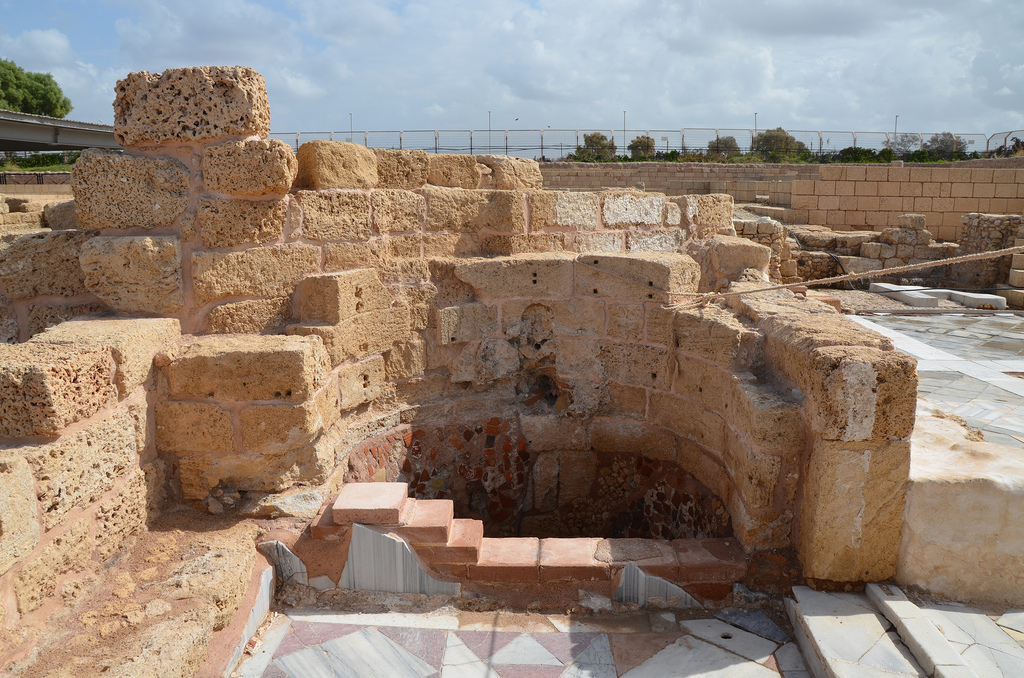
A pool in the Byzantine Bathhouse built in the 4th century AD.
A pool in the Byzantine Bathhouse was built in the 4th century AD.
The palaestra of the Byzantine Bathhouse.
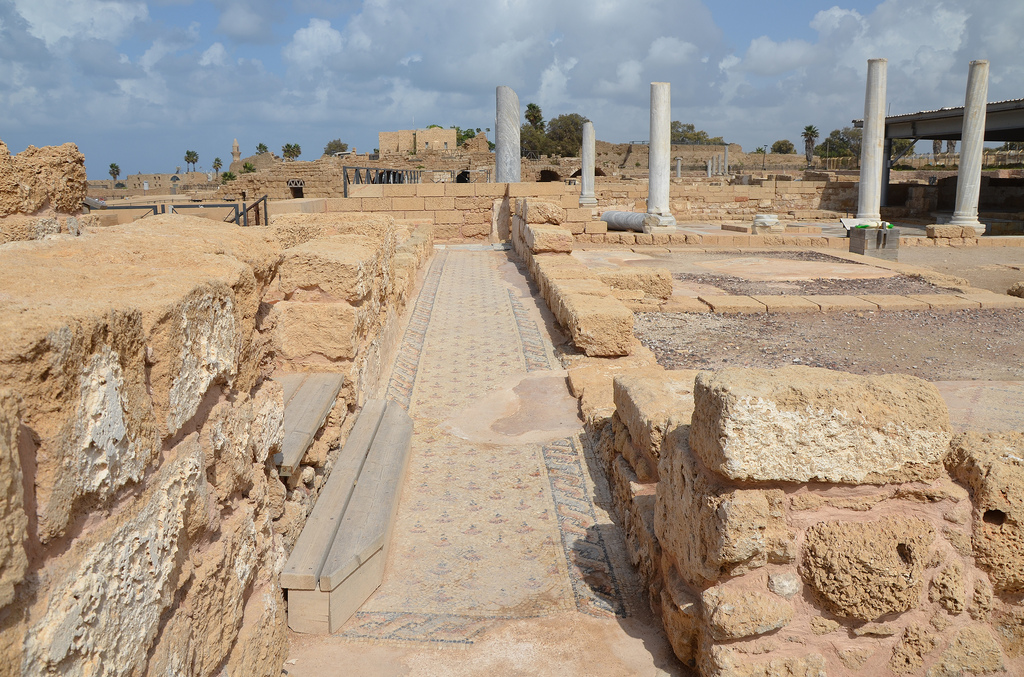
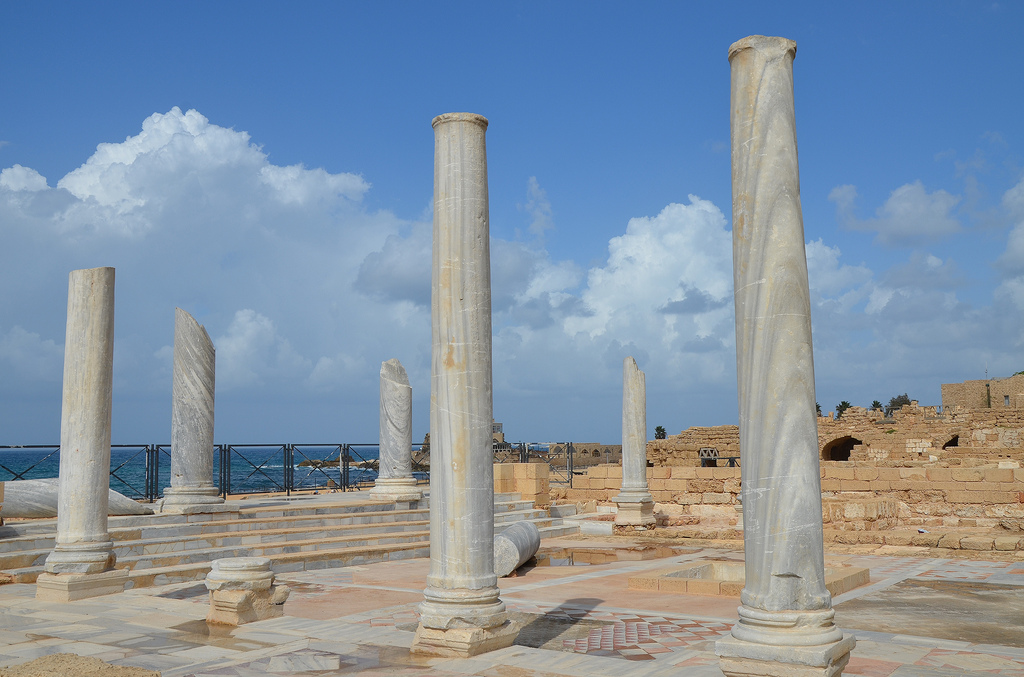
The public latrine used during the Roman and Byzantine periods. Marble benches were set along the southern and western walls of the latrine. Water flushed through its channels laid a the bottom of the walls and connecting with the main sewer beneath the decumanus street.
The public latrine was used during the Roman and Byzantine periods. Marble benches were set along the southern and western walls of the latrine. Water flushed through its channels, lay at the bottom of the walls, and connected with the main sewer beneath the decumanus street.
The Praetorium, the Byzantine Governor's Palace, combining administration, financial and judicial functions.
The Praetorium, the Byzantine Governor’s Palace, combined administration, financial and judicial functions.
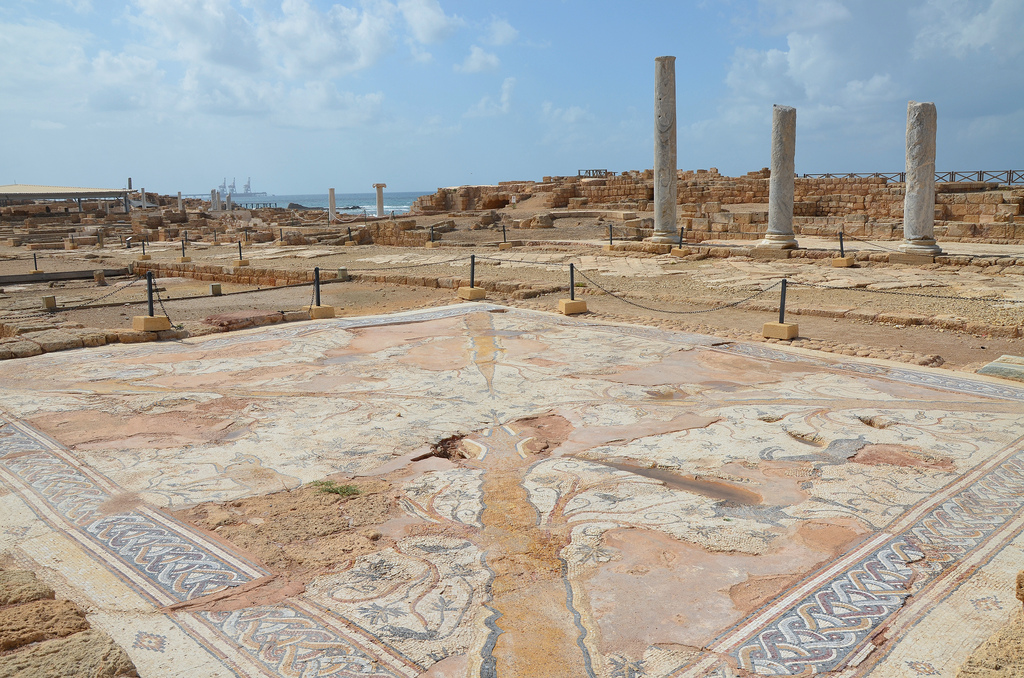
The Ibexes Mosaic Hall in the Praetorium, the Byzantine Governor's Palace.
The Ibexes Mosaic Hall in the Praetorium, the Byzantine Governor’s Palace.
The Governor's Palace Baths.
The Governor’s Palace Baths.
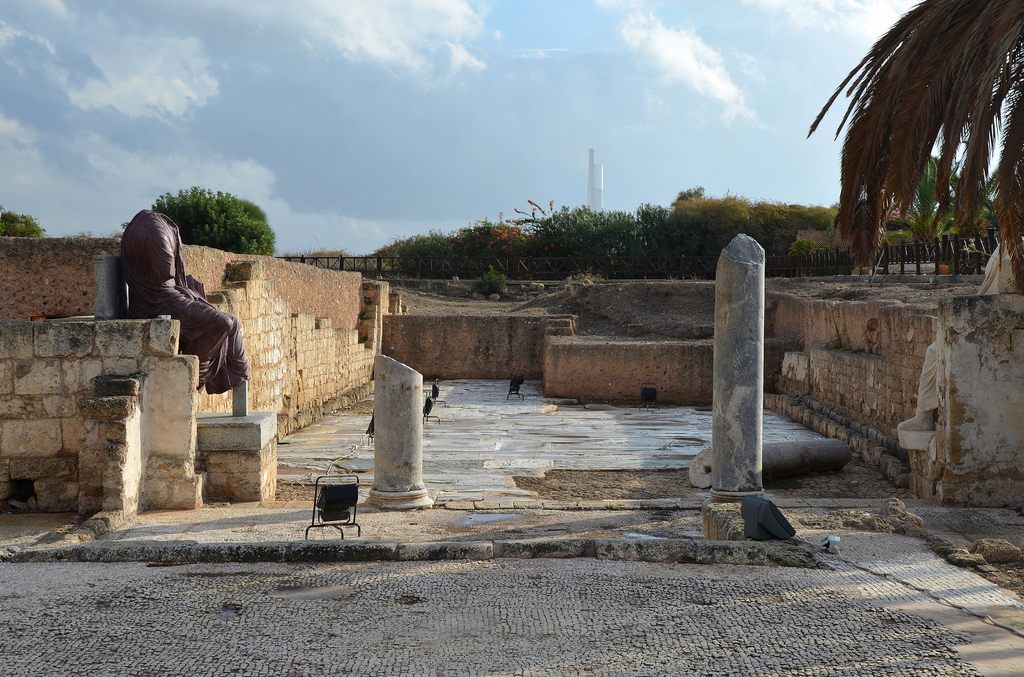
A section of a Byzantine street paved with opus sectile and mosaics, the statues are older dating to the 2nd and 3rd century AD, they originally belonged to Roman temples.
A section of a Byzantine street paved with opus sectile and mosaics. The statues are older and date to the 2nd and 3rd century AD. They originally belonged to Roman temples.
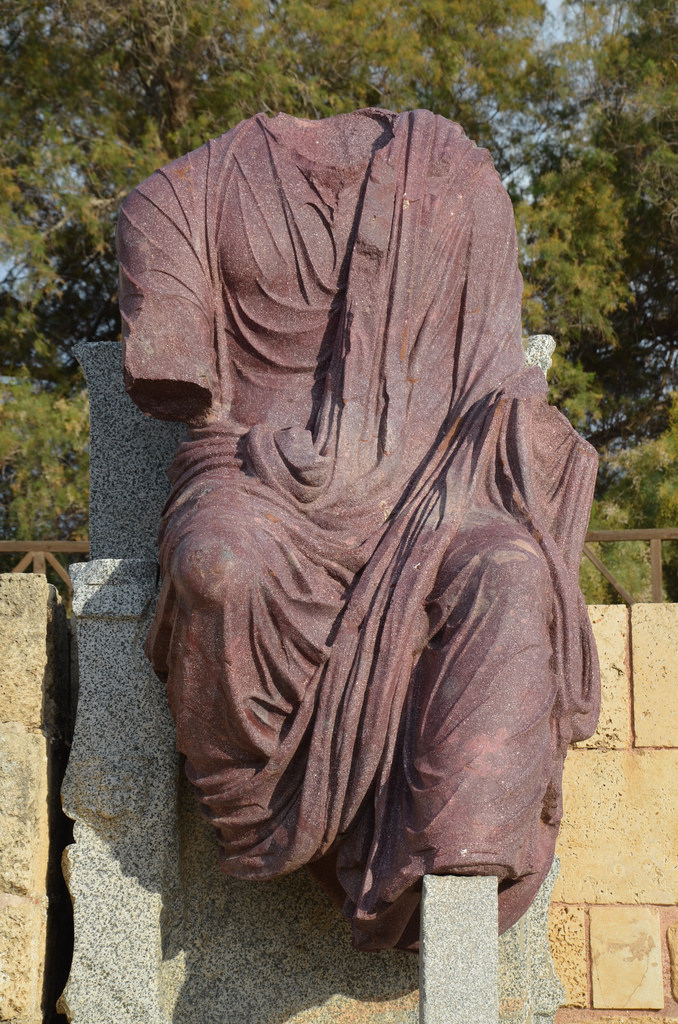
Porphyry statue of Hadrian seated and holding scepter and orb (now missing).
The headless porphyry statue of Hadrian is depicted seated and holding a sceptre and orb (now missing). The statue’s original location was not on Byzantine Street. It may originate from a nearby temple dedicated to Hadrian, which he visited in AD 130 and endowed with a new aqueduct.
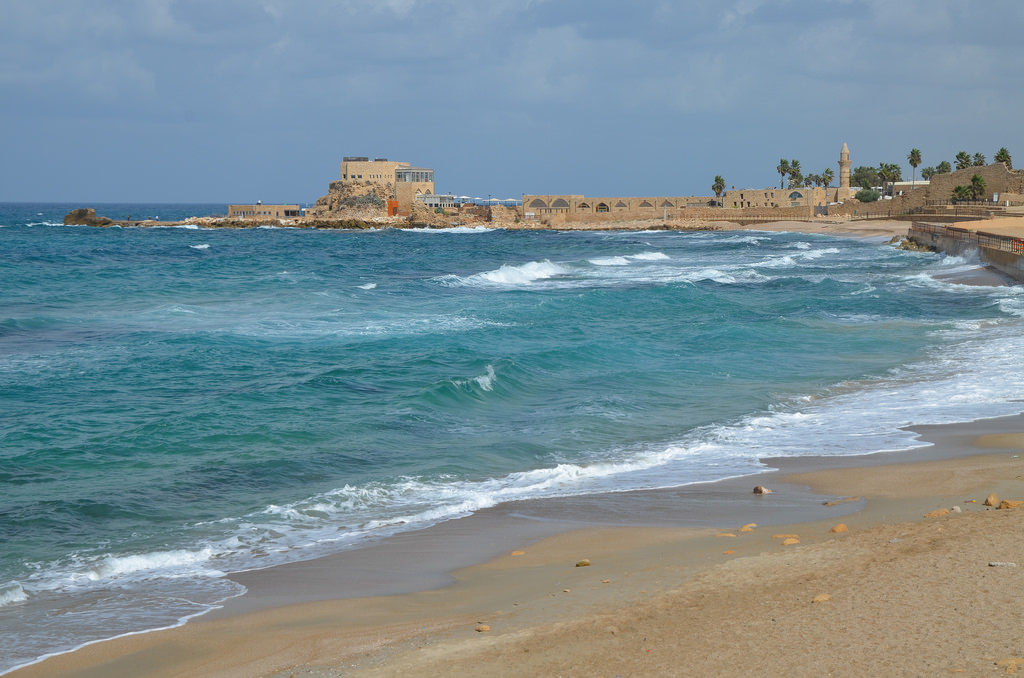
Caesarea.
Caesarea.

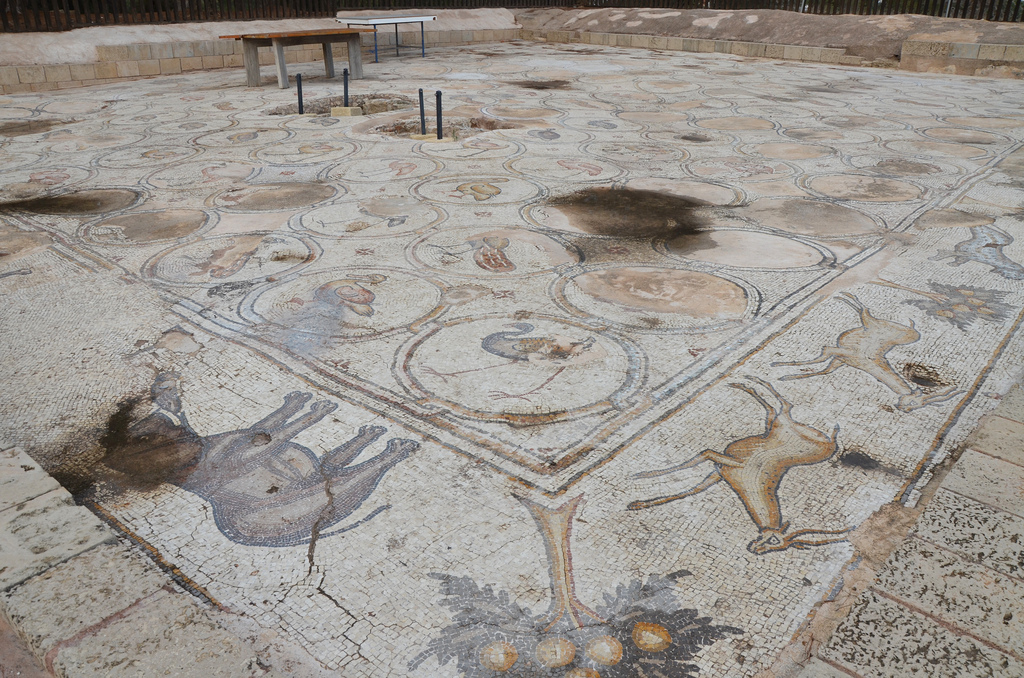
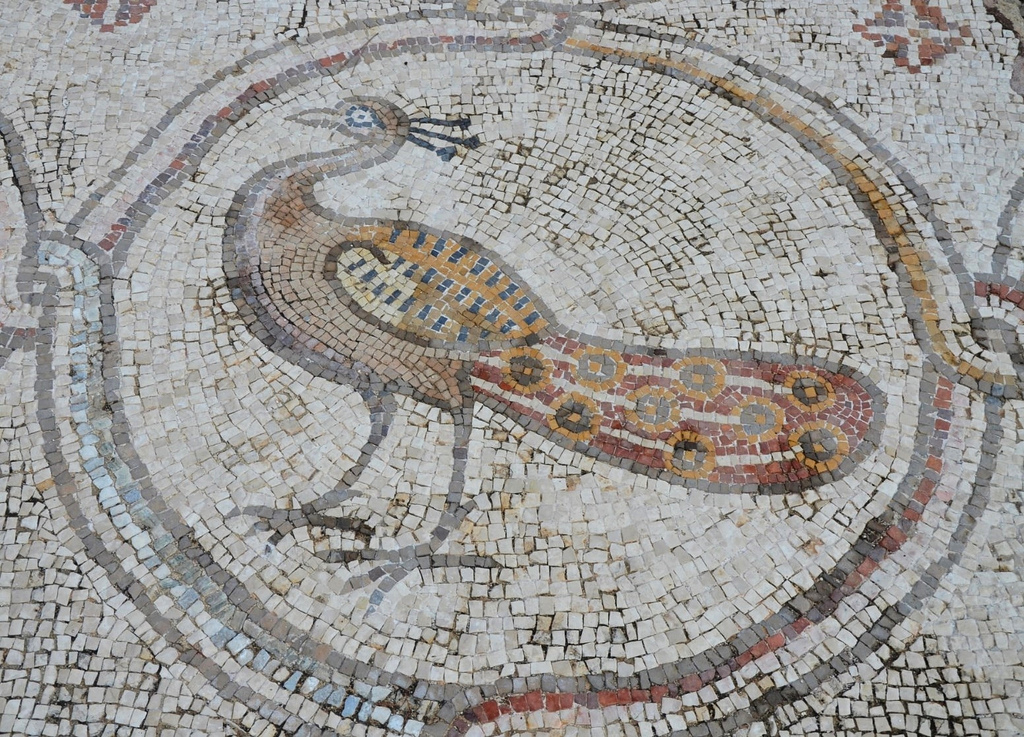
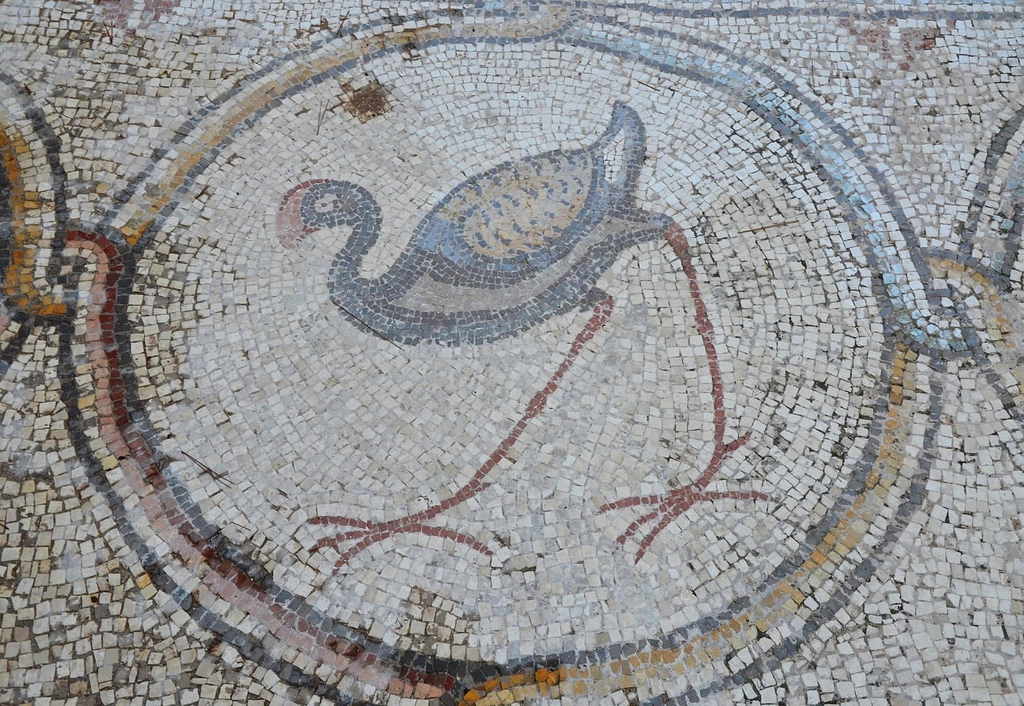
A stunning mosaic floor, known as the “Bird Mosaic,” was accidentally uncovered in 1955 on the outskirts of Caesarea, outside the walls of the ancient settlement. During the excavations of 2005, archaeologists determined that the ‘Bird Mosaic’ was part of a Byzantine palace complex dating from the 6th century AD. During the Byzantine period, the harbour city of Caesarea flourished and expanded as much as 800m inland. This palace complex, covering an area of nearly 1 acre (4,000 sq. metres), was probably owned by a reputable and wealthy family. The “Bird Mosaic” adorned the floor of a large open courtyard, the atrium, with a portico along the western and southern sides.

6th century AD Bird Mosaic that adorned the atrium of a large palace complex outside the city wall of Byzantine Caesarea.
A peacock, detail from the 6th century AD Bird Mosaic that adorned the atrium of a large palace complex outside the city wall of Byzantine Caesarea.
A peacock, a detail from the 6th century AD Bird Mosaic.
6th century AD Bird Mosaic that adorned the atrium of a large palace complex outside the city wall of Byzantine Caesarea.

Links: