Ulpia Oescus

The imposing and impressive ruins of the Roman town Ulpia Oescus are located near the village of Gigen in northern Bulgaria, at the confluence of the Iskar River and the Danube. The city was established in AD 106 in the province of Moesia Inferior. It was granted the status of a colony by Emperor Trajan in honour of his victory over the Dacians. Ulpia Oescus was built on the former camp of the Fifth Macedonian Legion, which was positioned at this place with a canabae (civilian settlement) in late-Augustan times.

Coordinates: 43°42’28.6″N 24°28’00.2″E

In the 1st century AD, Oescus was an important military post that protected the Danube Limes road to Trimontium (modern-day Plovdiv). At this time, the Romans began to build a strong defensive system of fortresses on its northern border to protect them from attacks by barbarian tribes. Oescus thus became a main military point and the camp of two Roman legions, the Legio IV Scythica and the Legio V Macedonica. It maintained its permanent military encampment at this site until AD 101.

L(egio) V M(acedonica) Oes(ci)

The early military camp of the 1st century is now localized precisely under the ruins of the colony built over the subsequent century. The epigraphic monuments of veterans of the necropolis of Oescus also provide information about the early military camp, the canabae and the presumed vicus. In AD 96, the future emperor Hadrian served the fifth Macedonian legion as tribunus militum in Oescus.

The earliest inscription from Oescus, set up in memory of Resius Chronius, liberated slave of centurion Resius Albanus from Legio V Macedonica. Dated 9 AD.
Pleven Regional Historical Museum.

After his victory over the Dacian tribes, Trajan turned the military camp into a town centre and directly elevated it to a colonia, the highest rank of provincial government. The name of the colony – Colonia Ulpia Oescensium – is mentioned for the first time in an inscription from the time of Hadrian.

Ulpia Oescus flourished in the 2nd-3rd century AD as a major city in the Roman province of Moesia Inferior during the times of the Antonines (r. AD 117-192) and the Severans (r. AD 193-235) dynasties. The town had a typical Roman urban planning with a rectangular shape and streets oriented east-west and north-south, covering an area of about 28 hectares. The streets were covered with stone slabs, under which lay a water supply system and sewage channels. About one-third of the city was occupied by public buildings and the rest by workshops and houses. At its peak, Ulpia Oescus had a population of about 100,000.
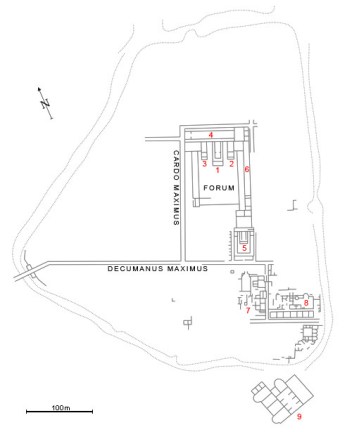
Plan of Ulpia Oescus: 1- 3. Temples of the Capitolian Triad (Jupiter, Juno and Minerva), 4. Civic basilica, 5. Temple of Fortuna, 6. Building for the walking during the winter, 7. Building with the mosaic “Acheioi”, 8. Late Roman Bath, 9. Extra muros building.

The town flourished again at the beginning of the 4th century AD during the reign of Constantine the Great when the capital of the Roman Empire was moved to Constantinople. A stone bridge was erected over the Danube (officially inaugurated on 5 July AD 328 in the emperor’s presence) between Sucidava (present-day Romania) and Oescus. The town was partly destroyed in the 5th century AD by the Huns and rebuilt under Justinian in an attempt to re-establish Oescus as the stronghold of the Danube defence system. However, all the efforts were stopped in late AD 585 and early 586 by the invasion of the Avars.

The archaeological excavations have revealed the city’s Forum, the temples of the Roman deities from the Capitoline Triad (Jupiter, Juno, and Minerva), built in AD 125 during the reign of Hadrian, a large basilica (built in AD 135), thermae, and other public buildings. In 1948, the mosaic known as “The Achaeans” was discovered. It is currently on display, along with many other of the site’s artefacts, at the Pleven Regional Historical Museum. Other artefacts from the site, such as a statue of the goddess Fortuna, are on view at the National Archaeological Museum in Sofia. Most of the inscriptions and monuments belong to the 2d century AD and give evidence of people coming from Asia Minor and Gaul, the city’s establishment, and numerous religious cults, including Mithras.

PORTFOLIO

View of the public baths built during the last quarter of the 3rd century AD when the V Macedonica returned to Oescus following Aurelianus’ retreat from Dacia. The baths occupied an area of 700 sq.m, were built in opus mixum (mixed masonry), and had 8 separate rooms.
The remains of stores with 7 rectangular rooms arranged side by side with entrances from the south. The stores were built at the end of the 2nd century AD. In one of them, fine glazed pottery was sold from big ceramic centres in Lower Moesia.
The street between the public baths and the stores.
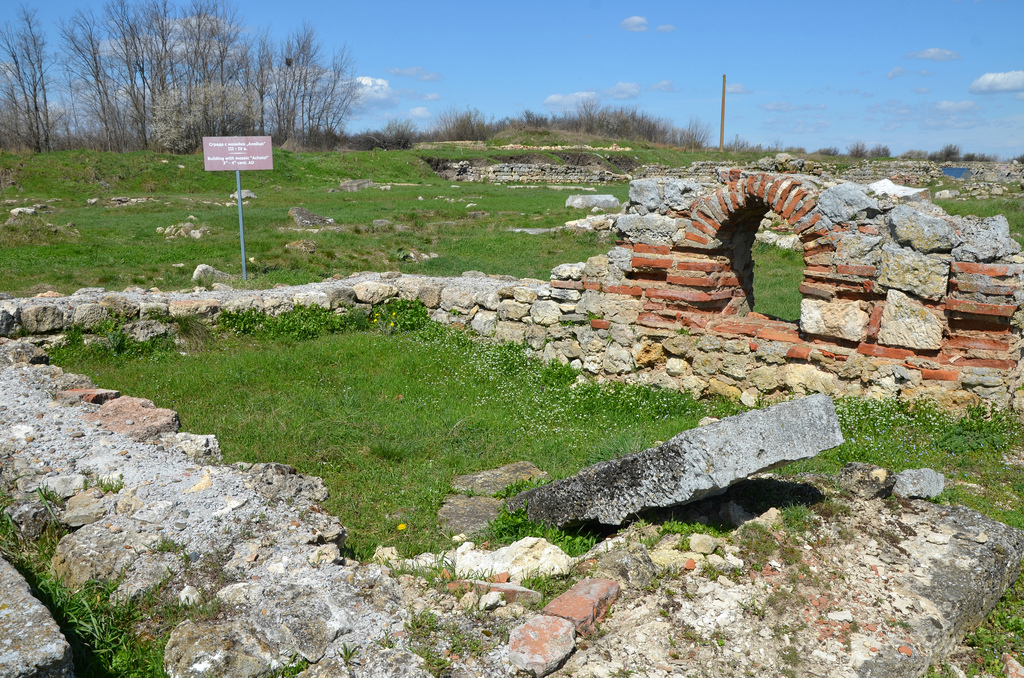
The Building with the “Achaeans” Mosaic. This was the praetorium of the Roman colony. In one of the rooms was found a coloured floor mosaic depicting a scene of the play The Achaeans by Menander.
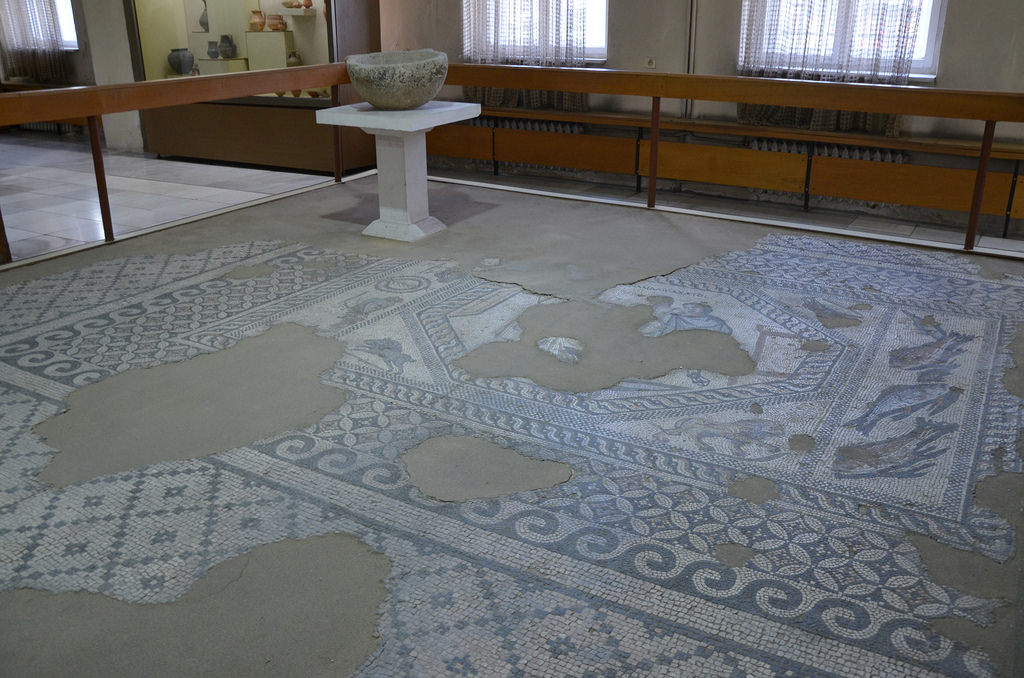
The mosaic “The Achaeans of Menander” depicting a scene of Menander’s The Achaeans with the inscription MENANDROU ACHAIOI. It is dated to the time of the Septimius Severus. The play was unknown before the mosaic’s discovery in 1948. Pleven Regional Historical Museum.
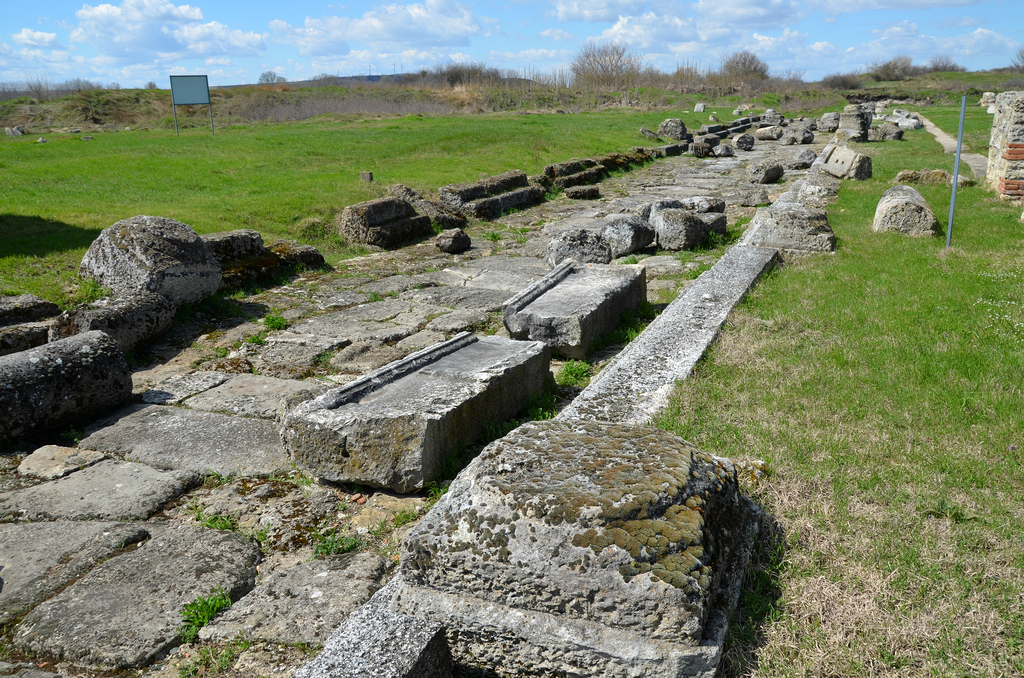
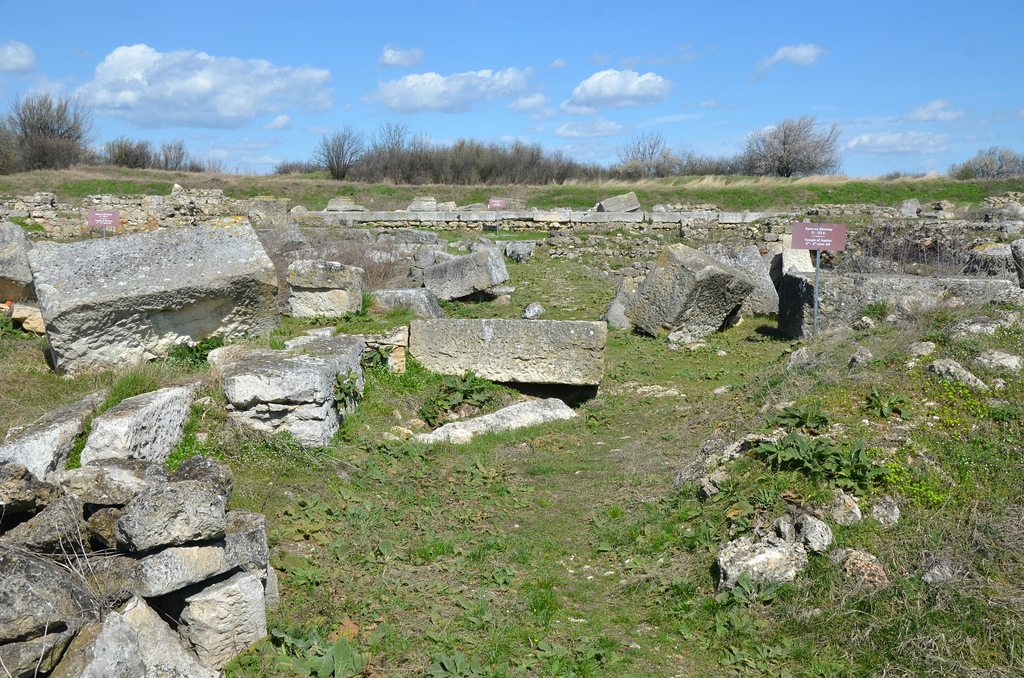
Overview of the Decumanus Maximus and the Temple of Fortuna.
The Decumanus Maximus.
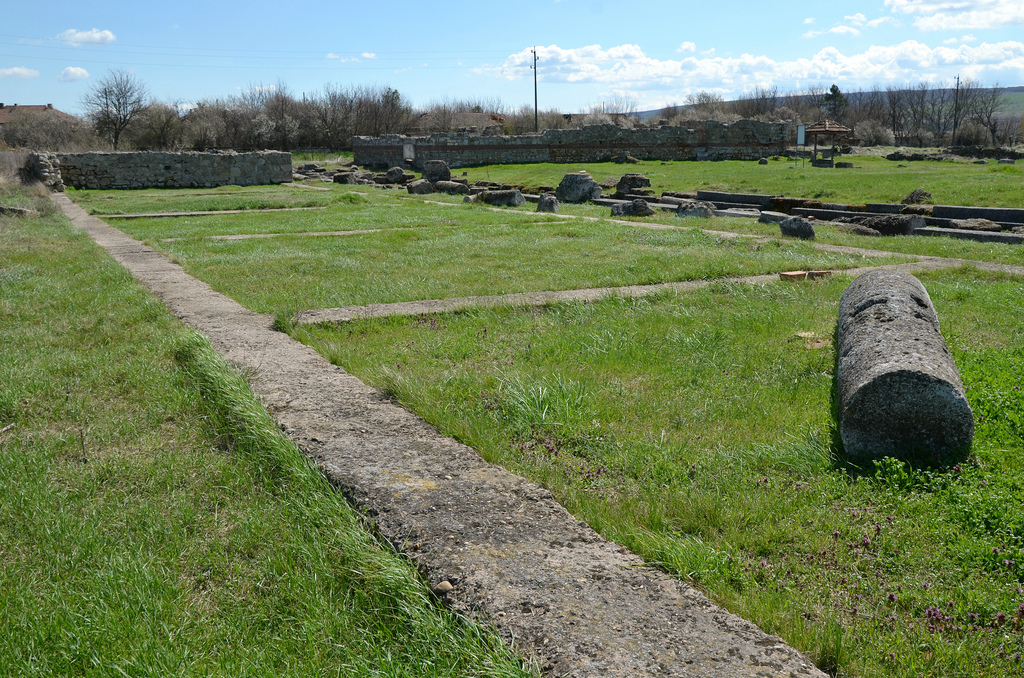
The ruins of the Temple of Fortuna. The temple area, which adjoined the southeast corner of the forum complex, consisted of a portico facing the south, a peristyle courtyard and the temple itself, occupying an area of ​​50 x 29 m.
The ruined Temple of Fortuna is one of the emblematic buildings of Ulpia Oescus. It was erected in AD 190-192 AD, with funding provided by Commodus. The temple area was destroyed by fire during the Goth invasion in 376/78.

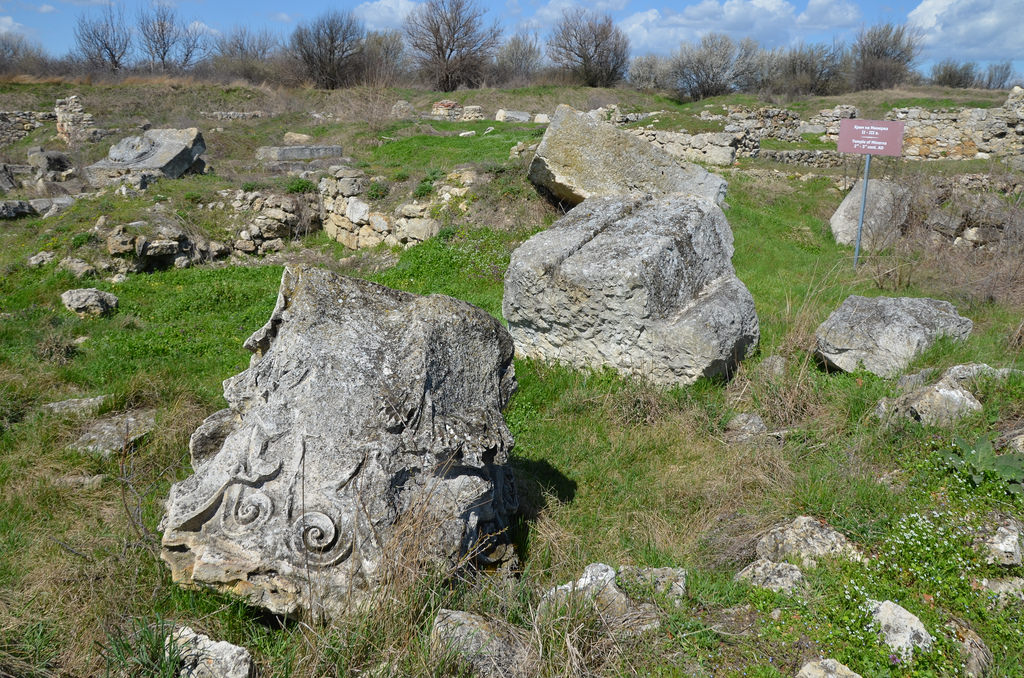
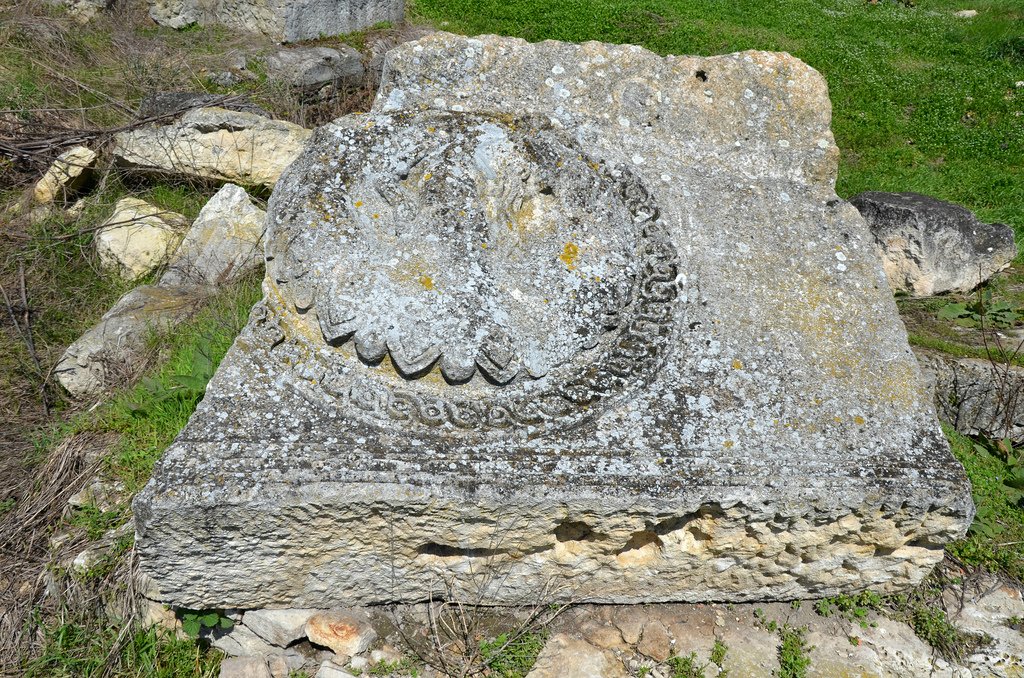
Architrave from the Temple of Fortuna with garlands, medusa heads and bucrania.
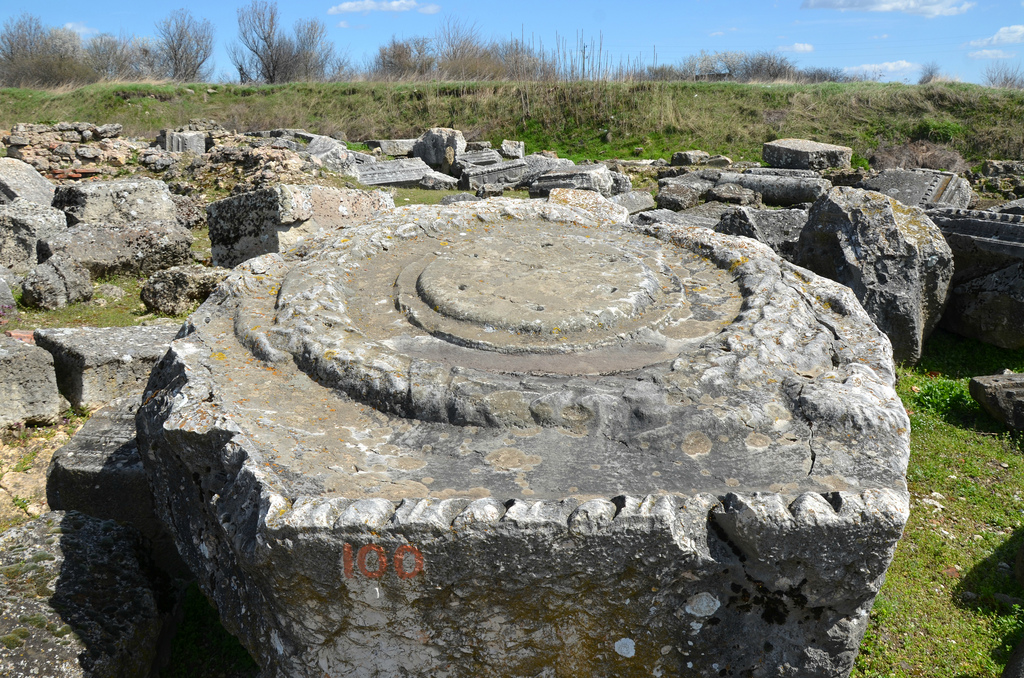
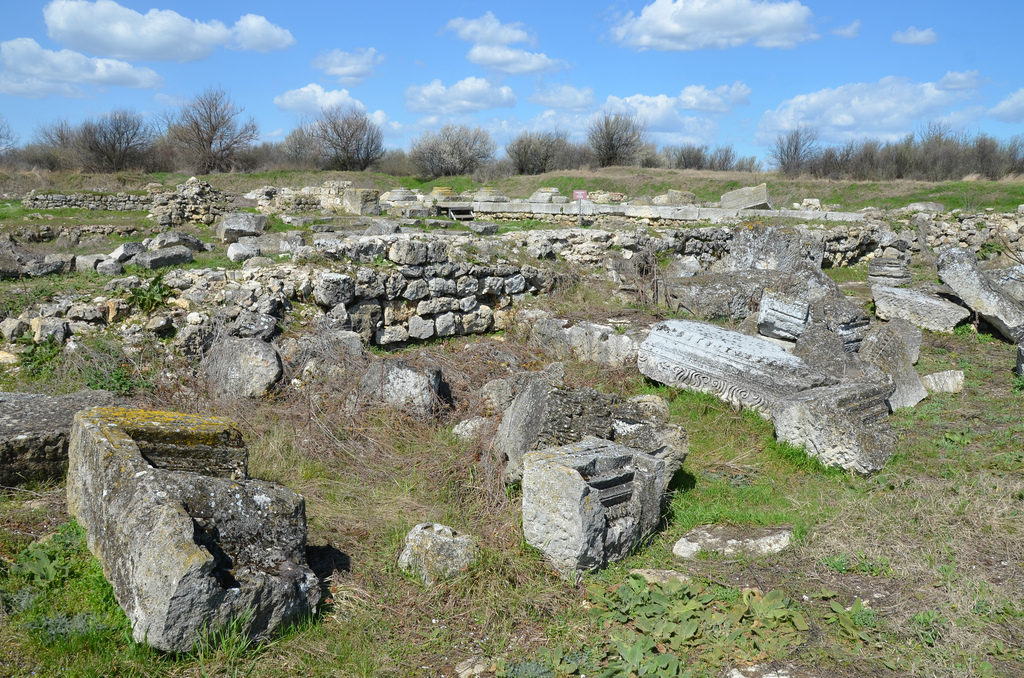
Scattered architectural elements from the Temple of Fortuna.
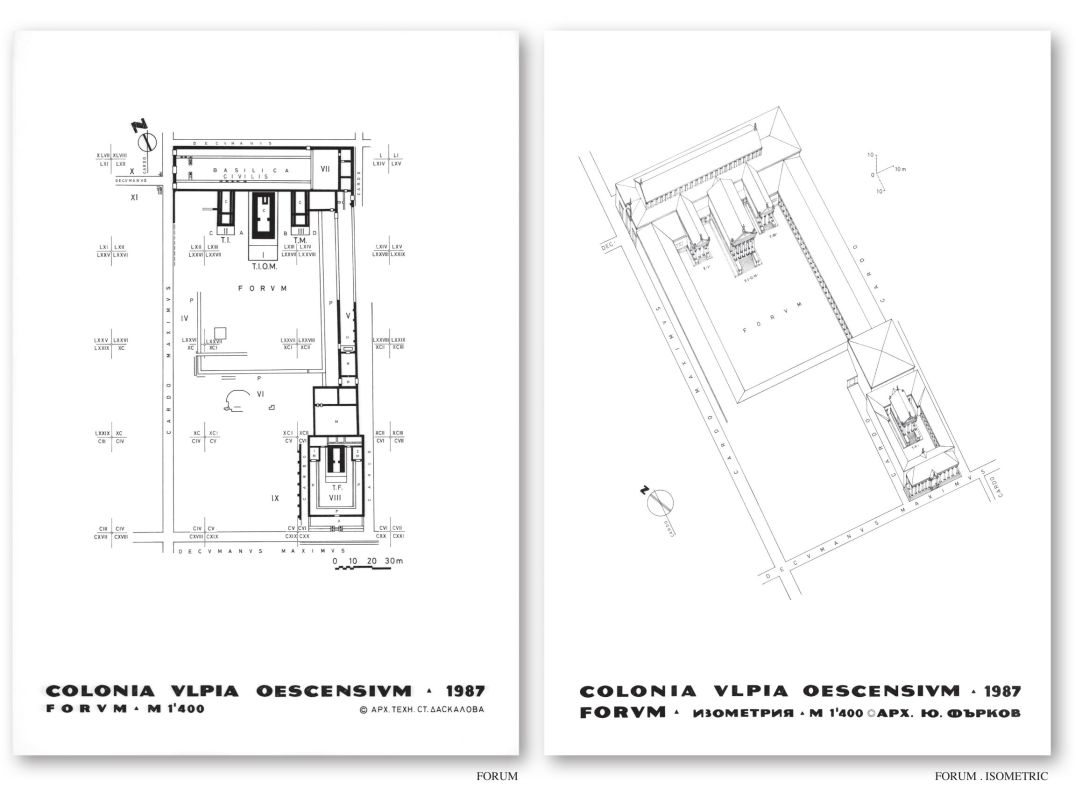
View of the Forum was made out of limestone in the Corinthian style. It occupied an area of ​​96 x 58 m and was surrounded by porticoes to the east, south and west. At the north end of the Forum stood the three temples of the Capitoline Triad and the Basilica Civilis.

Pediment with a Latin inscription from the eastern portico of the Forum.
The northern end of the forum complex was flanked by a three-aisled civic basilica of impressive dimensions (100 х 24 m). The basilica was the last building to be erected in the Forum during the reign of Hadrian.

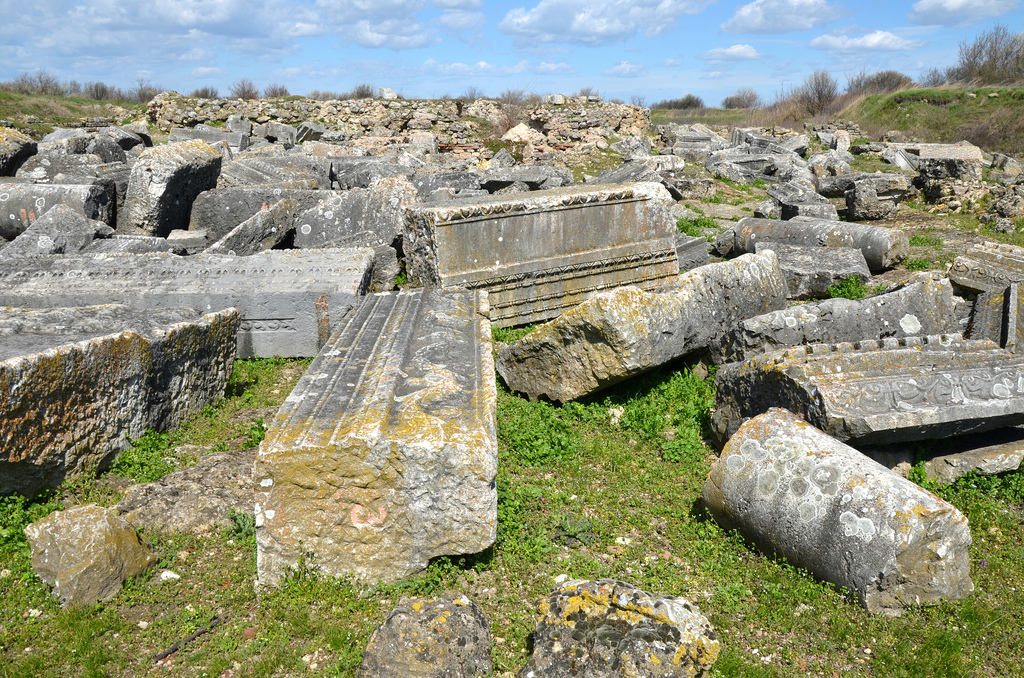
Scattered architectural elements from the civil basilica.
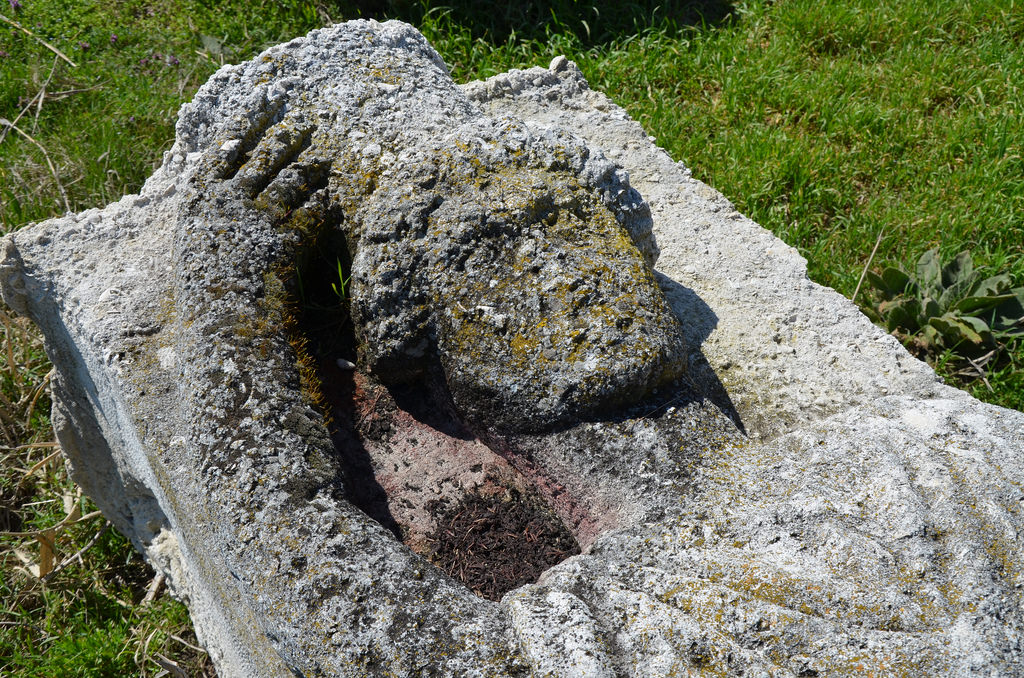
A caryatid, one of the sculpted female figures that served as architectural elements and supported the pillars of the basilica. The use of relief caryatids in public buildings has been without parallel in the Roman cities of Thrace and Moesia.
Fragment of fresco from the civic basilica.
Pleven Regional Historical Museum.
One of the medallions with portrait busts decorated the basilica and was placed beneath the caryatids.
Scattered architectural elements from the civil basilica.

Scattered architectural elements from the Temple of Minerva.
Scattered architectural elements from the Temple of Jupiter.
Scattered architectural elements from the Temple of Juno.
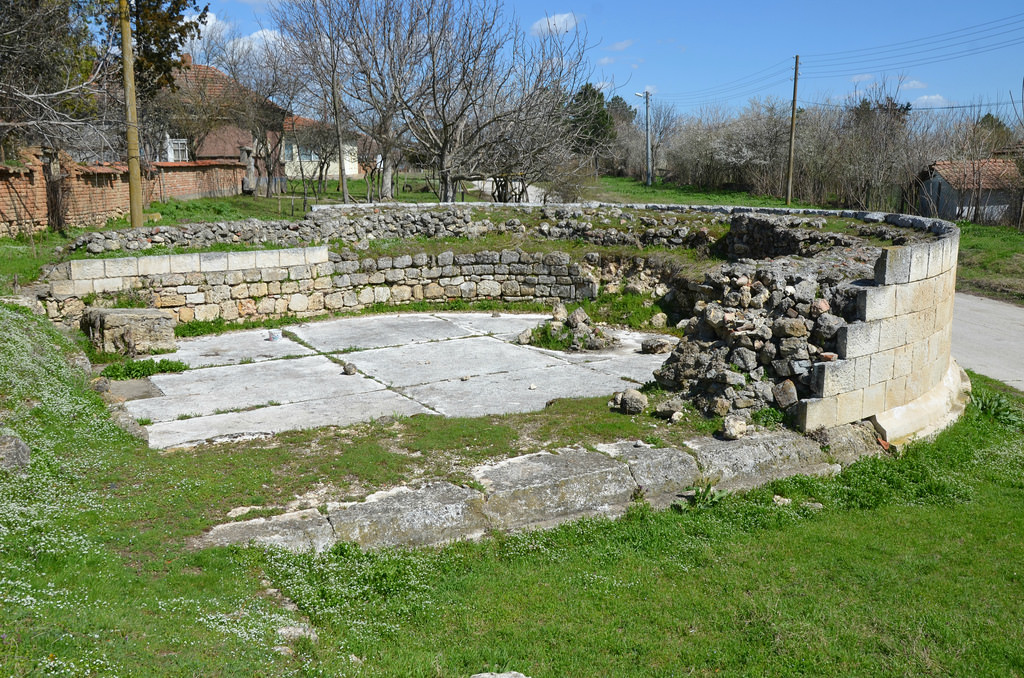
The Extra Muros building dates to the middle of the 3rd century AD and covers an area of ​​52 x 64 m.
U – U-shaped tower dating to the 4th to 5th century AD.

Links:

Alcántara Bridge

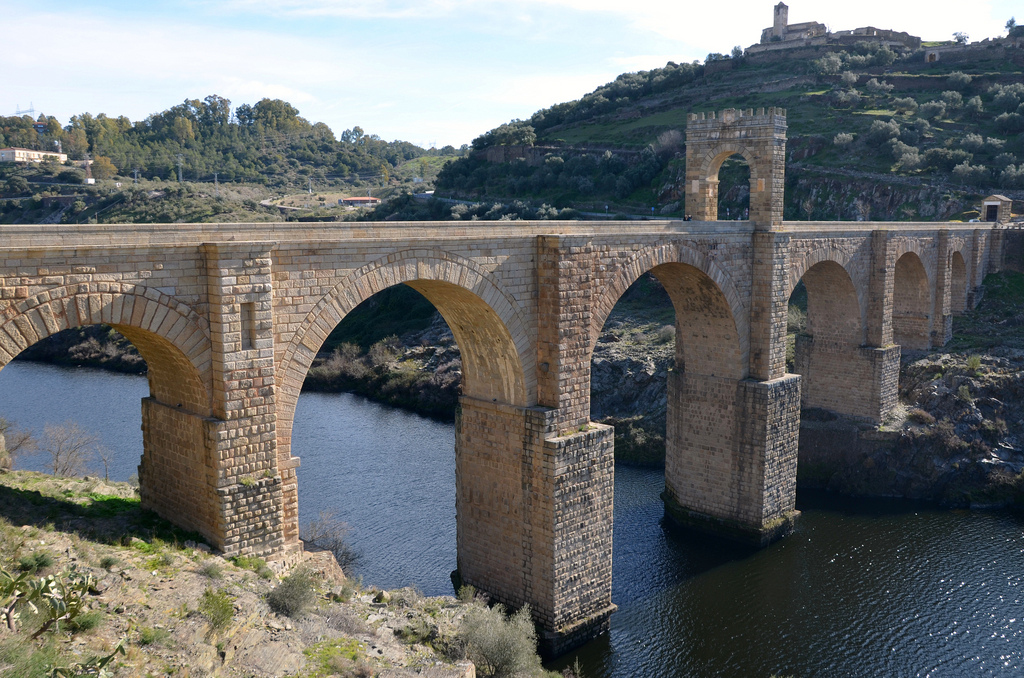
The Roman bridge at Alcántara in Extremadura, Spain, is one of the finest examples of Roman bridge-building and a monumental feat of engineering. It was built over the Tagus River in the ancient Roman province of Lusitania between 104 and 106 AD. It was dedicated to the Roman emperor Trajan on behalf of the local indigenous populations. Built of granite and without mortar, the Alcántara Bridge consists of six semicircular arches supported by five pillars. It spans the river at almost 200 m and rises more than 40 m meters above the water level. The architect of this great masterpiece was a man called Caius Julius Lacer.

The name of the bridge comes from the Arabic “El Kantara”, meaning “bridge”. Its dimensions make it unique among Roman bridges, and it boasts the largest arch span of the peninsular Roman bridges, with an arch of almost 29 m. At its ends, the arches are supported by buttresses.

An honorific arch at the centre of the bridge was dedicated to the emperor Trajan. The inscription found on the attic reads (CIL II 759): Imp(eratori) • Caesari • divi • Nervae • f(ilio) • Nervae / Traiano • Aug(usto) • Germ(anico) • Dacico • pontif(ici) max(imo) / trib(unicia) • potes(tate) • VIII • imp(eratori) • V • co(n)s(uli) • V • p(atri) • p(atriae).

Another inscription from the side of the triumphal arch reveals that the bridge was paid for by eleven Lusitanian municipalities (municipia provinciae Lusitaniae). The inscription also claims that, in addition to contributing funds to the building of the bridge, these local municipalities ‘completed’ the bridge (perfecerunt).

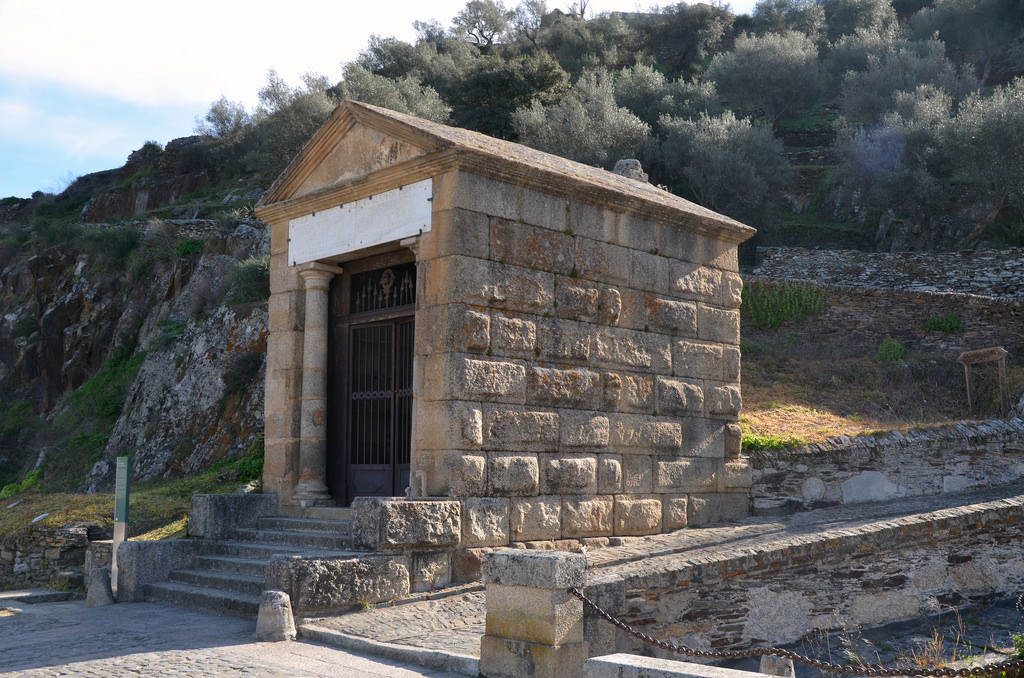
At the southeast end of the monumental bridge are the remains of a small votive temple, distyle in antis, of Tuscan order with a single cella. It was constructed as an offering to Trajan and the gods of Rome. It was designed by the same architect as the bridge and the triumphal arch, Gaius Julius Lacer. The dedicatory inscription (CIL II 761) on the temple (now a reconstruction of the original), cut in a slab of marble, records that the temple was dedicated to Trajan, erected by the bridge’s architect Gaius Iulius Lacer, with the help of his associate and friend Curio Lacone Igaeditano (from the city of Idanha-a-Velha). After the conquest of Cáceres in 1169 by Ferdinand II of Leon, the temple was converted into a chapel of St. Julian, which explains why the building remains so well-preserved. The architect was buried in the temple, and his tomb is still preserved inside.

pontem perpetui mansurum in saecula mundi (a bridge that would last forever)

Over the centuries, the Alcántara Bridge sustained damage in various armed conflicts and environmental events, mainly water-related, which have led to the destruction of part of its structure and degraded it. The bridge was restored during the reign of Isabel II by the engineer Alejandro Millan y Sociats in 1859. It was listed as a Spanish National Monument in 1924 and is in the process of being declared a World Heritage Site by UNESCO.

Coordinates: 39° 43′ 21.00″ N 6° 53′ 33.00″ W

PORTFOLIO

View of the Alcántara Bridge looking northwest.
View of the Alcántara Bridge looking northeast.

The honorific arch at the centre of the bridge is dedicated to the emperor Trajan.
View of the Alcántara Bridge looking southeast.
The small votive temple was dedicated to the Roman emperor Trajan and the Roman Gods.
Dedicatory inscription (CIL II 761) on the votive temple honouring Trajan and the Gods for successfully building the bridge.
The entrance is flanked by two Tuscan columns and accessed by an exterior staircase, covered with a gabled roof made of slabs of stone, with a pediment with trim at the edges and a smooth tympanum without decoration.
The interior of the small votive temple.
The Alcántara bridge and the small temple view from the east.
The Alcántara bridge is still used for traffic.

Links: