Alcántara Bridge

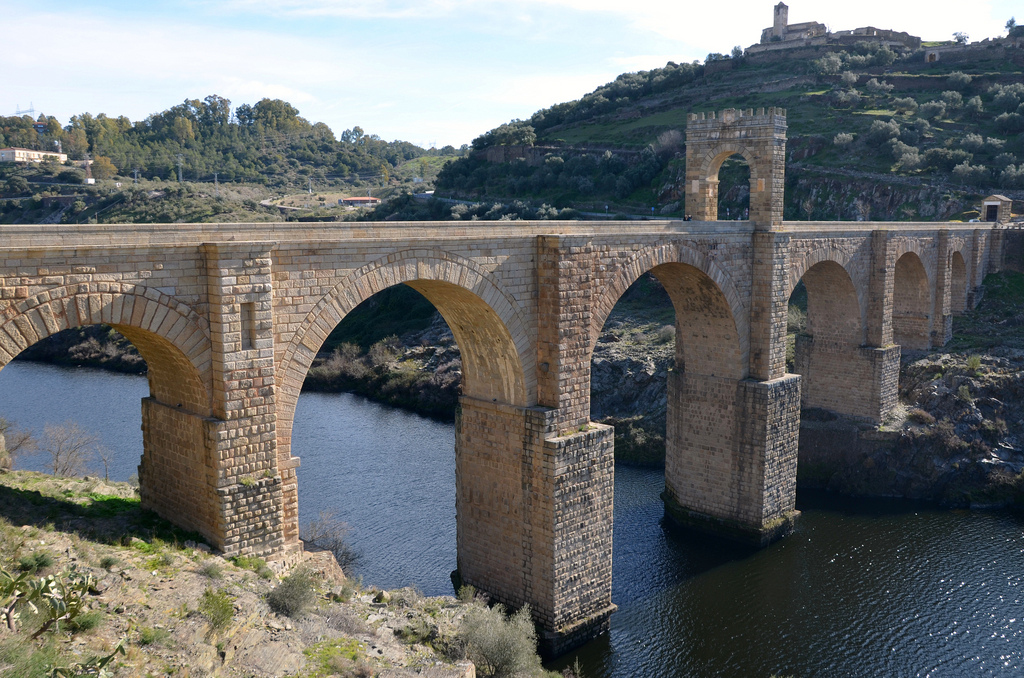
The Roman bridge at Alcántara in Extremadura, Spain, is one of the finest examples of Roman bridge-building and a monumental feat of engineering. It was built over the Tagus River in the ancient Roman province of Lusitania between 104 and 106 AD. It was dedicated to the Roman emperor Trajan on behalf of the local indigenous populations. Built of granite and without mortar, the Alcántara Bridge consists of six semicircular arches supported by five pillars. It spans the river at almost 200 m and rises more than 40 m meters above the water level. The architect of this great masterpiece was a man called Caius Julius Lacer.

The name of the bridge comes from the Arabic “El Kantara”, meaning “bridge”. Its dimensions make it unique among Roman bridges, and it boasts the largest arch span of the peninsular Roman bridges, with an arch of almost 29 m. At its ends, the arches are supported by buttresses.

An honorific arch at the centre of the bridge was dedicated to the emperor Trajan. The inscription found on the attic reads (CIL II 759): Imp(eratori) • Caesari • divi • Nervae • f(ilio) • Nervae / Traiano • Aug(usto) • Germ(anico) • Dacico • pontif(ici) max(imo) / trib(unicia) • potes(tate) • VIII • imp(eratori) • V • co(n)s(uli) • V • p(atri) • p(atriae).

Another inscription from the side of the triumphal arch reveals that the bridge was paid for by eleven Lusitanian municipalities (municipia provinciae Lusitaniae). The inscription also claims that, in addition to contributing funds to the building of the bridge, these local municipalities ‘completed’ the bridge (perfecerunt).

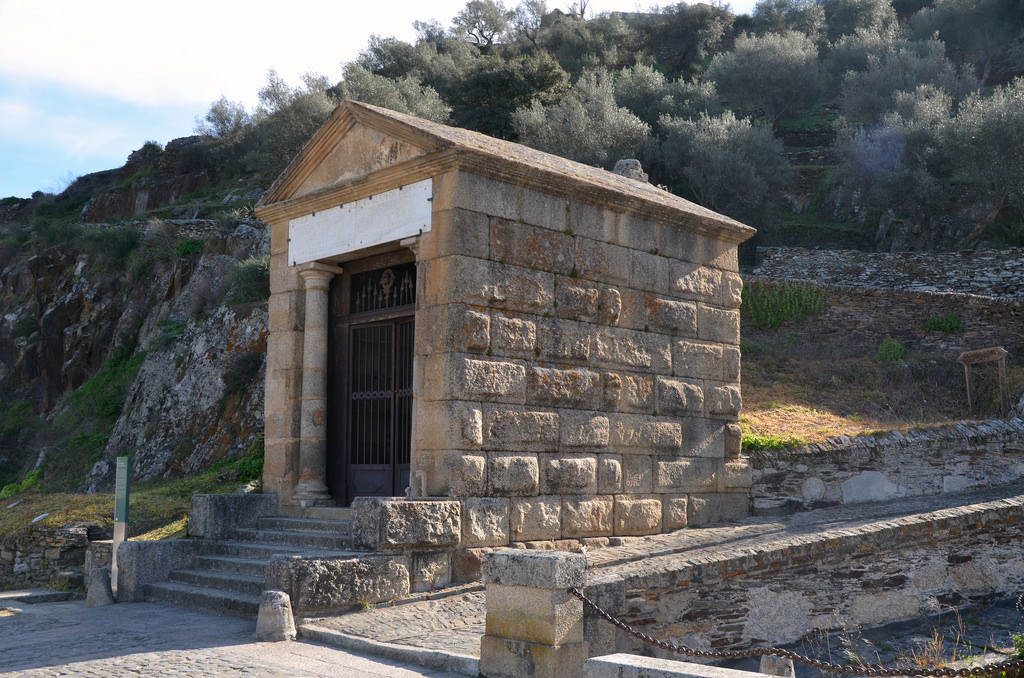
At the southeast end of the monumental bridge are the remains of a small votive temple, distyle in antis, of Tuscan order with a single cella. It was constructed as an offering to Trajan and the gods of Rome. It was designed by the same architect as the bridge and the triumphal arch, Gaius Julius Lacer. The dedicatory inscription (CIL II 761) on the temple (now a reconstruction of the original), cut in a slab of marble, records that the temple was dedicated to Trajan, erected by the bridge’s architect Gaius Iulius Lacer, with the help of his associate and friend Curio Lacone Igaeditano (from the city of Idanha-a-Velha). After the conquest of Cáceres in 1169 by Ferdinand II of Leon, the temple was converted into a chapel of St. Julian, which explains why the building remains so well-preserved. The architect was buried in the temple, and his tomb is still preserved inside.

pontem perpetui mansurum in saecula mundi (a bridge that would last forever)

Over the centuries, the Alcántara Bridge sustained damage in various armed conflicts and environmental events, mainly water-related, which have led to the destruction of part of its structure and degraded it. The bridge was restored during the reign of Isabel II by the engineer Alejandro Millan y Sociats in 1859. It was listed as a Spanish National Monument in 1924 and is in the process of being declared a World Heritage Site by UNESCO.

Coordinates: 39° 43′ 21.00″ N 6° 53′ 33.00″ W

PORTFOLIO

View of the Alcántara Bridge looking northwest.
View of the Alcántara Bridge looking northeast.

The honorific arch at the centre of the bridge is dedicated to the emperor Trajan.
View of the Alcántara Bridge looking southeast.
The small votive temple was dedicated to the Roman emperor Trajan and the Roman Gods.
Dedicatory inscription (CIL II 761) on the votive temple honouring Trajan and the Gods for successfully building the bridge.
The entrance is flanked by two Tuscan columns and accessed by an exterior staircase, covered with a gabled roof made of slabs of stone, with a pediment with trim at the edges and a smooth tympanum without decoration.
The interior of the small votive temple.
The Alcántara bridge and the small temple view from the east.
The Alcántara bridge is still used for traffic.

Links:

Munigua

Munigua is the site of the Roman city of Municipium Flavium Muniguense, located in the Sierra Morena, 8 km from Villanueva del Río y Minas in the province of Seville. Its origins date back to the pre-Roman period, and evidence of human occupation can be traced back from the mid-4th century BC to the 8th century AD. During the Romanisation of the province of Baetica, Munigua prospered rapidly. It received Latin rights from Emperor Vespasian and was recognised as a municipium, which further strengthened its importance as a centre of commerce, culture, and administration in the region.

Coordinate: 37°42’47.1″N 5°44’25.9″W

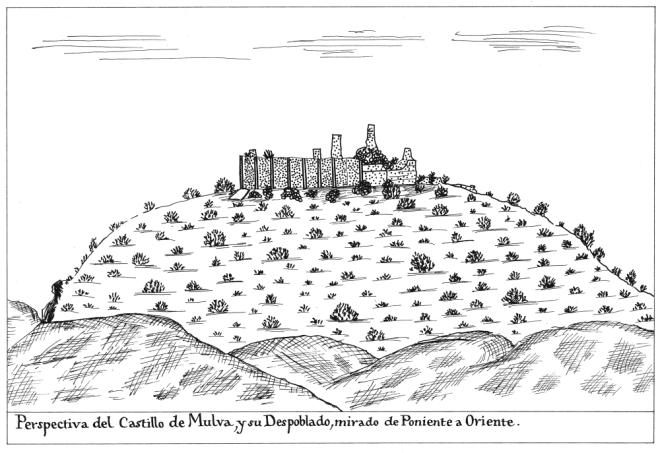
The site of Munigua was first discovered by two researchers from the Academy of Letters in Seville in 1765. However, it was later forgotten until 1956, when the German Archaeology Institute in Madrid studied it once again. Archaeologists have discovered many interesting things here, such as temples, sanctuaries, a two-story porticus, residential houses, a forum, public bathhouses, city walls, and a vast necropolis. The site also features a monumental terrace sanctuary on the slope of the hill, known from 18th-century drawings referred to as the “Castle of Mulva”.

18th-century drawing by Tomás de Gusseme depicting the “Castle of Mulva”.

According to archaeologists, the settlement in Sierra Morena was founded by the Turdetani, an Iberian tribe who lived in the region. The first settlement owed its existence to the mining and metallurgy activities that have long characterised the Sierra Morena, a mountain range rich in copper and iron ore. During the Roman occupation, copper production increased significantly, and the Romans built elaborately ventilated underground galleries, interconnected tunnels, and deep shafts to facilitate mining activities.

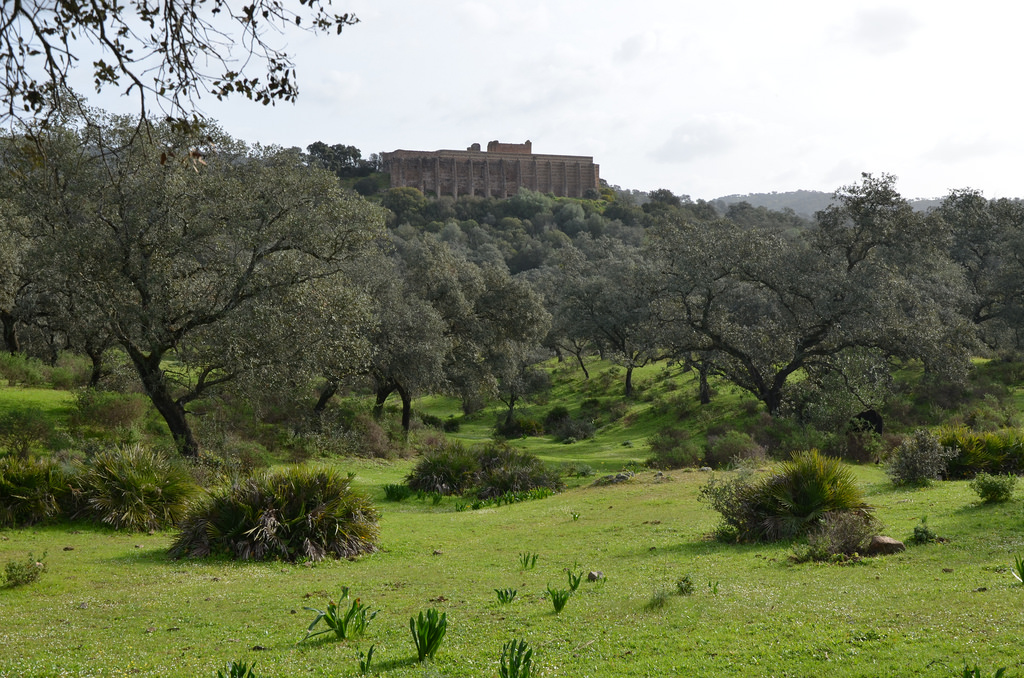
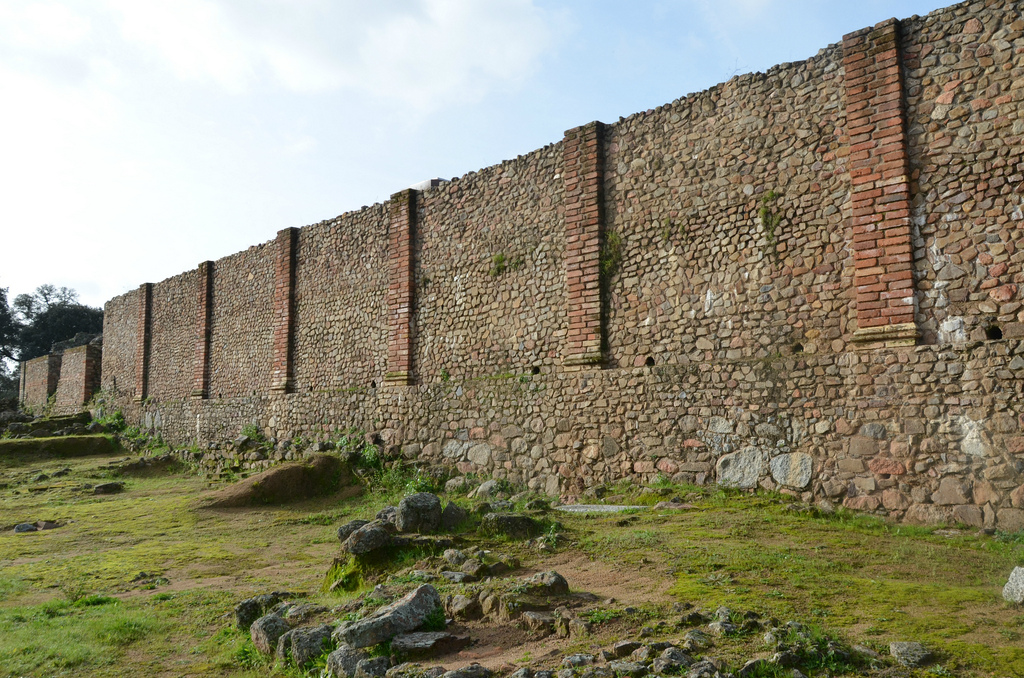
Thanks to the wealth derived from the mines, several monuments were constructed. One of the most remarkable structures was a terraced sanctuary located on the slope of a hill, which dominated the city. The impressive building stood on multiple-tiered terraces and was reinforced by 13 buttresses at the back, giving it the appearance of a fortress. This structure later became known as the Castle of Mulva. The building is characterised by its architectural symmetry, with access ramps and stairs neatly paired on either side of the sacred precinct. The plan seems to have been inspired by the Sanctuary of Fortuna Primigenia at Praeneste or the Temple of Hercules Victor in Tivoli. However, it’s not known which deity was worshipped on the site, though it’s speculated that it may have been Fortuna and Hercules.

The city developed at the feet of the terraced sanctuary. Construction work was accelerated when Vespasian granted Munigua the Latin right around AD 73/74, elevating its status to municipium. Between the mid-1st century and the late 2nd century AD, all the town’s structures, including the forum, the baths, and the houses, were constructed.

Munigua flourished during the reign of Hadrian, but its prosperity declined towards the end of the 3rd century AD due to an earthquake that struck the town. Later, another earthquake during the late antiquity period marked the end of Munigua’s golden era. However, it is known that the site was continuously inhabited, at least until the Almohad period in the 12th century.

The town has yielded numerous archaeological artefacts: some 45 stone sculptures and approximately 160 terracotta pieces. Additionally, a significant number of glass objects have been found in funerary contexts, along with almost 1,500 metal artefacts and various items of jewellery. Over 80 inscriptions have been uncovered at Munigua, including two made of bronze, a tessera hospitalis (which was a hospitality token), and a letter from Emperor Titus.

PORTFOLIO

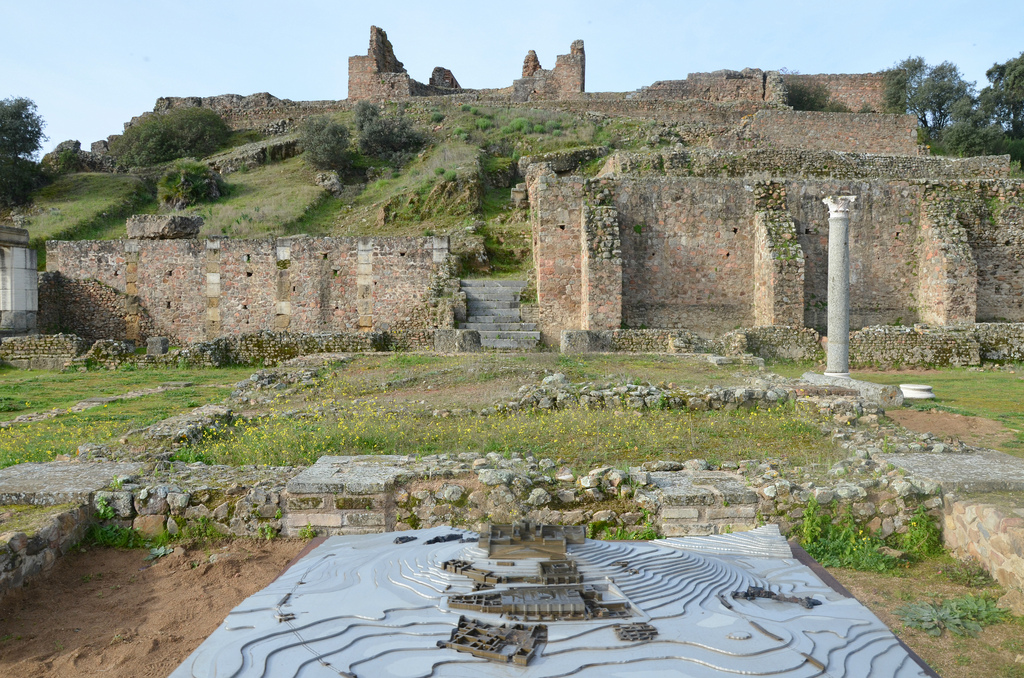
General view of the Sanctuary of Terraces from the access road.
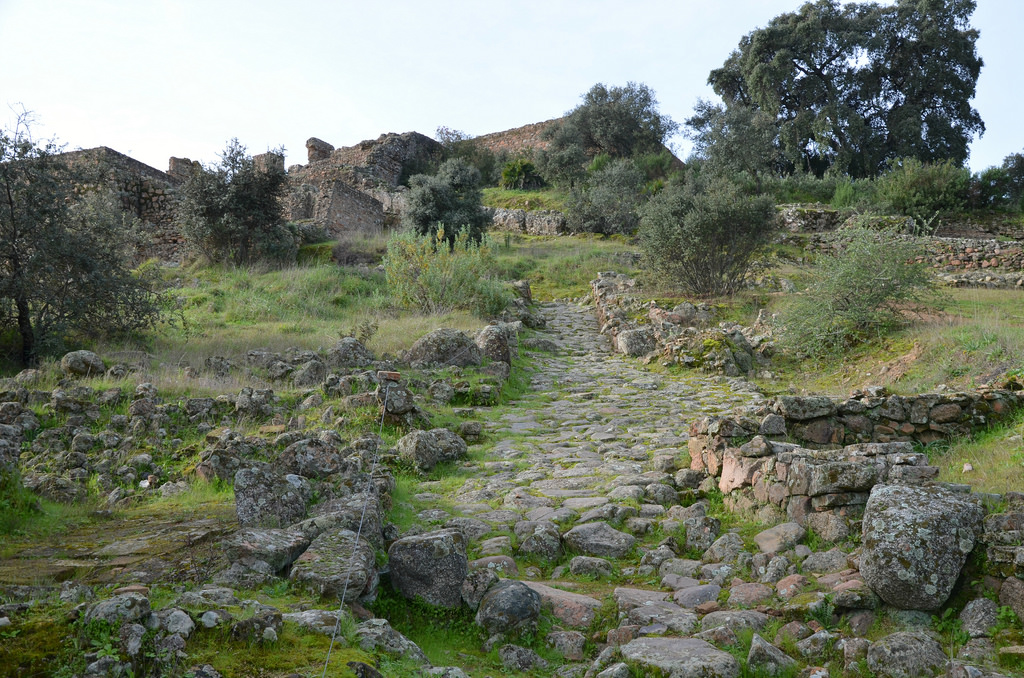
The northern roadway ascending to the Terraced Sanctuary.
The main facade of the Terraced Sanctuary faced east towards the city.
The cella in the Sanctuary of the Terraces.
View of the Double-height portico with the Terraced Sanctuary in the background.
Virtual reconstruction of Munigua, view from the east. © DAI
View towards the small Temple of Mercury standing in the entrance street leading to the Forum, which consisted of the Forum Temple, the Curia, the Tabularium, the Basilica and the Shrine of Dis Pater, the god of miners.
The small Temple of Mercury, located at the southern end of the portico. It included a podium in the form of an exedra as well as an aedicula, with two frontal columns supporting the architraves and pediment. The altar, still in situ, was consecrated by a certain Ferronius to a divinity whose name is indecipherable but another altar found in front of the temple had a dedication to Mercury.
The remains of the large two-tier portico of the forum.
The Forum Temple, surrounded by porticoes on three sides. The divinity to which the temple was dedicated is unknown.
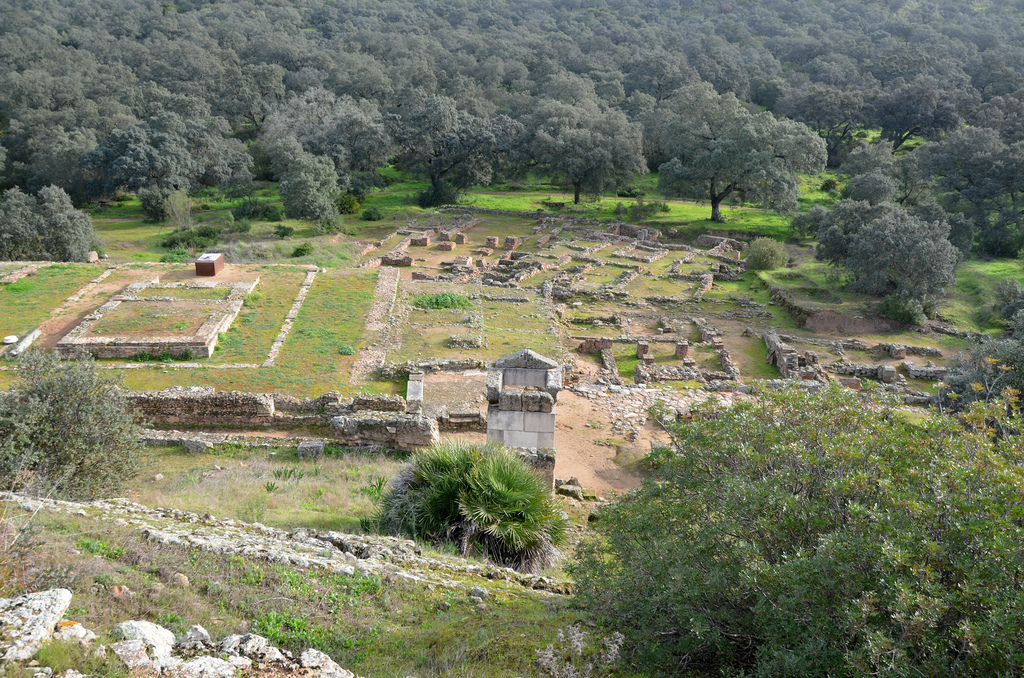
View of the Temple Forum, the small Temple of Mercury and the eastern residential zone.
View of the Podium Temple, a square block structure that was supported by four buttresses on its eastern side. Its walls rested on a podium supporting another smaller podium. It was embellished with marble slabs and reached by a flight of steps preserved in situ. The temple was built in the early 2nd century AD.
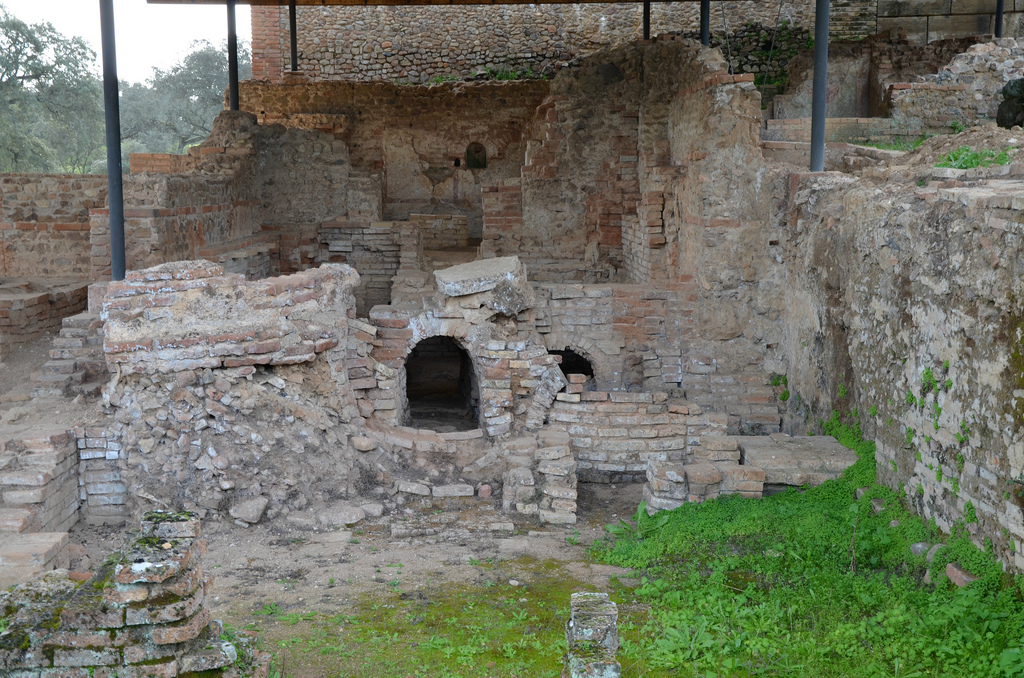
The baths with an L-shaped floor plan had seven different rooms, including the apsidal hall and the nymphaeum. Judging by their small size (barely 280 m2) and the absence of a palaestra, these facilities were probably balneae rather than thermae.
The bath complex was built during Nero’s reign. Later, at the end of the 1st century AD, part of the baths was demolished to make room for the forum.
Detail of the mural paintings in the baths.
View of the eastern residential zone with the Forum and the Terraced Sanctuary in the background.

Links: