Baalbek (Heliopolis)

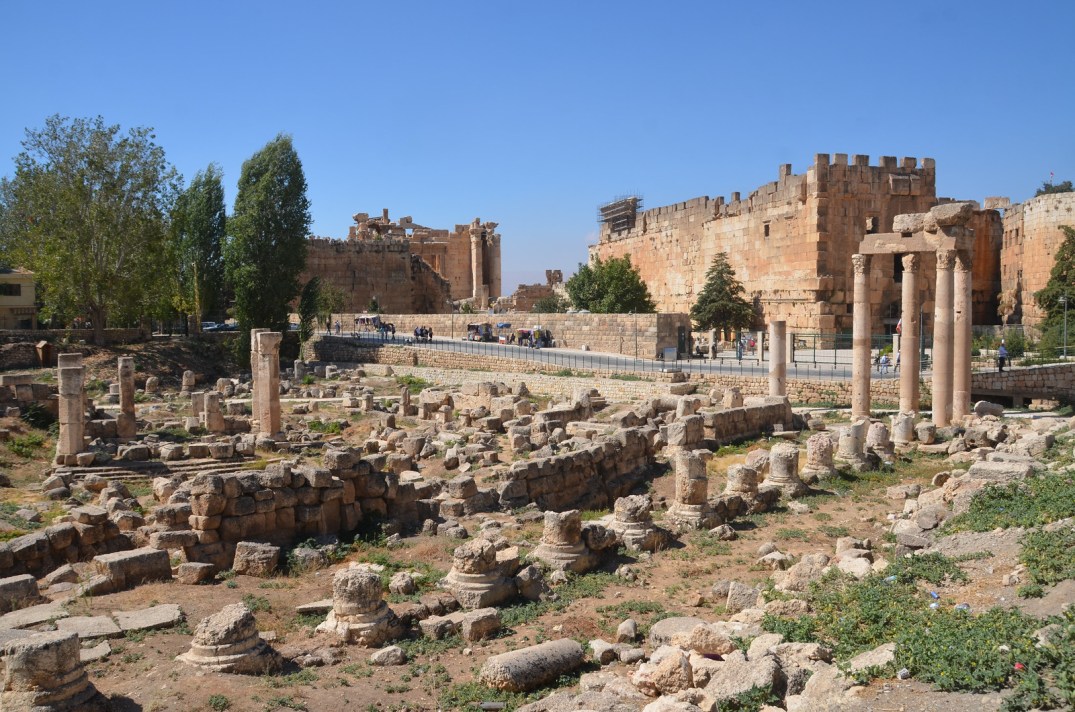
Baalbek is an ancient Phoenician city located in modern-day Lebanon, in the northern part of the Beqaa Valley, a fertile area abundant with springs. It was first settled at the beginning of the 3rd millennium BC and became an important waypoint on the Phoenician trade route from Tyre to Damascus. Over time, Baalbek evolved into a significant pilgrimage site where the god Baal, associated with the sun, was worshipped alongside his consort, Astarte, the Queen of Heaven. The city was renamed Heliopolis, meaning “City of the Sun,” by the Greeks. Today, it is renowned for its exceptionally well-preserved colossal sanctuary that was constructed during the Roman period, as well as for the worship of its three main deities: Jupiter Heliopolitanus, Venus Heliopolitana, and Mercury Heliopolitanus. Baalbek is one of the most remarkably preserved archaeological complexes in the Middle East and is Lebanon’s most celebrated tourist attraction. In 1984, it was designated as a UNESCO World Heritage site.

Coordinates: 34° 0′ 22.81″ N36° 12′ 26.36″ E

The settlement history of Baalbek dates back to the Chalcolithic and Early Bronze Ages. The earliest settlement was located on the hilltop of Tell Baalbek, which likely served as a site of worship. During the Canaanite period, the local temples were primarily dedicated to the Heliopolitan Triad: Baal, his consort Ashtart, and their son Adon. The name Baalbek likely derives from Canaanite words meaning “Lord of the Spring,” associated with the god Baal, and may reflect the nature of the original cult. However, this name does not appear in historical records until the 5th century AD.

Baalbek was transformed into a fortified site during the Hellenistic period, as the Seleucid Empire sought regional power against the Ptolemies of Egypt around 198 BC. During this time, the town was likely renamed Heliopolis, meaning “City of the Sun.” This name continued to be used even after Roman rule began in 64 BC, when Pompey conquered Syria and Palestine. Heliopolis became part of the first Roman colony in Syria, established in Berytus (modern-day Beirut). However, under Emperor Septimius Severus, the city gained independence and was renamed Colonia Julia Augusta Felix Heliopolitana.

The Baalbek Sanctuary with the Drawing locations; (Drawing: Lohmann)
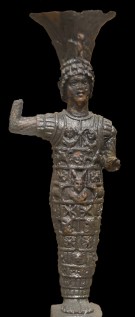
Statuette of Jupiter Heliopolitanus.

The main construction campaign of the sanctuary complex lasted for over 200 years, from the mid-1st century AD to the 3rd century AD. It began with the creation of a T-shaped terrace approximately 12 meters high, along with a propylon and a small altar located in the central courtyard. During the second phase of construction, the colossal Temple dedicated to Jupiter Heliopolitanus, a powerful god of agricultural fertility and the cosmos, was built in the 1st century AD. This temple was constructed on a podium that rose 7 meters above the surrounding courtyard and followed a peripteral Greek design. It featured 10 columns on the shorter side and 19 columns on the longer side, all in the Corinthian order. Although only six of the original 54 columns remain, they clearly indicate the grandeur of this immense structure. Covering an area of approximately 48 by 88 meters, it was one of the largest temples from the Roman period.

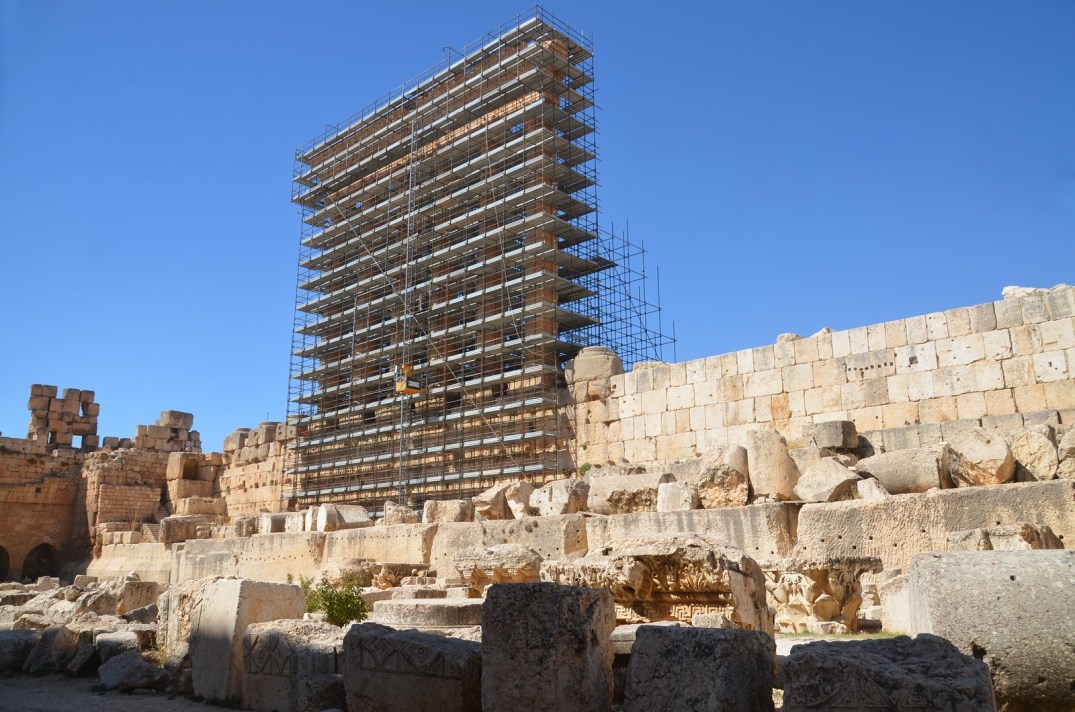
The third phase of construction at the sanctuary was initially undertaken by Hadrian and continued through the Antonine period. During this phase, the courtyard was expanded and enhanced with 128 red granite columns from Aswan, Egypt, along with additional rooms and a semicircular exedra. A Great Altar was built about five meters east of the Small Altar; it stood approximately 14 meters high and featured a staircase leading to a sacrificial platform. Unfortunately, the magnificent structures from this phase remained unfinished.

A 1921 bird’s-eye view reconstruction of the Baalbek temple complex, based on the 1901-1904 German excavation findings.

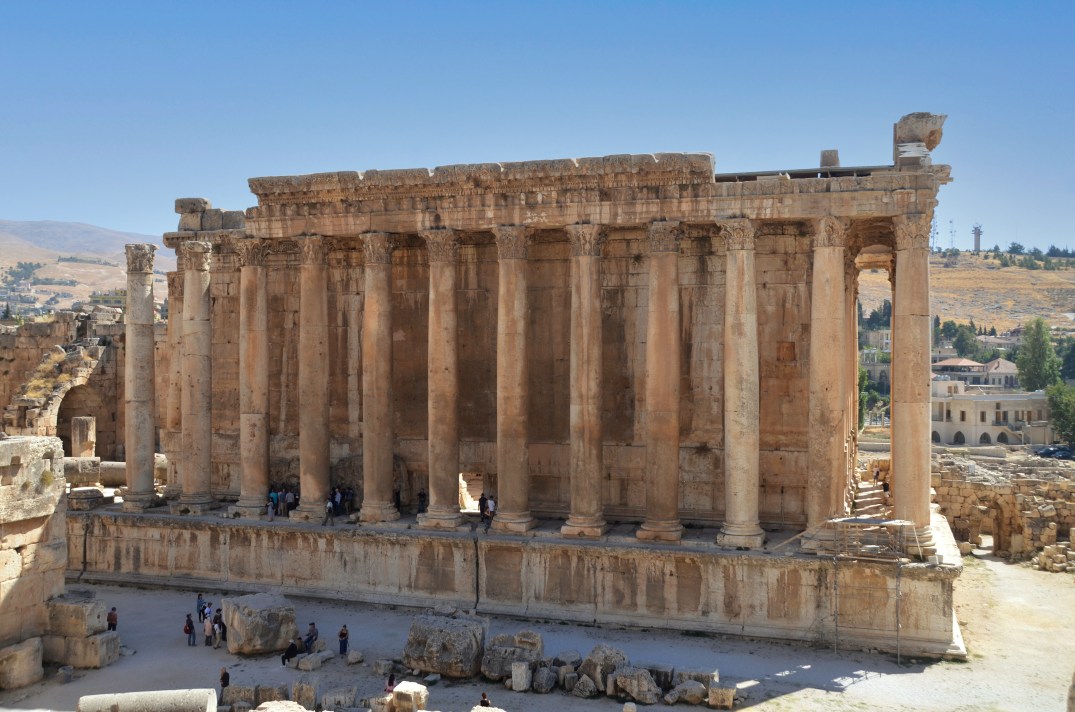
The final construction phase at the sanctuary occurred in the early 3rd century AD during the reign of Emperor Septimius Severus. This period reflects changes in the city’s political status and religious activities. The visit of Caracalla and his mother, Julia Domna, in AD 215 led to the construction of the Hexagonal Courtyard and the Propylaeum. These structures included three gilded-bronze column capitals honouring them, along with inscriptions on the column bases that mentioned Caracalla. Additionally, the Temple of Bacchus was constructed during this time. It was named after the god of wine, Bacchus, due to the Dionysiac motifs that decorated the structure. However, it is possible that the Temple was also used for the imperial cult, honouring gods such as Bacchus and perhaps Venus. The last building added to the complex was a small round temple, which was constructed on a tall podium.

A copper coin from the Heliopolis of Septimius Severus, with the Temple of Jupiter Heliopolitanus on the reverse and the legend COLHEL (Colonia Julia Augusta Felix Heliopolitana).

Quarries located approximately 1 kilometre south and west of the sanctuary provided local limestone for its construction. Additionally, granite was imported from Egypt and the Troad region in northwestern Anatolia to create hundreds of massive columns.

The Temple of Jupiter also functioned as an oracle. The 5th-century Roman author Macrobius noted that Trajan consulted the oracle at Heliopolis before embarking on his second Parthian campaign, where it predicted his imminent death. While it is not known if Hadrian ever visited Heliopolis, he spent considerable time in the region and made significant contributions to the temple’s completion and embellishment.

The rise of Christianity had a significant impact on Heliopolis-Baalbek. At the end of the 4th century, Emperor Theodosius I ordered the destruction of much of the sanctuary, including the construction of a church in the courtyard of the Temple of Jupiter. Additionally, the Round Temple was converted into a church. In AD 635, Baalbek was incorporated into the Islamic Empire. Between the 12th and 14th centuries, the preserved temple areas were integrated into a large fortress.

Scientific research on the ruins began in the early 17th century, focusing on detailed reproductions of the above-ground structures. However, systematic excavations did not commence until 1898, prompted by the visit of German Emperor William II. He was deeply impressed by the beauty and scale of the monuments and requested a thorough investigation and documentation of the site. Throughout the 20th century, German and French scholars, along with Lebanese professionals, worked to uncover and record the main sections of the ruins. Following the end of the civil war in 1991, archaeological investigations resumed. In 1997, a cooperative program was established between the Directorate General of Antiquities (DGA) and the Deutsches Archäologisches Institut (DAI).

PORTFOLIO
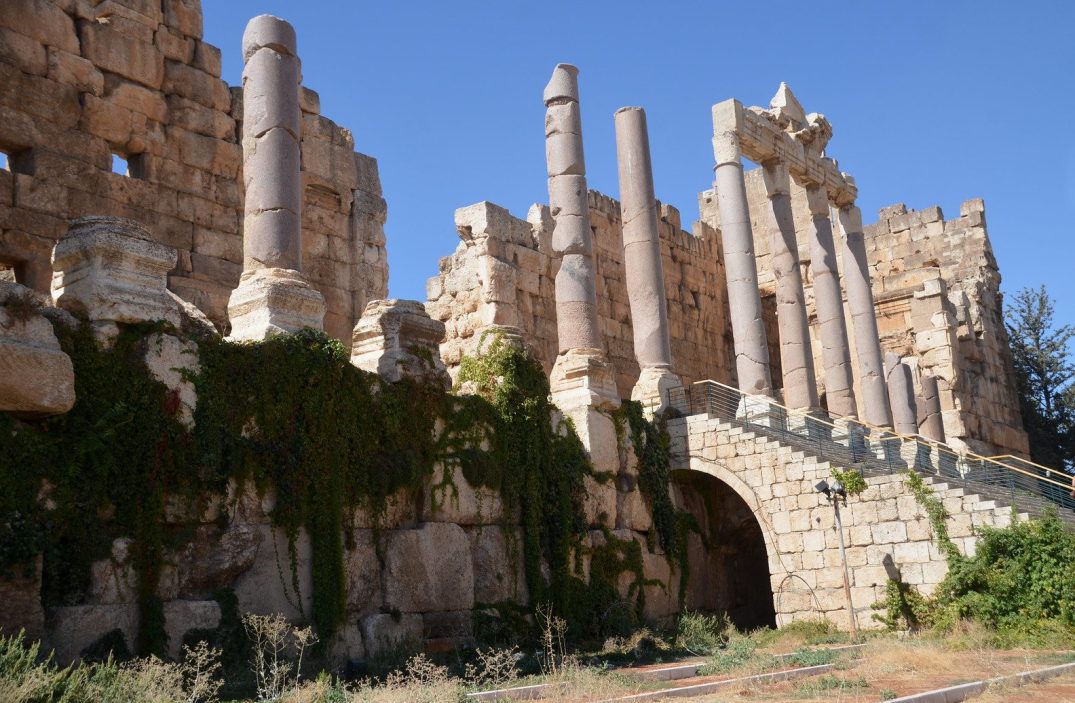
The Propylaeum. The ceremonial entrance was completed in the middle of the 3rd century AD.
The Propylaeum was 48 m wide and 11 m deep. It was flanked by two massive towers and, in front, by a row of twelve columns supporting the entablature.
One of the two towers flanking the Propylaeum still has niches with seashell bases for statues.
The Hexagonal Courtyard, the only example attested in Roman architecture, was built in the 2nd century AD.
The Hexagonal Courtyard served as a forecourt to the main, sacred Great Courtyard.
The hexagonal courtyard was roofed during the Byzantine period, and a covered way was added during the medieval period when the Temple was transformed into a citadel.
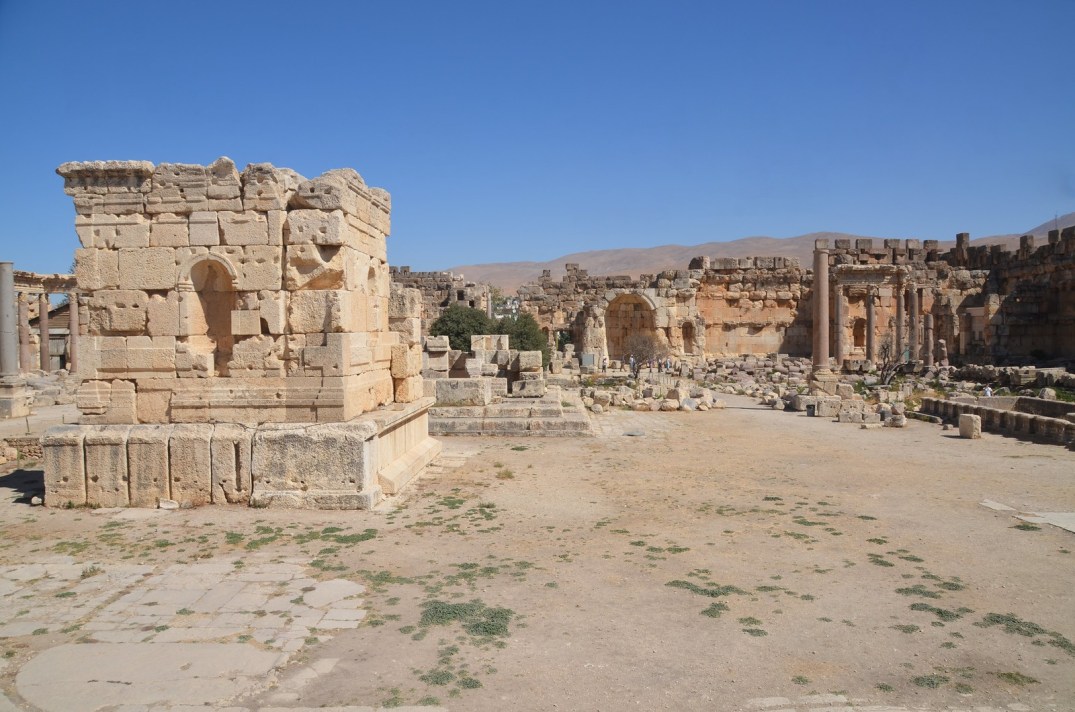
This is an overview of the Great Courtyard of the Temple of Jupiter Heliopolitanus, which has two monumental altars and two water basins within a porticoed enclosure. It covers a vast area of some 134m by 112m.
The northern portico and water basin in the Great Courtyard.
Architectural detail of the northern water basin; sea creatures and cupids are surrounded by two heads.
The porticoes surrounding the Great Courtyard were fronted by columns of pink granite from Egypt (84 in total). Behind this line of columns were several semicircular halls with two levels of niches for statues.

The two tower-altars in the Great Courtyard served as platforms for sacrifices. The Small Altar (right) was built at the beginning of the 1st century AD, while the Great Altar dates to the 2nd century AD. It must have been about 14m high.
The southern portico and water basin.

A dedication to the divine Vespasian by Antonia Pacata and her sister Antonia Priscilla.

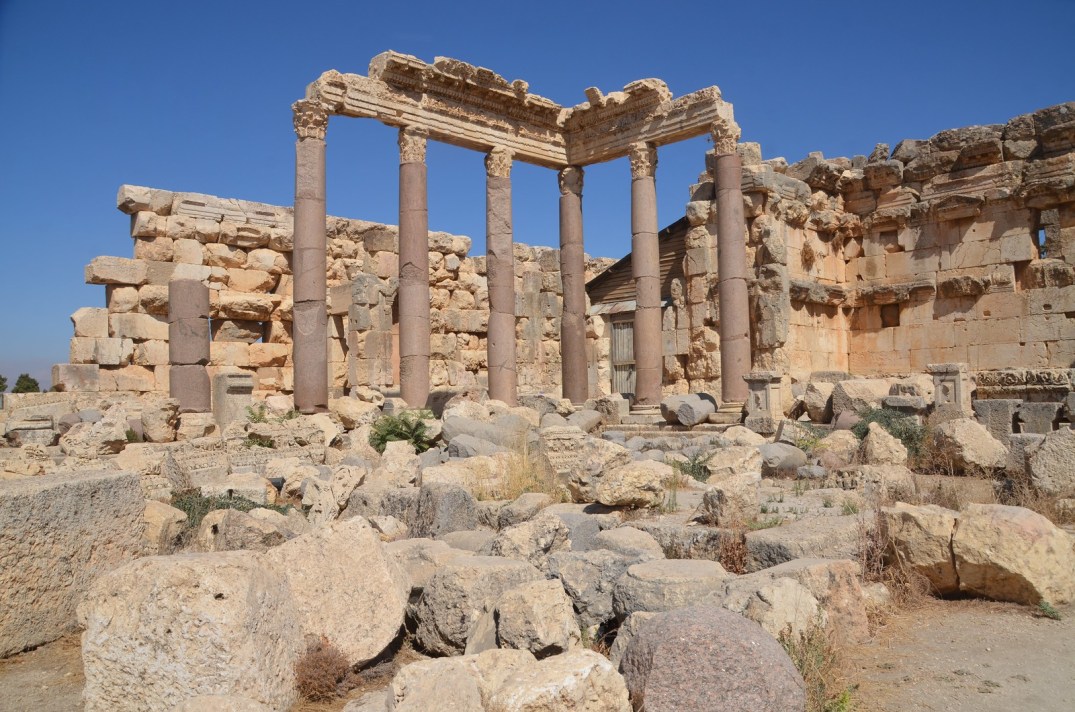
The colossal Temple of Jupiter was constructed on a podium 7m above the surrounding courtyard. It followed a peripteral Greek design of 10 by 19 columns in the Corinthian order. Only six original columns remain standing.
Enormous in size, the Temple of Jupiter was 53m wide and 94m long and reached by a flight of steps running the entire building width. It was one of the largest temples of the Roman period.
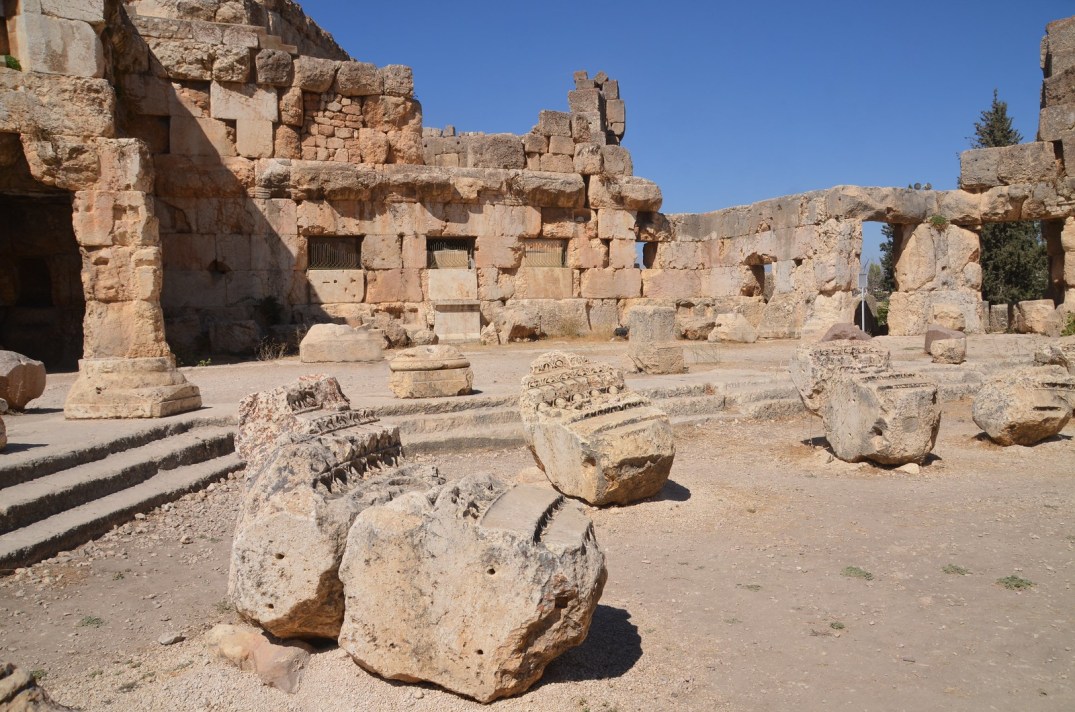
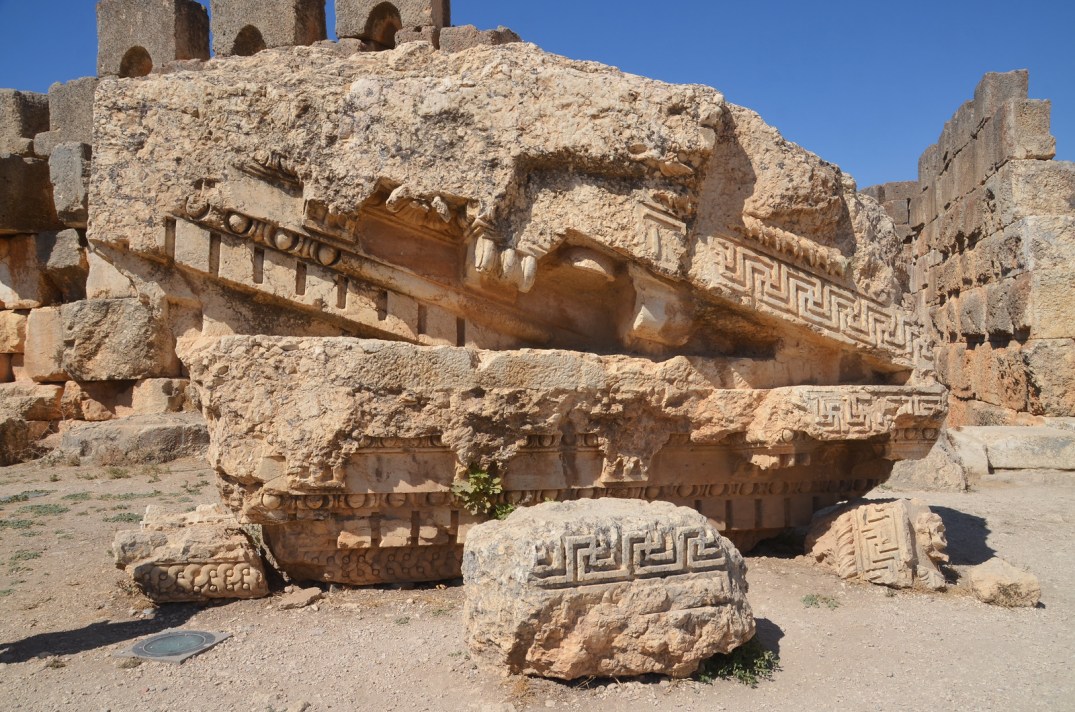
Fallen entablature from the Temple of Jupiter Heliopolitanus.
Lionhead gargoyle from the entablature of the Temple of Jupiter.
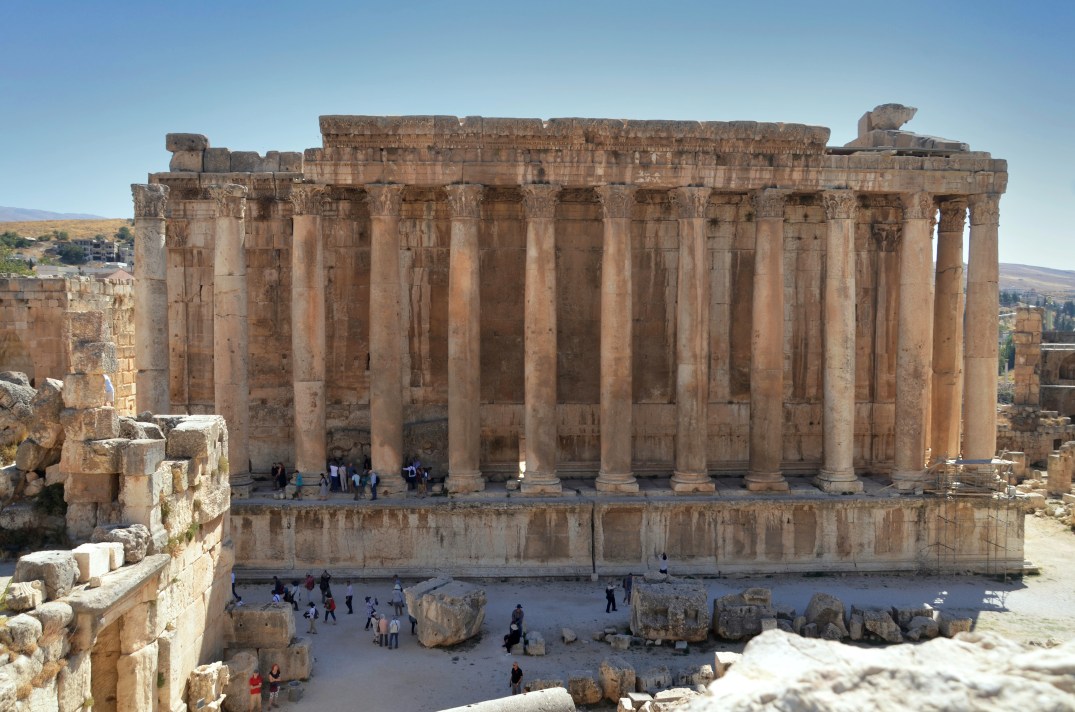
The so-called Temple of Bacchus was flanked on all sides by several 19m-tall Corinthian columns. It was built over a much earlier Phoenician structure.
Interior of the so-called Temple of Bacchus with its magnificent and highly ornamental entrance door.
In addition to its remarkable state of preservation, the interior of the so-called Temple of Bacchus is exceptional for its architectural decoration, including Corinthian columns and niches that originally held statues.
Interior of the so-called Temple of Bacchus.
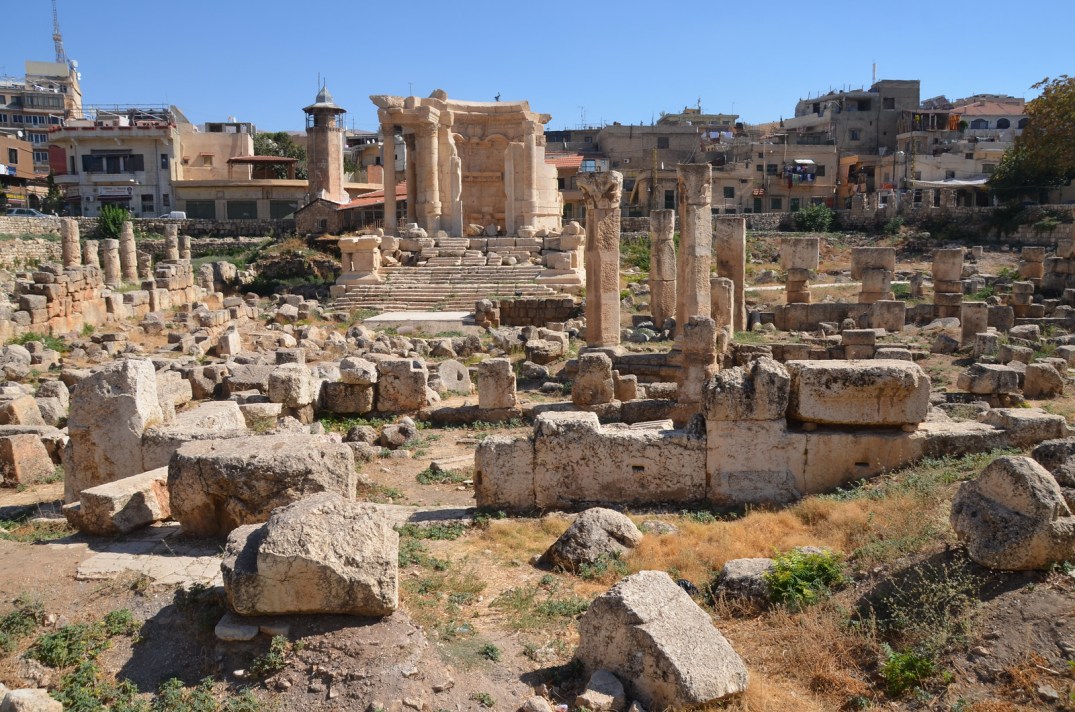
The Round Temple and the Temple of the Muses are located outside the sanctuary complex.

The Stone of the Pregnant Woman is one of the largest stone building blocks ever carved by human hands. It is 20.76 m long, 4 m wide, 4.32 m high, and weighs an estimated 1,000 tons. The stone block still lies in the ancient quarry near Baalbek.
The largest stone building block ever carved by human hands (still partly buried) is 19.60 m long, 6 m wide, and 5.60 m high and weighs an estimated 1,650 tons. The stone blocks were presumably intended for the nearby gigantic Roman Temple of Jupiter.

Links:

Temple of Antas

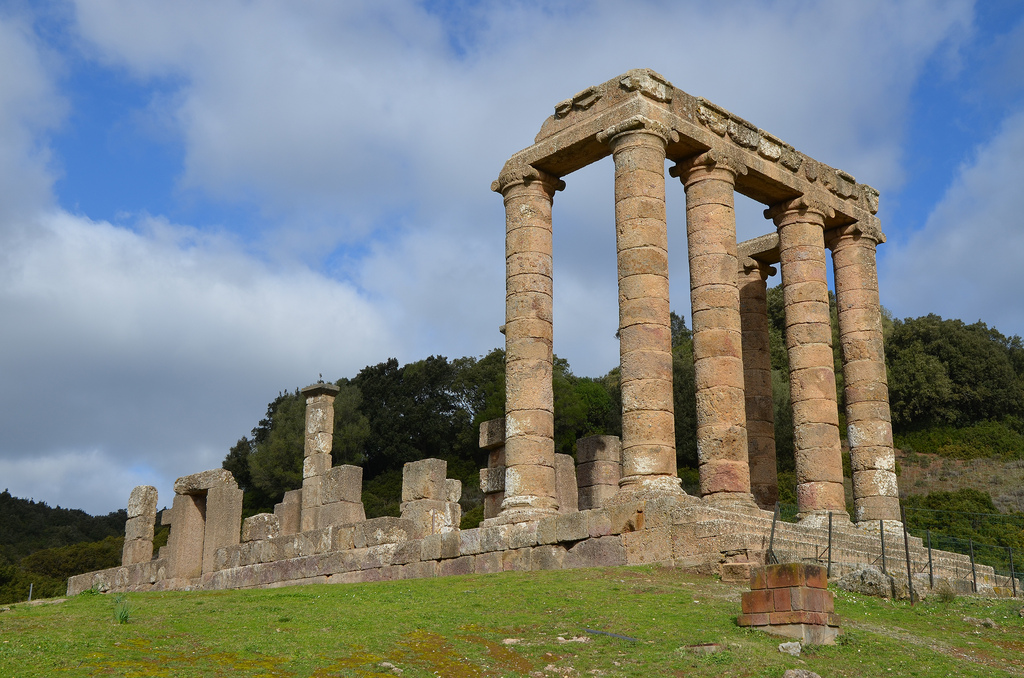
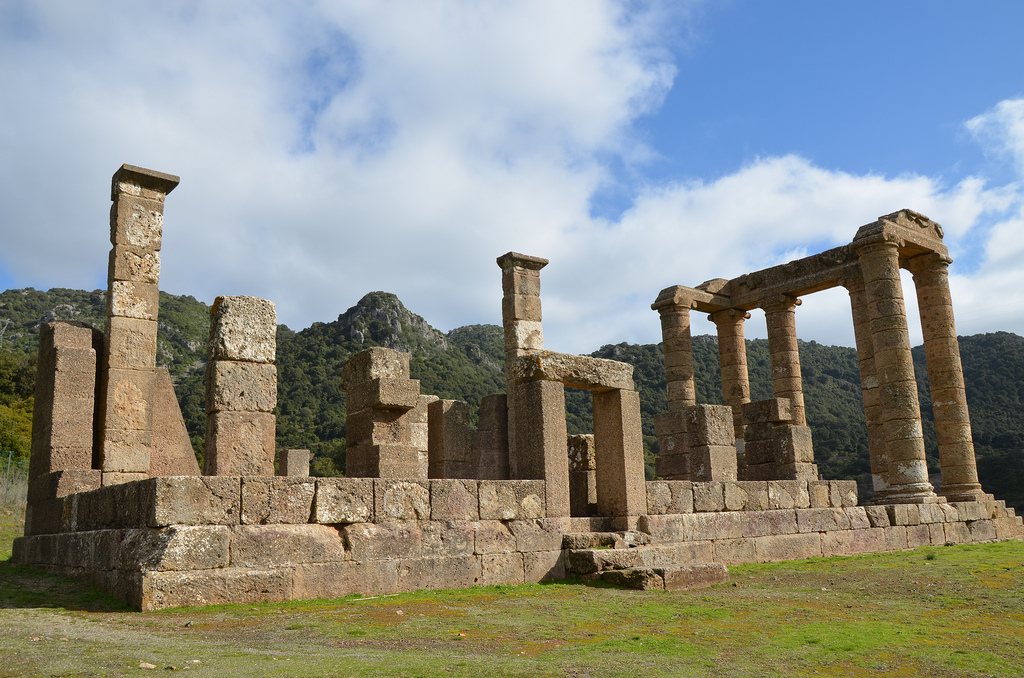
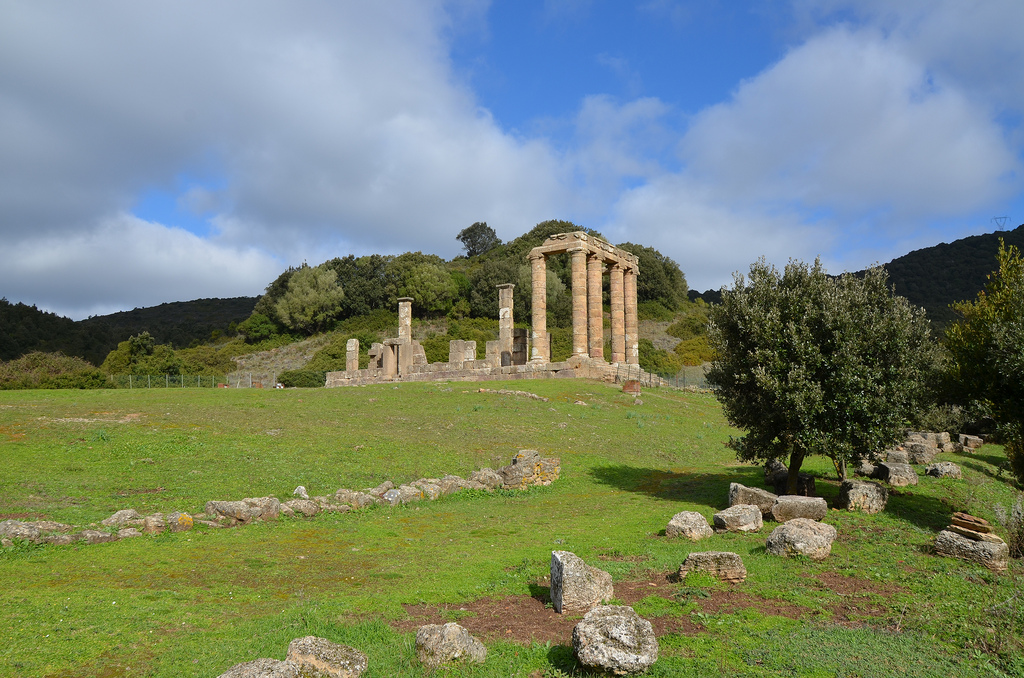
The Temple of Antas is an ancient Punico-Roman temple in the commune of Fluminimaggiore in southern Sardinia. After lying abandoned for centuries, the temple was discovered in 1838 and extensively restored in 1967. The present visible structure dates to the 3rd century AD on a floor plan from the Augustan age. Nestled in the middle of the Iglesiente mountains, the ruins of the temple offer visitors a truly majestic sight.

Coordinates: 39° 23′ 38.4″ N, 8° 30′ 0.72″ E

The area, rich in silver, lead and iron, was originally a Nuragic necropolis in use in the early Iron Age (9th-8th century BC) and was identified probably as a sanctuary. The god worshipped here was Babai, the main male divinity of the Nuragic civilisation. Attracted by its metal deposits, the Carthaginians colonised the area at the end of the 5th century BC. They built a temple in honour of the Punic deity Sid Addir, the god of warriors and hunters, who personified the indigenous god worshipped in the nearby Nuragic sanctuary. Its construction was divided into two phases: the more archaic dates back to 500 BC when the place of worship was made up of just a simple rectangular cella (sacred enclosure) where a rock served as a sacred altar. Later in approximately 300 BC, a series of transformations began. The area has produced numerous fragments of Punic sculptures and a large number of dedicatory inscriptions. Some remains of the Punic temple can be seen in front of the temple, which were covered in Roman times by a broad staircase.

The Roman temple was built on the site of its Punic predecessor, and the Romans, in turn, identified the Punic deity as Sardus Pater. Both Sallust and Pausanias record that Sardus was the son of Hercules, who migrated out of the land of Libya to settle on the island of Sardinia, which he called after himself. Under the Roman emperors, the cult of Sardus was encouraged because, in Rome, there was a temple dedicated to Hercules on the Forum Boarium, which made a strong connection between Sardus and Rome.

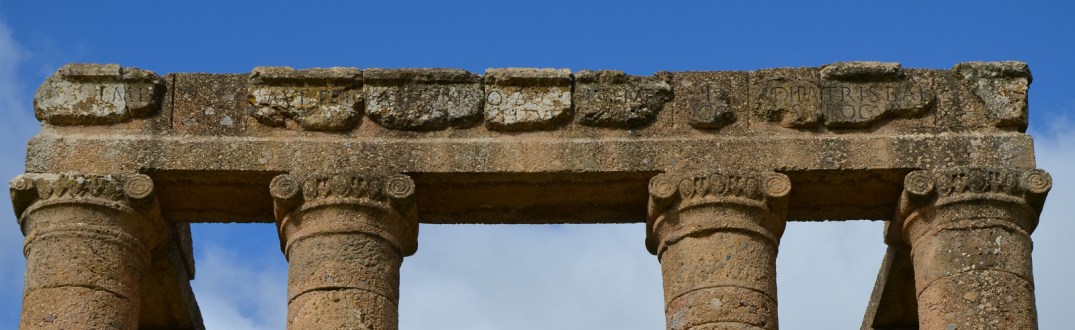
The temple was built on a podium accessible by a broad flight of steps on the front side consisting of various levels. On the fourth level stood the altar, where sacrifices were made according to Roman rituals. The podium was 20 m long and was divided into three parts; the pronaos, cella and adyton. The pronaos had four Ionic columns (tetrastyle) upholding the main beam that contained a Latin inscription: Imp(eratori) [Caes(ari) M.] Aurelio Antonino. Aug(usto) P(io) F(elici) temp[(lum) d]ei [Sa]rdi Patris Bab[i/vetustate c]on[lapsum] (?) [—] A[—] restitue[ndum] cur[avit] Q (?) Co[el]lius (or Co[cce]ius) Proculus

The inscription reveals that the temple was restored under the emperor Caracalla and dedicated to the god Sardus Pater Babi, the forefather of the Sards, by a man called Proculus. This dates the restoration phase to around 215 AD, but the Roman version of the temple could have been built as early as 27 BC under Augustus.

At approximately 1 km from the temple are the Roman quarries from which limestone boulders were extracted and used for the sanctuary’s construction. The work was carried out with a hammer and chisel, while the transport was probably made by carts pulled by oxen. The line cuts followed to extract the limestone blocks are still visible.

PORTFOLIO

In front of the temple are the excavated structures belonging to the Punic phase of the temple.
The columns of the pronaos had a height of approximately 8 meters and were built of local limestone with attic bases. They were surmounted by Ionic capitals.

The Latin inscription in honor of Caracalla.
The Latin inscription in honour of Caracalla.

The cella, the central hall of the temple, had large pillars leaning against the perimeter walls supported by roof beams. Its floor was covered with a black and white mosaic of which only part has survived.
The cella, the central hall of the temple, had large pillars leaning against the perimeter walls supported by roof beams. Its floor was covered with a black and white mosaic of which only part survived.
At the back of the temple was the adyton. It was divided into two rooms, each with their own entrance and in front of their doorway two square water basins on the floor which contained holy water for purification ceremonies (ablution).
At the back of the temple was the adyton. It was divided into two rooms, each with its own entrance, and in front of their doorway were two square water basins on the floor containing holy water for purification ceremonies (ablution).

Roman quarry near the Temple of Antas.

The temple’s isolated position in a fertile valley makes it an enchanted place to visit and offers visitors incredible natural scenery. It is one of the island’s most impressive and exciting archaeological remains.

Opening times:
– from July to September, every day from 9.30 to 19.30
– from April to May and October from 9.30 to 17.30
– June from 9.30 to 18.30
– from November to March from 9.30 to 16.30 except Monday

Links: