Claros

Claros was an ancient Greek sanctuary situated on the coast of Ionia between Smyrna and Ephesus. It belonged to the city of Colophon and was a significant centre of prophecy, as in Delphi and Didyma. The sanctuary contained a temple and oracle of Apollo, who was worshipped here as Apollo Clarius. People from far and wide visited this place to seek guidance and prophecies until the end of the 4th century AD. Hadrian visited the sanctuary and contributed considerably to the temple’s reconstruction.

Coordinates: 38°00’18.0″N 27°11’34.0″E

The cult centre at Claros was a complex devoted to multiple deities, including Artemis, Leto, Dionysus, and Apollo. It was part of the territory controlled by the Ionic city of Colophon, one of the oldest of the twelve cities of the Ionian League. The religious area was constructed around a freshwater spring during the Archaic Period, but there is evidence of a pre-Greek use of the site with a possible Hittite origin. The first known construction is a round altar that dates back to the second half of the 7th century. It was later replaced by a large rectangular altar measuring 14.85 × 6.05 m. In the middle of the 6th century AD, a marble temple was built for Apollo around the spring. Artemis also had her own precinct and a smaller altar measuring 3.50 × 150 m. Later, in the 3rd century AD, construction began on the new altar and the new temple of Apollo, which had a crypt-like adyton from where the oracle delivered his prophecies.

Claros, alongside Didyma, was one of the two major oracular centres in western Asia Minor during the Graeco-Roman period. However, the origins of cultic activity Claros is the oldest in the region. The earliest mention of Claros is in the Homeric Hymn to Apollo (see here) from the 7th century BC. During this period, several altars and a marble temple dedicated to Apollo were constructed near a sacred spring. Later, in the 3rd century BC, various significant structures and cult statues of Apollo, Artemis, and Leto, along with a larger Doric Temple of Apollo, were built.

Larger-than-life seated statue of Homer from the Sanctuary of Apollo at Claros.
İzmir Art and Sculpture Museum.

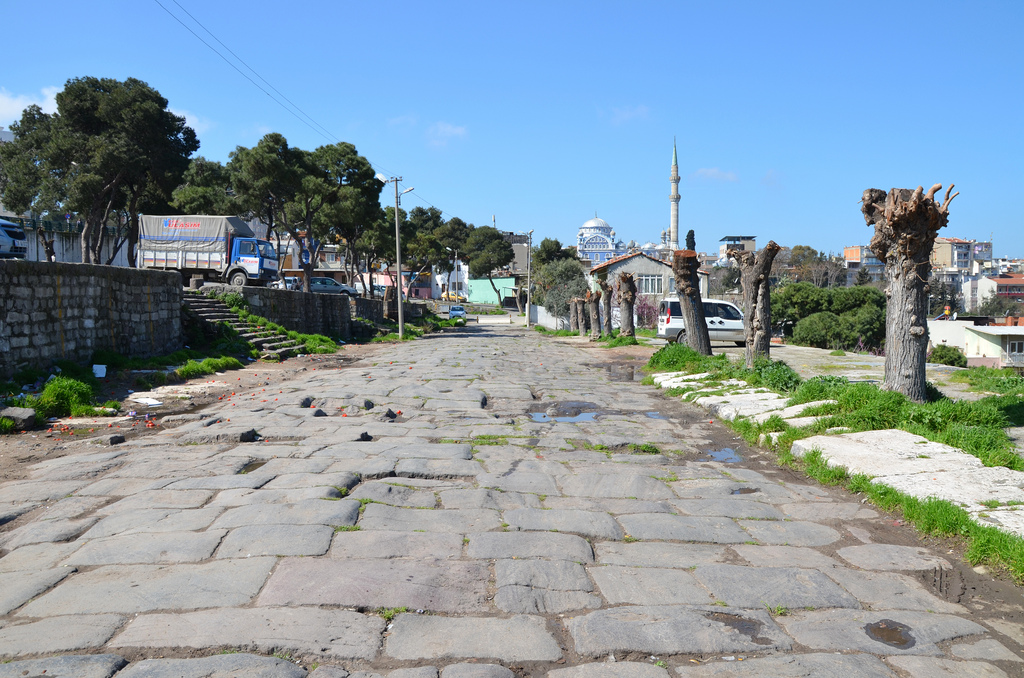
During the 7th century BC, an ancient Sacred Way connected Claros with Colophon and Notion. This route was used for several centuries, at least until 294 BC. The road was decorated with Kouros and Kore statues on both sides. Near the main altar, an impressive array of statues honouring Roman officials lined the Sacred Way in Claros. Some of the individuals commemorated included Pompey, Cicero, and Octavian, who was likely honoured after his Actium victory. Other honorees were Sextus Appuleius II, the half-nephew of the Roman emperor Augustus, L. Valerius Flaccus, the governor of Asia in 61/2, his father (consul 86 BC), and his uncle C. Valerius Flaccus, who was Asia’s governor in the 90s.

Kouros statue from the Sacred Road that connected Claros with Colophon and Notion. Dated to the Archaic Period.
Izmir Museum of History and Art.

The oldest piece of information about the function of the Temple of Apollo in Claros dates back to the Hellenistic Period. According to the Greek historian Pausanias, Alexander the Great had a dream in which he was directed to establish a new city at the base of Mt. Pagos (Smyrna). The Smyrnaeans asked for the interpretation of the dream from the Apollo oracle at Claros, and the oracle replied with a prophetic phrase: “Thrice and four times happy will those men be, who are going to inhabit Pagos beyond the sacred Meles.” As a result, New Smyrna was founded, becoming one of the most prosperous cities in Asia, while the old city of Smyrna was abandoned.

The oracular sanctuary of Apollo Clarius was a sacred place for devotees and visitors seeking divine wisdom and insight. According to inscriptions and literary texts, there were special nights on which consultations would occur, and people would gather at the temple of Apollo. During these nights, a procession of consultants would take place, sacrifices would be made, and hymns would be sung to seek answers from the divine. The Lesser and Greater Claria were two significant festivals that took place every fifth year in the Hellenistic Age, attracting visitors and generating substantial revenue for the sanctuary.

During the early days of the Roman Empire, the Clarian oracle became very popular, attracting a large number of visitors who sought its counsel. The prophecies were highly regarded by rulers, individuals and cities, and their fame was worldwide. For instance, some towns addressed famine and field infertility issues, others about coping with plagues or pirate and bandit attacks. Individuals and delegations from the entire Eastern Mediterranean and beyond sought the oracle’s guidance at Claros.
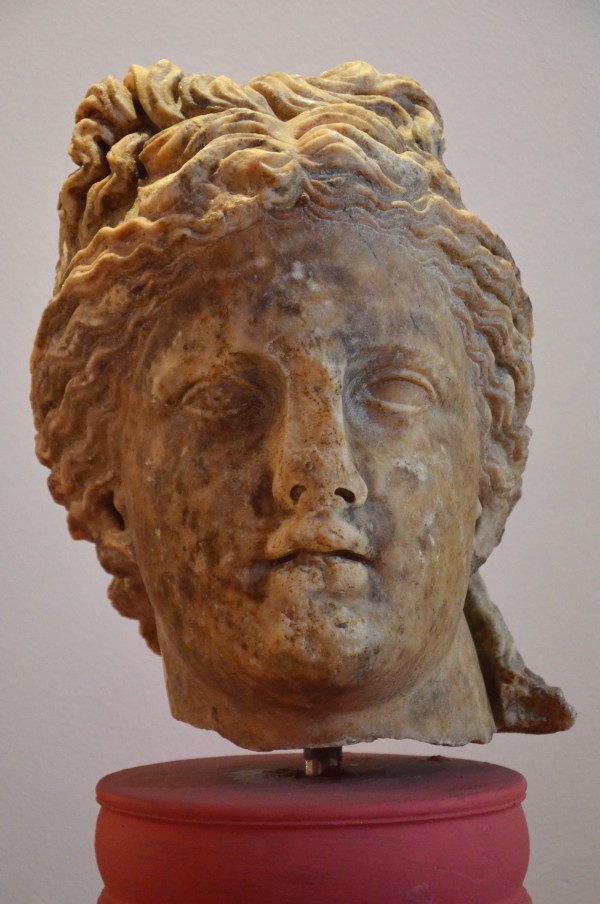
Head of Apollo from Claros. Dated to the Late Hellenistic Period.
Izmir Museum of History and Art.

In AD 18, Germanicus visited the oracle during his travels in the East and received a shocking prediction. The seer predicted that he would soon meet his end. This prediction came true just a year later when he passed away in Syrian Antioch (Antakya) at the young age of 34. Tacitus, a Roman historian who had likely visited the same oracle himself ten years prior as proconsul of Asia, described the procedure for receiving an oracle. He was surprised to discover that, unlike Delphi, no priestess was present but a male priest who spoke on behalf of Apollo (Tac. Ann. 2.54).

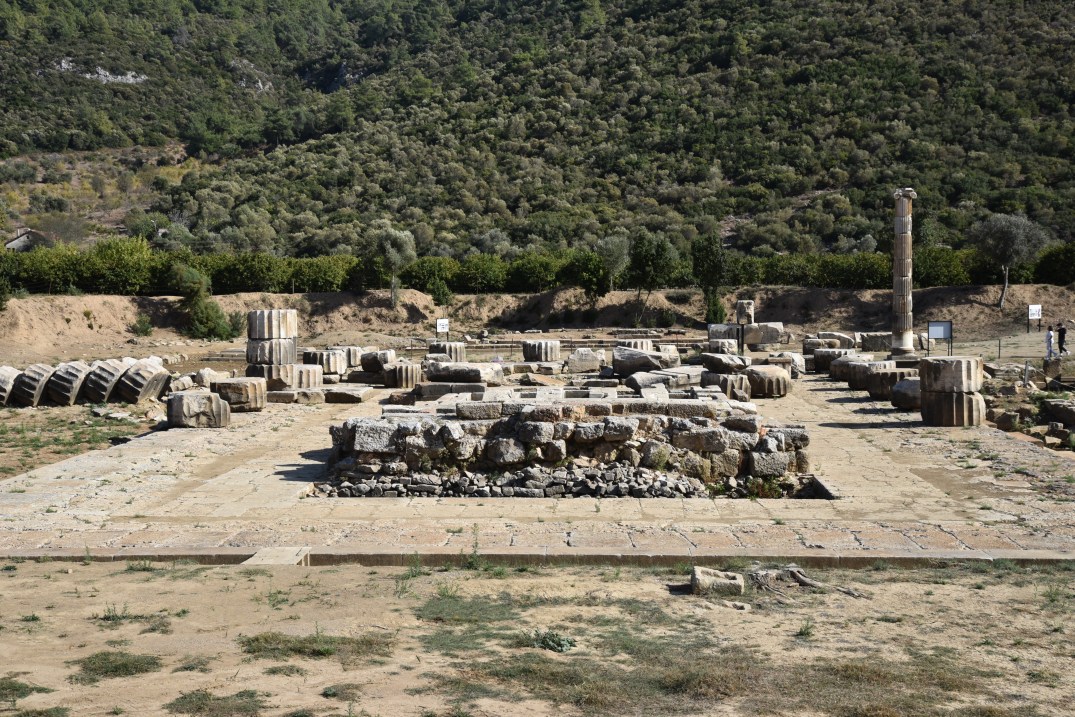
The oracular sanctuary consisted of various buildings, such as the temple itself, an altar, treasuries, and other structures that were associated with the oracle’s activities. The temple was built between the 4th and 3rd centuries BC on the site of an earlier sacred building and was restored during the reign of Hadrian. The new temple was constructed on a five-stepped platform with dimensions of 26 × 46 m and had six columns on the narrow sides and eleven on the long sides.

Plan of the Temple of Apollo at Claros.

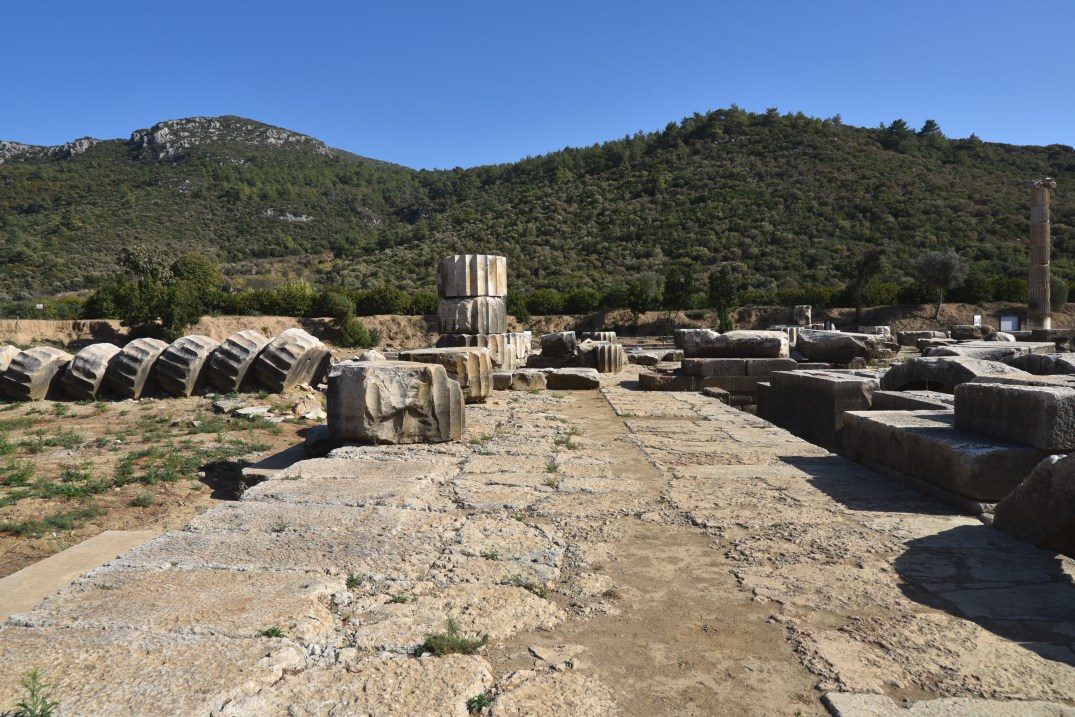
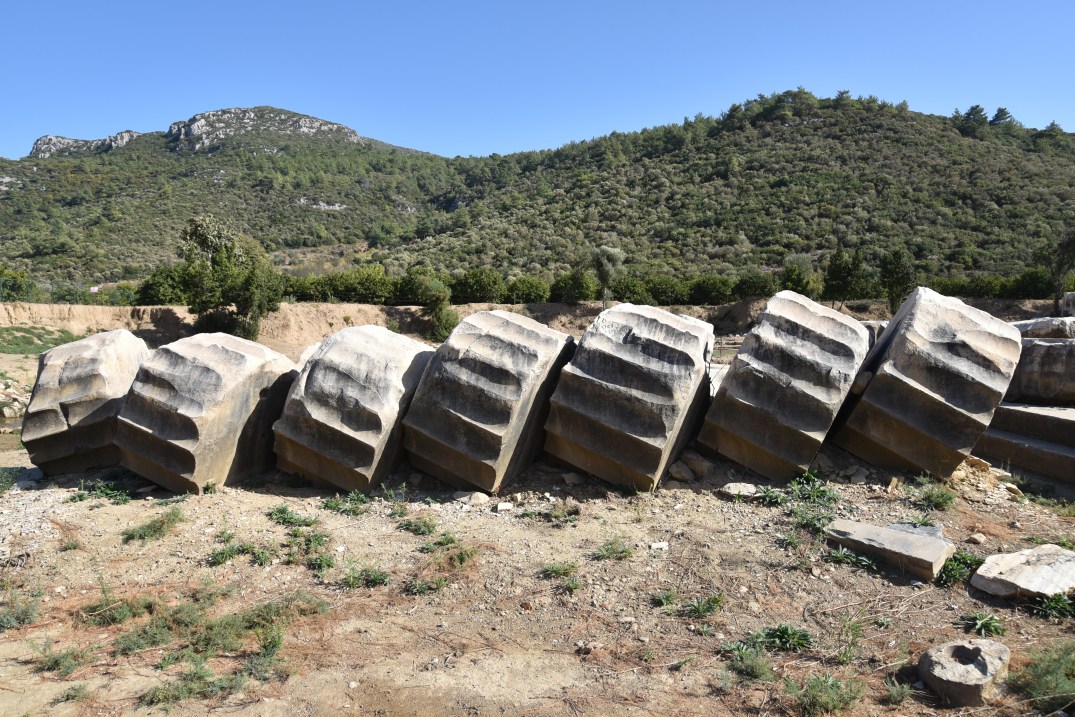
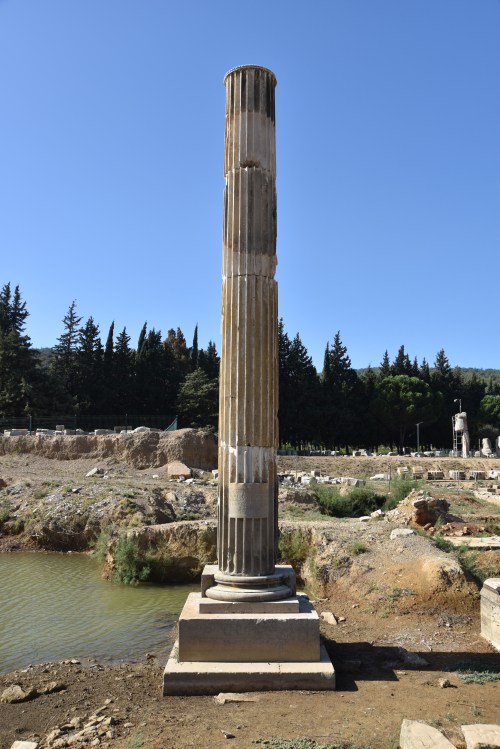
The rectangular-shaped temple had sides measuring 26 and 46 meters. There were 11 columns on the longer sides and six on the shorter ones, all in the Doric order. The diameter of the drums of these columns was up to 1.6 meters, and archaeologists have discovered seven capitals and around 150 drums. The temple complex included a sacred spring and a cave where the oracle would deliver prophecies in a trance-like state. After an oracle was pronounced, the believers wrote a votive and memorial text referencing the priests and praising Apollo. Over time, hundreds of inscriptions covered the temple’s columns, steps and walls, making it one of the largest corpus of surviving Greek inscriptions.
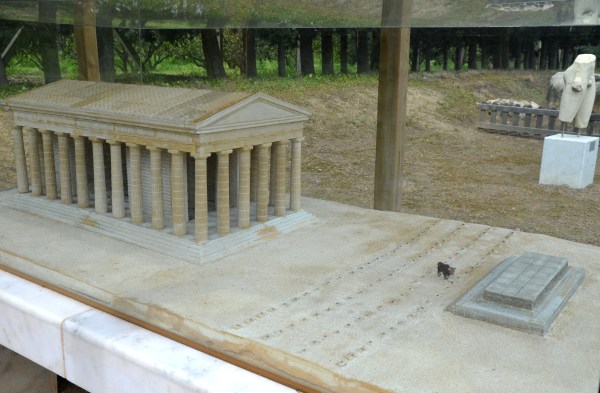
Model of the Temple of Apollo Clarius and the Altar.

Numerous monuments were constructed during the Roman Period, and recent excavations have revealed that the sanctuary underwent significant modifications during the first half of the 2nd century AD. Hadrian played a vital role in restoring the temple. A fragmented dedication of the temple of Apollo mentions Hadrian as the dedicator. The emperor visited Ionia in AD 124 and 129. The decision to restore the temple at Claros was likely taken during one of these visits, while the terminus post quem for the restoration of the temple is December 135. However, the temple was still not completed thirty or forty years after Hadrian’s death. Pausanias (7.5.4) mentions that the sanctuary of Apollo at Claros, along with that of Didyma, were unfinished buildings.

Hadrian is known to have supported oracles, and during his reign, Delphi saw a short-lived revival via his patronage. Hadrian’s visit to Claros suggests his profound interest in religious and cultural sites. He likely participated in rituals, made offerings, and sought advice from Apollo’s oracle.
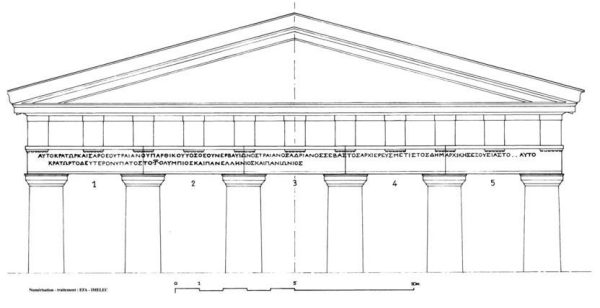
Restitution of the Hadrianic inscription.
Αυτοκράτωρ Καΐσ[αρ θεού Τραιαν]οΰ Παρθικού ύός θεού Νέρβα υίω[νός Τραϊανός Αδριανός Σεβαστός, άρχιερεύς μέγιστος,] δημ[αρχικής εξουσίας το (–), αύ]το κράτωρ το δε[ύτερον, ύπατος] το (τρίτον), ‘Ολύμπιος και Πανελλήν[ιος και Πανιώνιος — ]
The eponymous prytanis (local magistrate) of Colophon was responsible for the efficient functioning of the shrine and simultaneously served as the eponymous official of Claros. Two inscriptions evidence that Hadrian agreed to be the eponymous prytanis. Lucius Aelius Caesar, Hadrian’s first adopted son, also held the prytany.

Claros gained increased prominence after the Antonine Plague of AD 165-180 when many eastern cities consulted the oracle in response to the disease. The oracle, along with the other Greek oracles, must have been closed in AD 395, when the emperor Theodosius banned its operation. Later, a strong earthquake destroyed the temple and the remaining buildings.

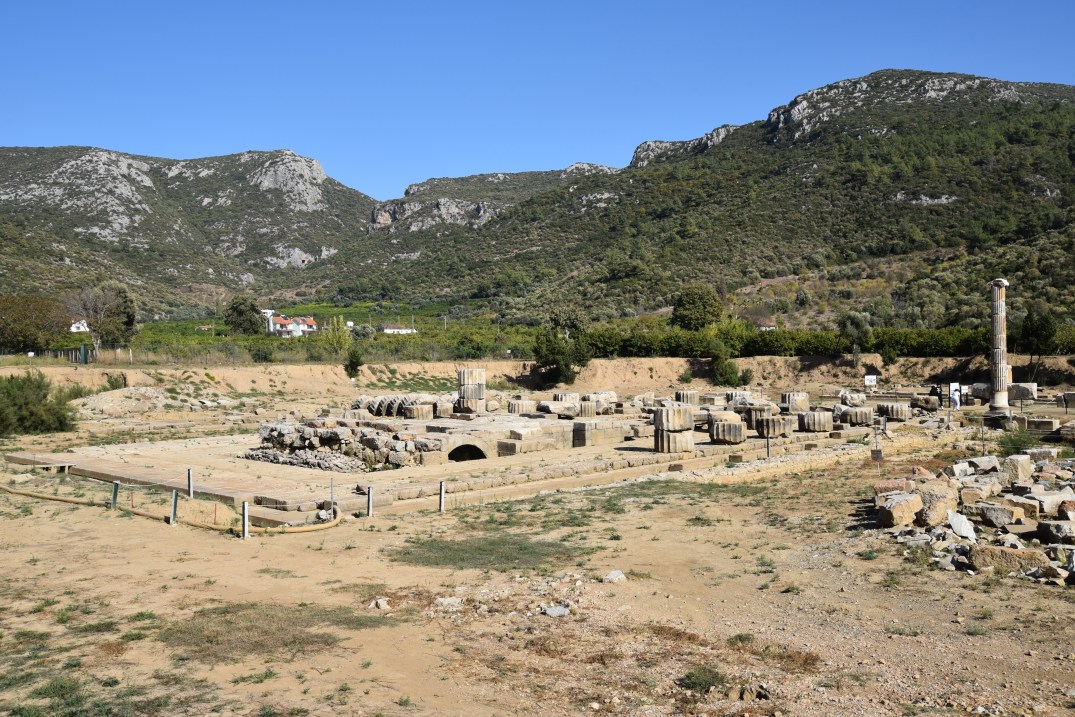
The sanctuary was discovered in 1907 by a German scholar named C. Schuchhard. Excavations started in the 1950s under the direction of Louis Robert, who uncovered the oracular chamber below the temple and several inscriptions related to its operation. Today, the ruins of Claros offer a glimpse into the religious practices and beliefs of the ancient world, preserving the legacy of this once-thriving sanctuary dedicated to the god Apollo. Above the ground, one can see the foundations of the temple and fragments of the colossal sculptures of a seated Apollo, accompanied by Leto and Artemis, which were over seven meters in height.

PORTFOLIO

The Proplyon. The monumental gate that led into the sanctuary.
The Katagogeion (hostel) is located south of the Sanctuary of Apollo. It contains twenty rooms, including a kitchen and a bathhouse. The Katagogeion was an inn for visitors who sought consultations with the oracle.
A well-preserved exedra, a semicircular recess where visitors sat and conversed, with lion claw ornamentation.

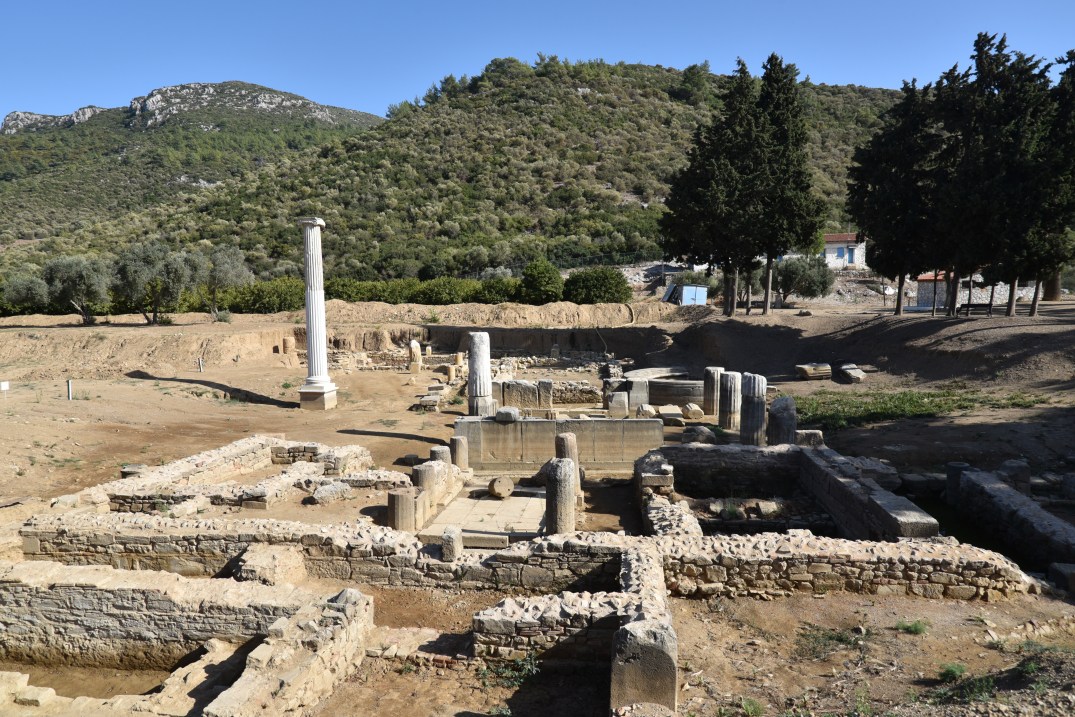
View of the ruins of the Doric Temple of Apollo from the south, with the base that held the colossal statues of Artemis, Apollo, and Leto in the foreground.
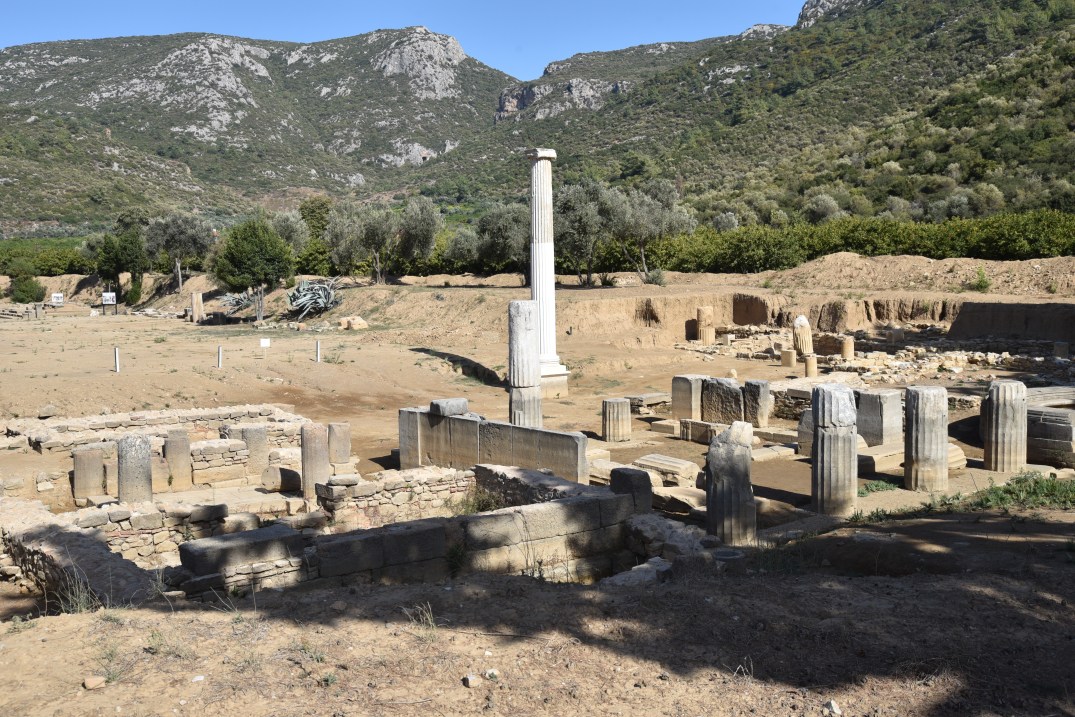
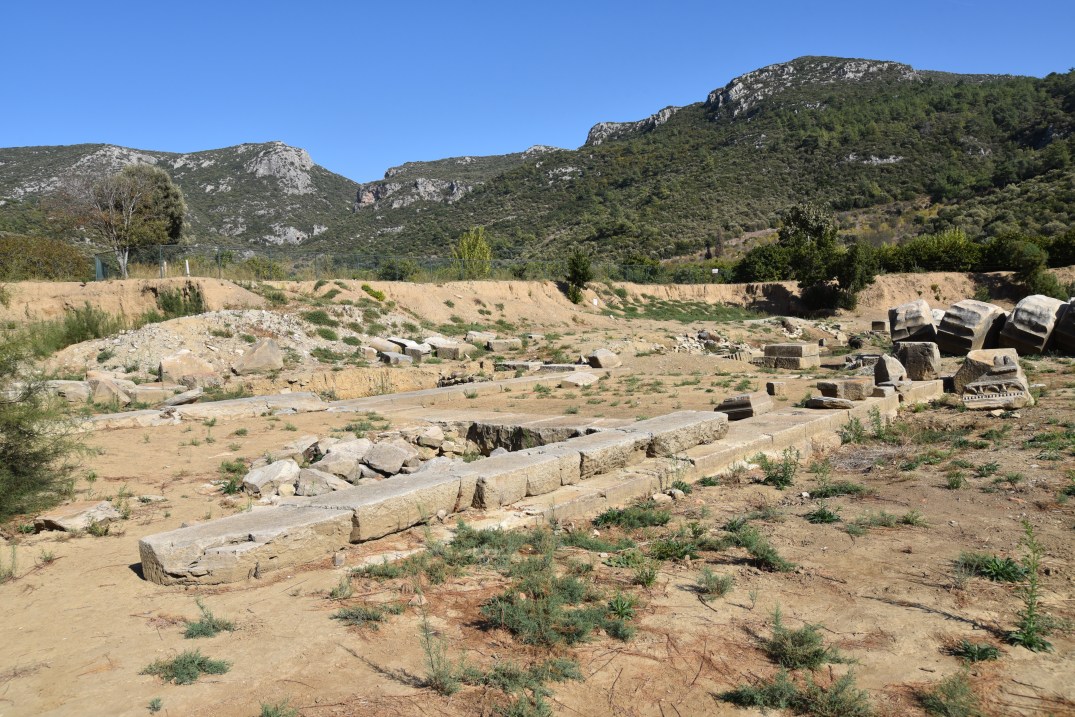
View of the ruins of the Doric Temple of Apollo from the southwest.

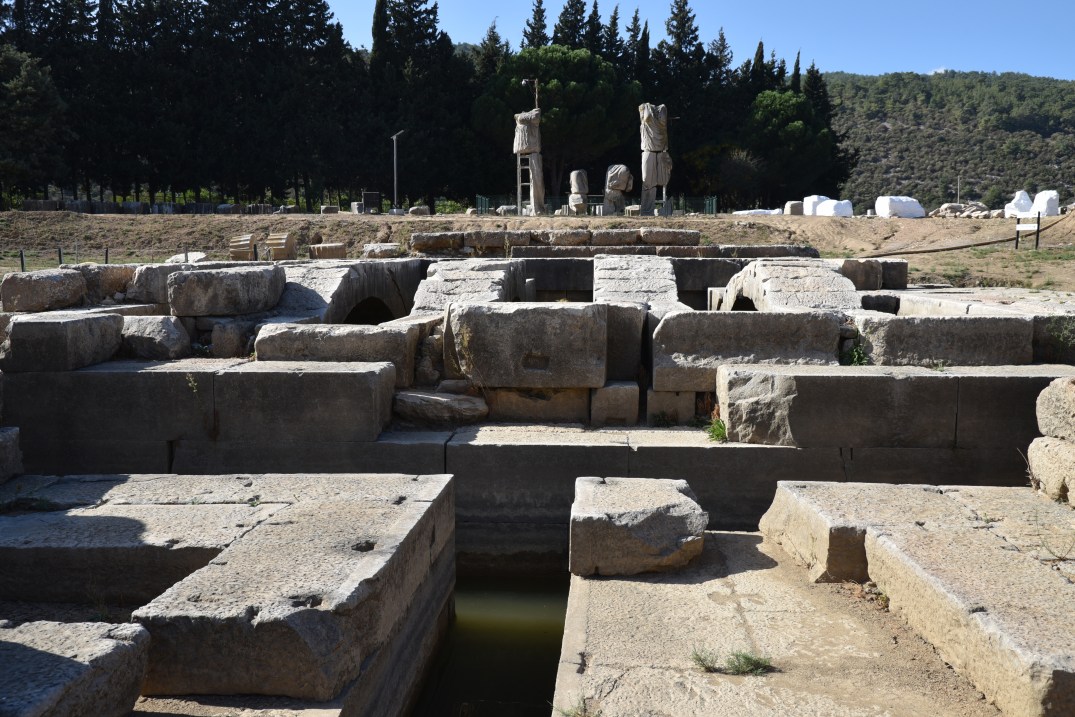
View of one of the two arched subterranean sacred rooms.
View of one of the two arched subterranean sacred rooms with the colossal statues of Apollo, Artemis and Leto in the background.
View of the ruins of the Doric Temple of Apollo from the southeast.
Column drums of the Temple of Apollo.
Part view of the ruins of the Doric Temple of Apollo.
The Monumental Altar of Apollo.
Hellenistic building dedicated to Artemis.
The Hellenistic altar to Artemis.
Three fragments from Hadrian’s dedication to the Temple of Apollo Clarios. Dated to between December 135 and December 136.
ΑΥΤΟΚΑΤΩΡΚΑΙΣ
ΚΡΑΤΩΡΤΟΔΕ
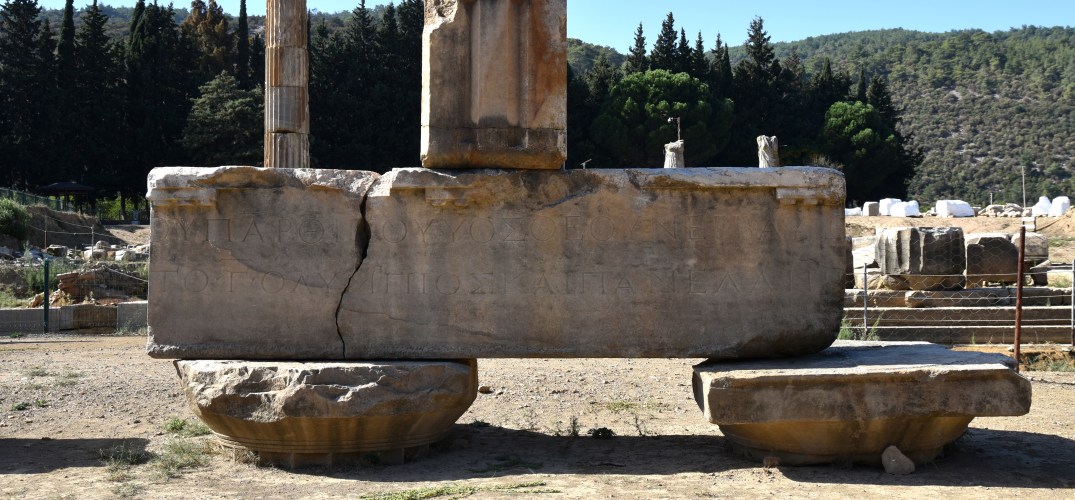
Two fragments from Hadrian’s dedication to the Temple of Apollo Clarios. Dated to between December 135 and December 136.
ΟΥΠΑΡΘΙΚΟΥΥΟΣΘΕΟΥΝΕΡΒΑΥΙΩ
ΤΟ.Γ.ΟΛΥΜΠΙΟΣΚΑΙΠΑΝΕΛΛΗΝ
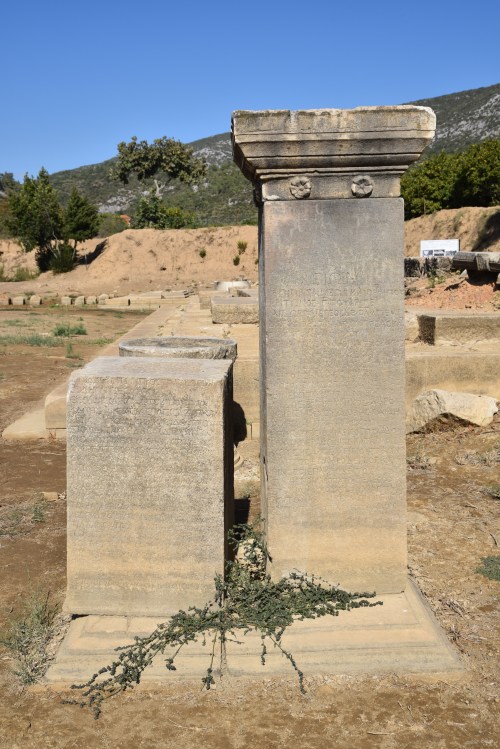
Square honorary monuments of the Flaccus Family and L. Valerius Flaccus and honorary columns of Sextus Appuleius and Menippos.

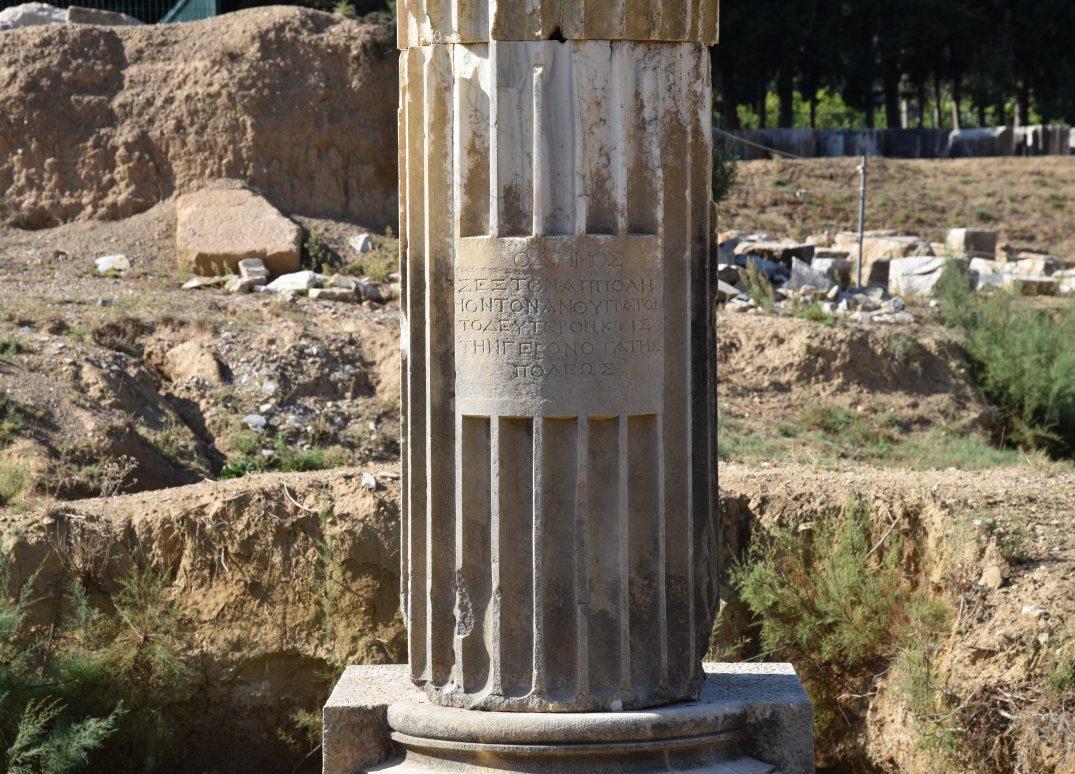
Corinthian column dedicated to Sextus Appuleius, son of Octavia, stepbrother to the emperor Augustus, and proconsul of Asia.
Greek inscription dedicated to Sextus Appuleius. The inscription reads:
‘People honours Sextus Appuleius who is the founder of the city and is elected as proconsul for the second time.’
Ό δήμος
Σέξτον Άππολή-
ιον τον άνθύπατον
το δεύτερον, κτίσ-
την γεγονότα της
πόλεως.
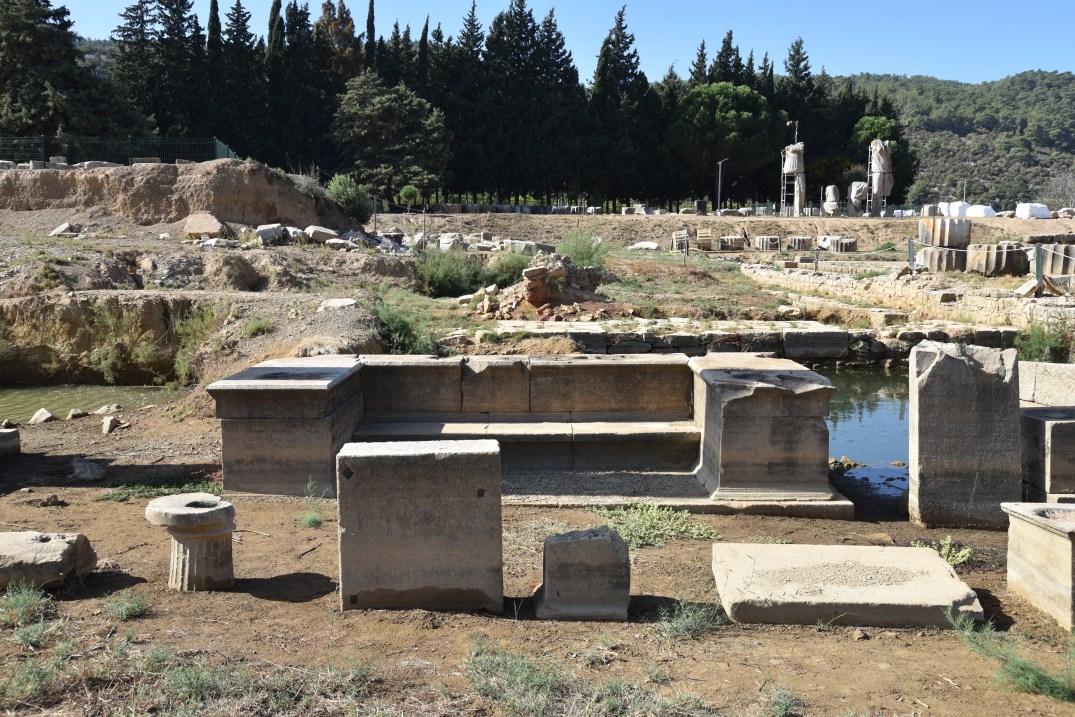
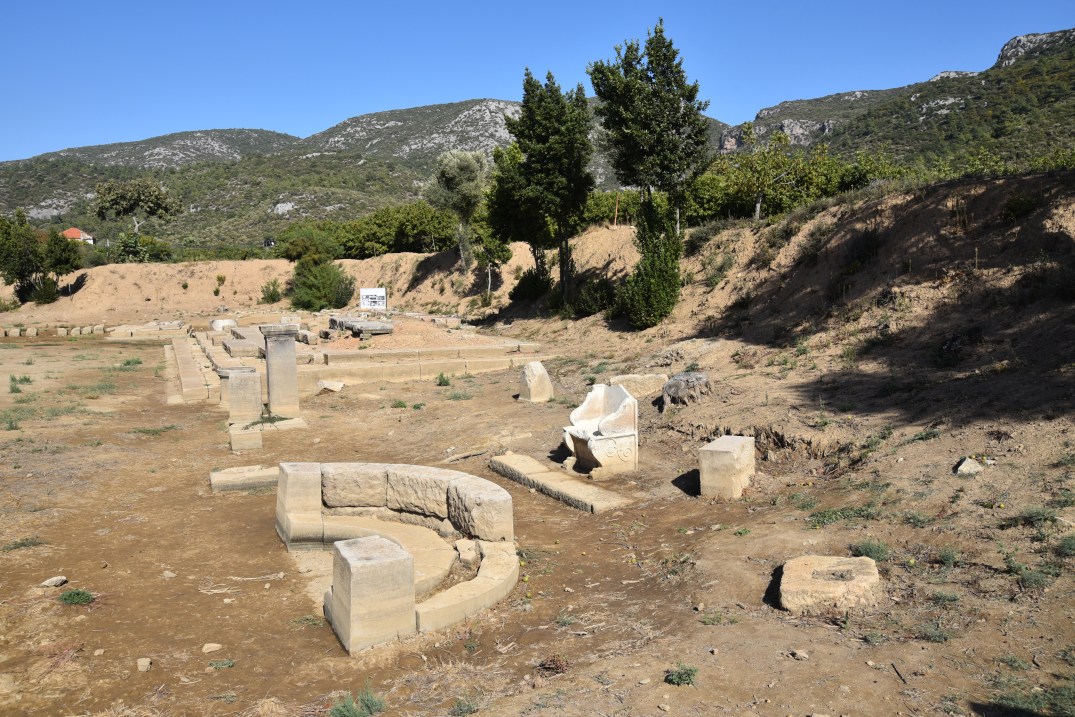
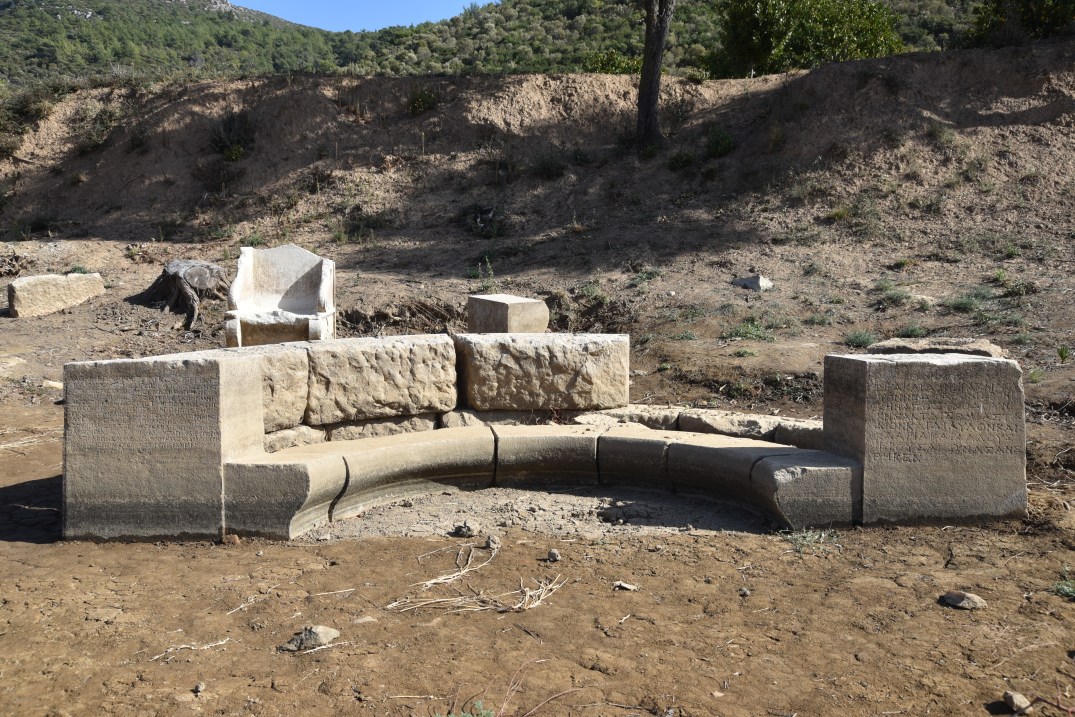
The Exedra of Roman Magistrates.
Hellenistic Sundial dedicated to Dionysus. The original is in the Izmir Archaeological Museum.

Small Exedra with two dedications.
Dedications on stone pillars.
Inscribed statue base.

Links:

Smyrna

Smyrna was an ancient Greek city and important seaport located at a central and strategic point on the western coast of Anatolia (today Izmir, western Turkey). The early Hellenic settlement lay on a small peninsula, inhabited since the beginning of the 3rd millennium BC, on the northeast coast of the Gulf of Smyrna. Excavations have brought to light some of the city’s most important ruins. Two sites of the ancient city are located within the boundaries of İzmir today. The first site, Old Smyrna, has a few Archaic Period remains on the northeastern side of the bay of Izmir. The second, known as New Smyrna and associated with the foundation of Alexander the Great, reached metropolitan proportions during the Roman Empire. Smyrna competed with Pergamon and Ephesus for the title “First City of Asia”, claiming to be the poet Homer‘s birthplace.

Coordinates: 38° 25′ 7″ N, 27° 8′ 21″ E

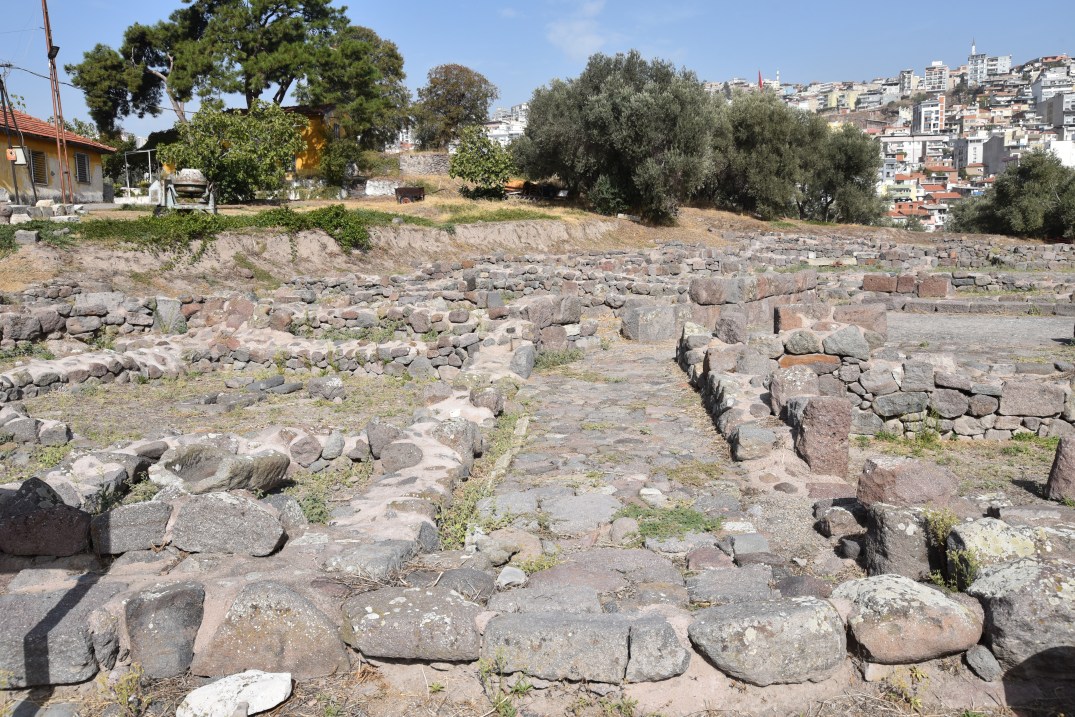
The Gulf of Smyrna was supposedly settled by Aeolians (Greeks from the sector north of Athens) at the beginning of the first millennium BC and later by Ionians (Athenians and their immediate neighbours). The site of the original settlement occupied an area of around 90,000 square meters and was inhabited for about 3,000 years until the second half of the 4th century BC. Smyrna’s principal place of worship was the Temple of Athena. Its ruins, located in the Bayrakli district of Izmir, date from 725-700 BC.

Old Smyrna was attacked by the Lydian king Alyattes around 627 BC and established control over the coastal communities. Alyattes destroyed the city and expelled its inhabitants, and henceforth, for 400 years, it was deserted and in ruins. The polis became a rural village, paying taxes to the Lydian king and subsequently to the Medes and the Persians.

Map of Old Smyrna.

In the time of Alexander the Great, a new, larger city was founded on the slope of Mount Pagus. According to legend, Alexander is said to have wanted to rebuild the city at this location. During one of his hunting expeditions on the slopes of Mount Pagus, Alexander, exhausted by the chase, fell asleep under a tree and had a dream in which two Nemeses instructed him to build a city on this very spot. And so Mount Pagus became the acropolis of New Smyrna. But Alexander did not live to carry this plan into effect; it was only accomplished by his successors, Antigonus and Lysimachus. New Smyrna was built at a distance of twenty stadia to the south of Old Smyrna.

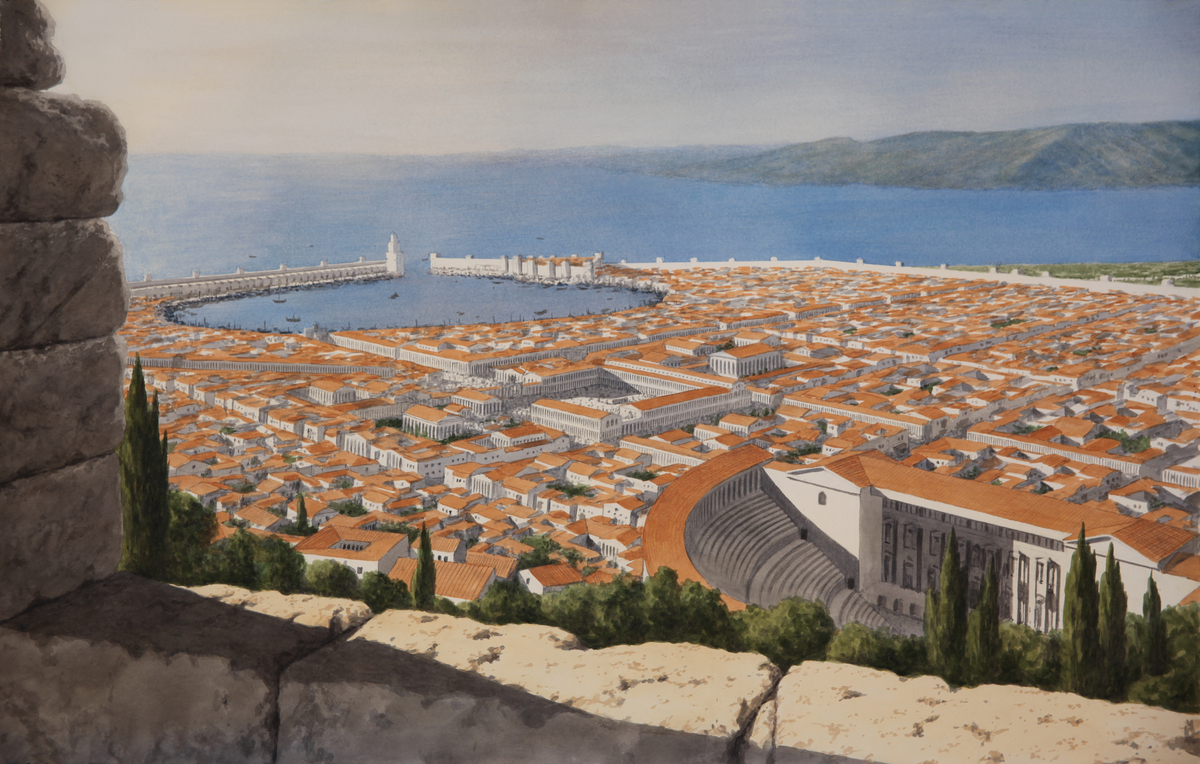
Smyrna in the Roman period, with the Acropolis of Mount Pagus.
Illustration by Balage Balogh / archaeologyillustrated.com

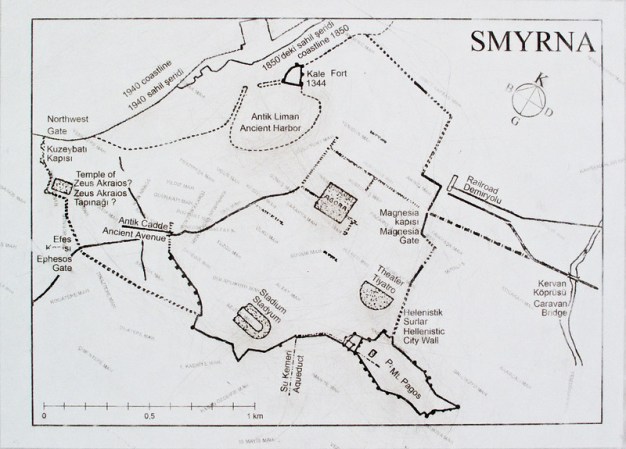
New Smyrna was built on the slopes and plains between the Acropolis Hill (Kadifekale) and the port (Kemeraltı), and the Agora of Smyrna was located at the centre of the ancient city. According to Strabo, the streets of New Smyrna were well paved with stone, and the city contained several squares, porticoes, fountains, a public library, and numerous temples and other public buildings. A temple dedicated to Zeus Akraios stood on the slopes of Mount Pagus. Smyrna also possessed a harbour where the Temple of the Mother Goddess and the gymnasium stood.

After the Roman Province of Asia was established in 133 BC, Smyrna was granted various privileges and honours for having sided with the Romans in the war against Mithridates. In AD 26, Tiberius granted Smyrna the privilege of building a local temple to the emperor (the first neokoria).

Map of New Smyrna.

The city became “twice neokoros” under Hadrian, whose benefactions to Smyrna exceeded all expectations. On a visit to the city in AD 124, Hadrian encountered one of the most renowned orators of his time, Antonius Polemon. Born in Laodicea, Polemon came to Smyrna as a youth to study rhetoric. He became the leading sophist of his generation and established his own school in Smyrna, attracting students from all over the Greek world. As a result of his fame, he became a prominent political leader and used his talents to benefit his adopted home.

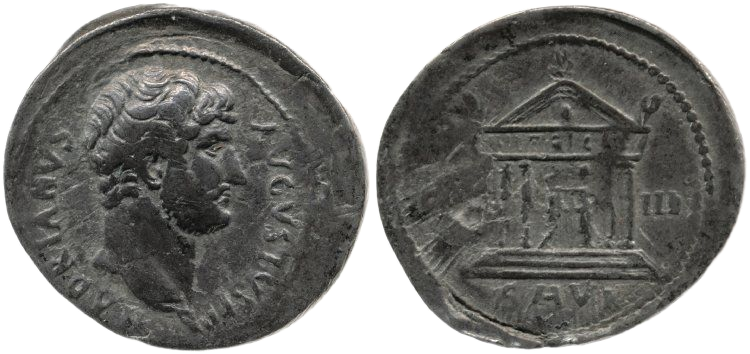
Thanks to Polemon’s intervention, Smyrna was allowed to build a second provincial temple dedicated to Hadrian. The façade of a hexastyle temple is seen on the reverse of the city coins struck under the administration of Strategos Sextus (RPC III, 1970). According to Philostratus, Polemon, who had won the emperor’s favour, persuaded Hadrian to spend “ten million” drachmae on Smyrna to reconstruct a grain market, a splendid gymnasium and a “temple that can be seen from afar”.

Silver coin of Hadrian minted in Smyrna.
(obverse) Bare head of Hadrian, right.
(reverse) Temple with four columns, within which the two Nemeses stand facing one another (the single goddess worshipped elsewhere became two at Smyrna).
© The Trustees of the British Museum

Hadrian’s benefactions are also attested by an inscription (IGR IV 1431 = Smyrna 54), which lists the emperor’s gifts mentioned by Philostratus (but at a cost of 1,500,000 drachmae) along with 98 columns of Synnadic and Numidian marble and porphyry to adorn the gymnasium, as well as immunity from taxes. In addition, ‘Olympian Hadrianic games’ (Hadrianeia Olympia) were established at Smyrna with musical and dramatic competitions. The sacred games were held in the stadium of Smyrna, where two altars dedicated to Hadrian Olympios have been discovered (ISmyrna 625 & ISmyrna 623).

Funerary stele of a gladiator, Roman period.

In AD 178, a major earthquake hit Smyrna, destroying most of the city. Reconstruction work started shortly after the event with the help of Marcus Aurelius. This is confirmed by a portrait of his wife, Faustina the Younger, still visible over an arch of the west colonnade of the Agora. A famous governor of Smyrna in the 3rd century AD was Cassius Dio, the Roman politician and historian best known for his 80-volume Roman History, who was appointed by Emperor Macrinus in AD 218 to this prestigious position.

To Christians, Smyrna was one of the Seven Churches of Asia. A Christian community was established there very early, and Bishop Polycarp was among the early Christians who suffered martyrdom in Smyrna during the reign of Marcus Aurelius. After the Roman Empire was divided into two distinct entities, Smyrna became a territory of the Eastern Roman Empire. However, in Late Antiquity, particularly after the foundation of Constantinople, Smyrna entered a phase of decline.

The studies and archaeological excavations have been intense in the last three decades. The buildings most studied are the Agora of New Smyrna, which, in its current form, dates to the Roman rebuilding phase, and the Archaic Temple of Athena of Old Smyrna. An expropriation process has continued in the Agora since 1997, and archaeologists have recently extended the site’s excavation field.

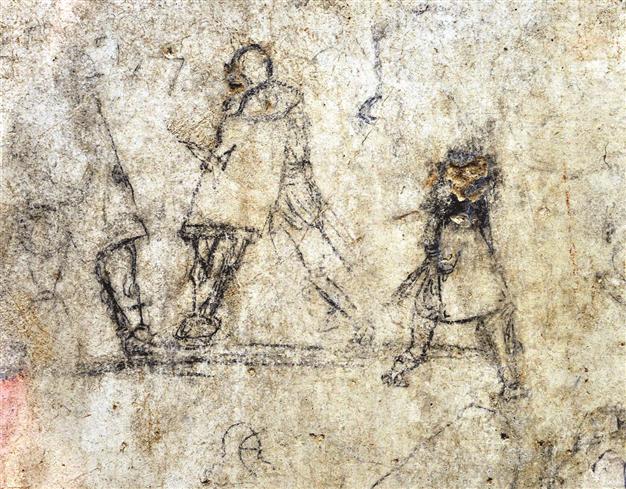
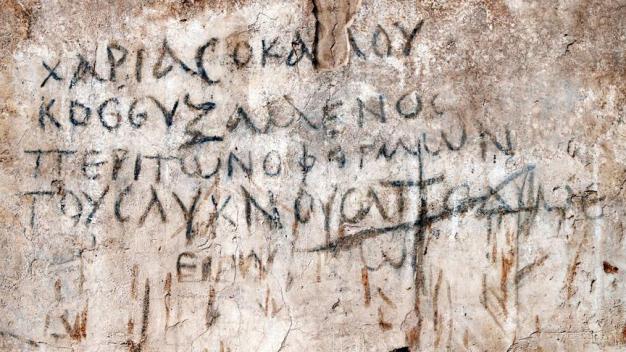
The most recent significant discovery is a rich collection of graffiti found during excavation work in the Agora, within the cryptoporticus of the Basilica. The graffiti (155 pictorial and 170 textual) are preserved on the plaster covering the north wall and on many of the pillars of the Basilica’s basement. They depict scenes of daily life, including images of trade ships, animals, and gladiators. One graffito could even be interpreted as a representation of the Temple of Hadrian, built after his visit. They are estimated to date from the late 2nd century (after an earthquake in 178) through at least the 3rd century AD. The Basilica has been covered to protect the workers and the graffiti from the elements.

The graffiti showing gladiators [Credit: DHA]
Greek graffiti from Smyrna (by Anadolu Ajansi)

Archaeologists recently discovered ashes from the eruption of Thera on the island of Santorini some 3,600 years ago at the site of Old Smyrna. About 100 people, including academics and experts from Turkey and abroad, participated in the Smyrna excavation.

There is still much to discover about Smyrna, as modern construction covers many ancient remains. Archaeological work is currently unearthing the Hellenistic theatre, which has been buried for hundreds of years (see here). The first information about the Theatre of Smyrna comes from Vitruvius’ De Architectura. Vitruvius (5.9.1) notes that there is a portico of the Temple of Aphrodite Stratonikis or an independent portico called Stratonikeion adjacent to or in the immediate vicinity of the skēnē (stage building) of the Theatre of Smyrna. Archaeologists have also recently unearthed the remains of a gymnasium and an adjoining bathhouse dating from the time of Hadrian (see here). The gymnasium could therefore be the one mentioned by Philostratus.

PORTFOLIO

  • Old Smyrna
Overview of Old Smyrna with the Archaic Temple of Athena in the background.
The Archaic temple dedicated to Athena and its well-preserved temenos terrace. The temple was the first religious building built by the Hellenes in Anatolia. It underwent four construction periods from 725 to 550 BC.
Ekrem Akurgal’s reconstruction of six columns across the rear of the Temple of Athena. The temple cella was reconstructed as peripteral with 6 x 11 columns. However, the reconstruction of the temple building is open to question.
Architectural elements from the Temple of Athena, made of white tufa, around 600 BC.
Izmir Museum of History and Art.
Aeolic capitals from the Temple of Athena, carving of white tufa, 570 BC.
Izmir Museum of History and Art.
The Temple of Athena had andesite foundations and a plan reconstructed with a peristyle of 11 x 15 Aeolic columns around a cella with a pronaos and possibly four columns in antis.
Meeting house Megaron dated to the last quarter of the 7th century BC. The megaron was the great hall in very early ancient Greek palace complexes. Architecturally, it was a rectangular hall surrounded by four columns, fronted by an open, two-columned portico, and featuring a central, open hearth that vented through an oculus in the roof.
Houses with courtyards dating to the 4th century BC. The ruins of Old Smyrna include three housing complexes of rooms built around central courtyards.
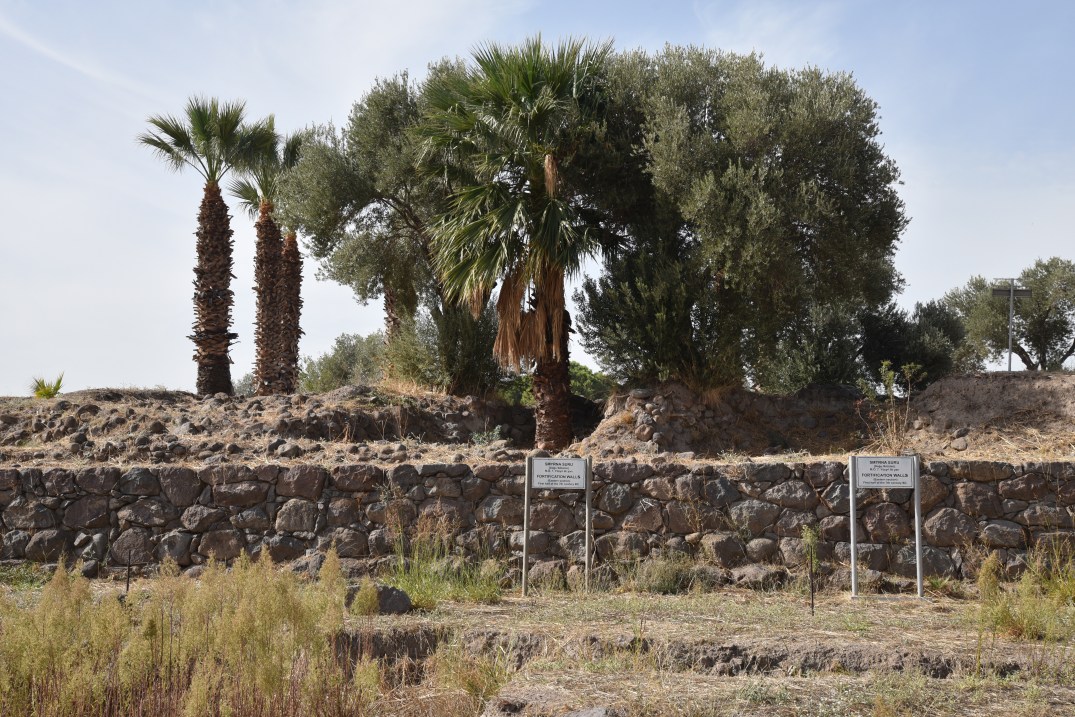
The eastern section of the fortification walls dating to the 1st half of the 7th century BC.
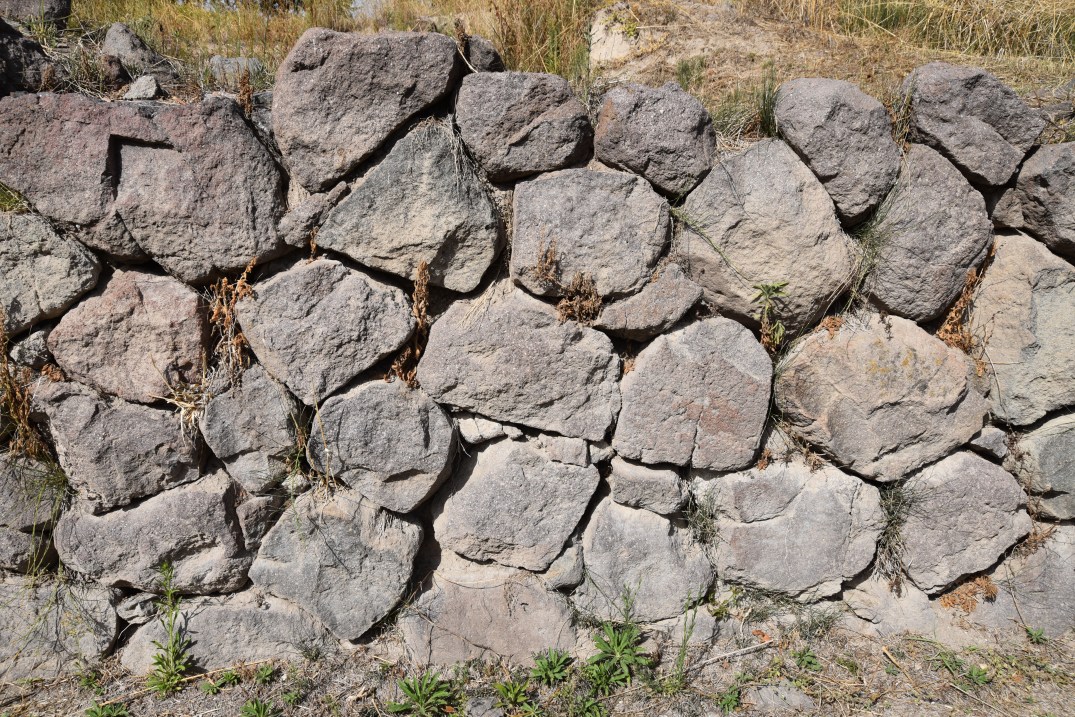
Andesite blocks of the fortification walls.
Archaic Fountain House, built of andesite stones. Belonging to the last quarter of the 7th century BC, it is thought to have been used continuously until the middle of the 4th century BC. The reservoir inside the fountain collected water from a small stream flowing to the east of Old Smyrna.
Western fortification wall.
A small necropolis was located in front of the fortification walls with limestone sarcophagi. It was used for a short period, between the end of the 7th century BC and the middle of the 6th century BC.
Mudbrick fortification wall, dated to the 9th century BC.
  • New Smyrna
The entrance to the İzmir Agora Open Air Museum.
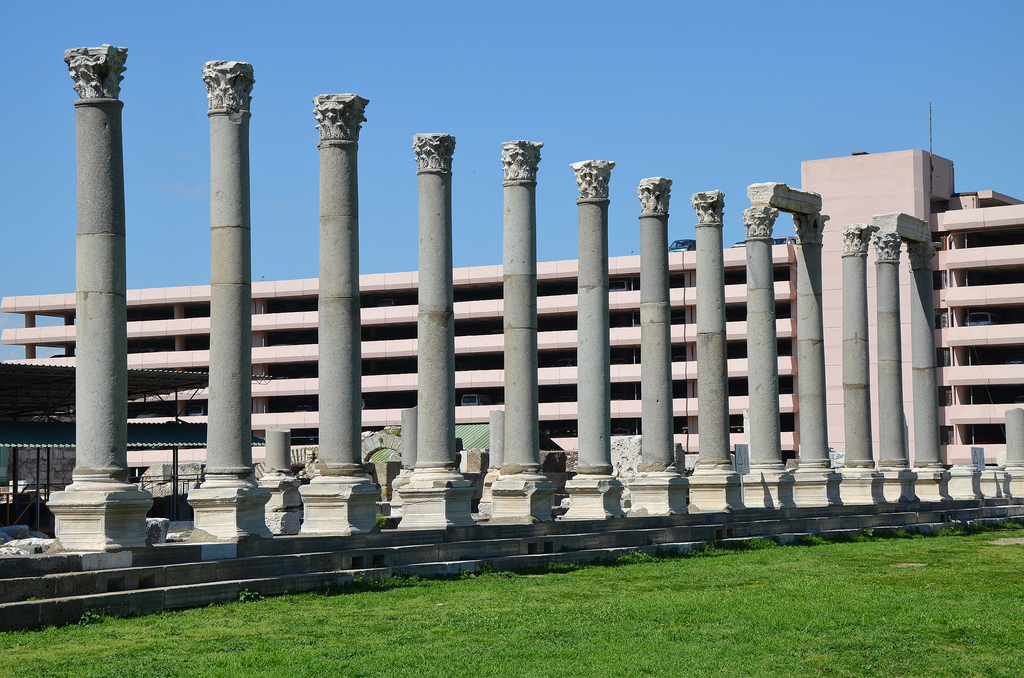
The excavated area of the Agora so far measures 129 m x 83 m. It is bordered on the east and west sides by porticoes, while the Basilica occupies the northern side. It is, so far, the largest and best-preserved among the Ionian Agoras.
The Agora of New Smyrna was constructed during the Hellenistic period and was rebuilt in the Roman period under Marcus Aurelius. It was a multi-storey building with many spaces on different levels and an open courtyard.
The bust of the emperor’s wife, Faustina, on the second arch of the western stoa, confirms the restoration phase under Marcus Aurelius.
The Gate of Faustina.
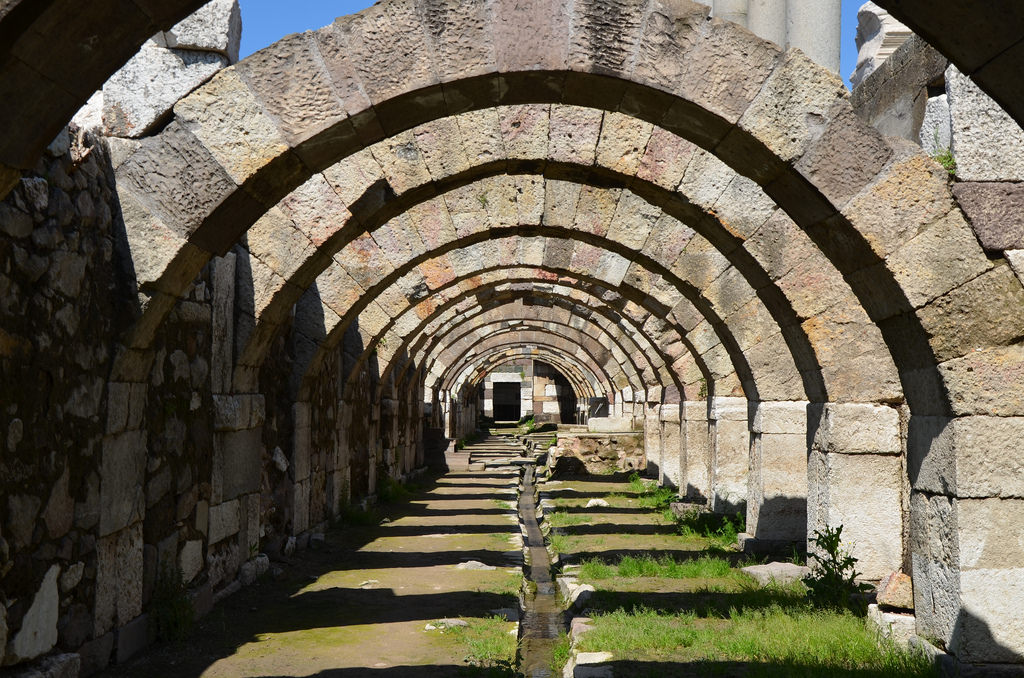
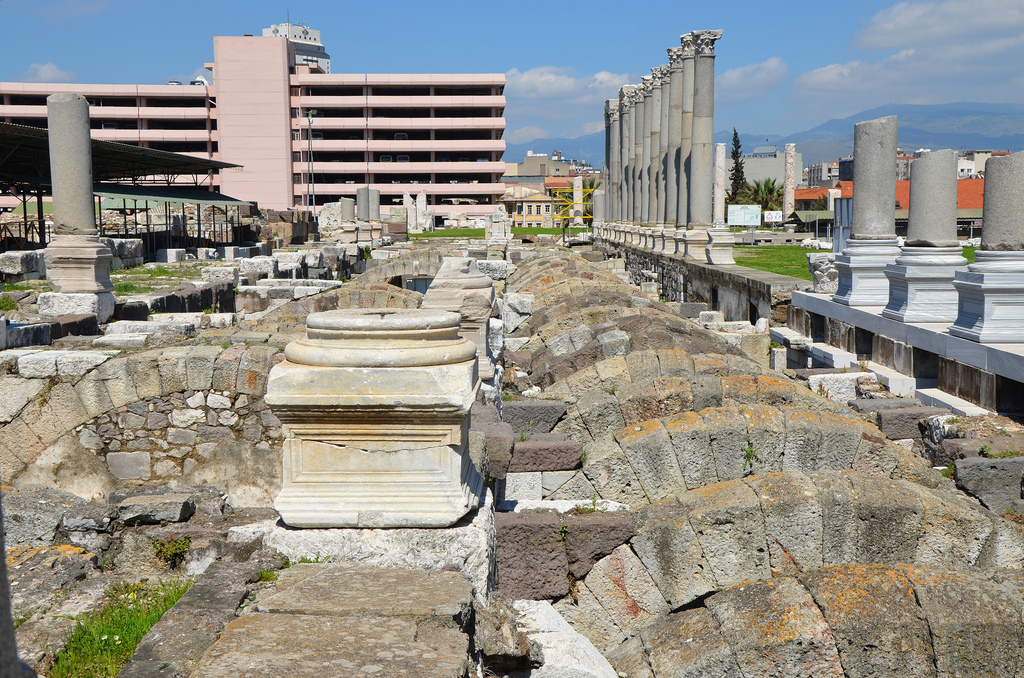
The Western Portico surrounded the Agora’s courtyard. It was 20 m wide and just over 100 m long. The porticoes of Smyrna were a two-storied structure with a basement underneath.
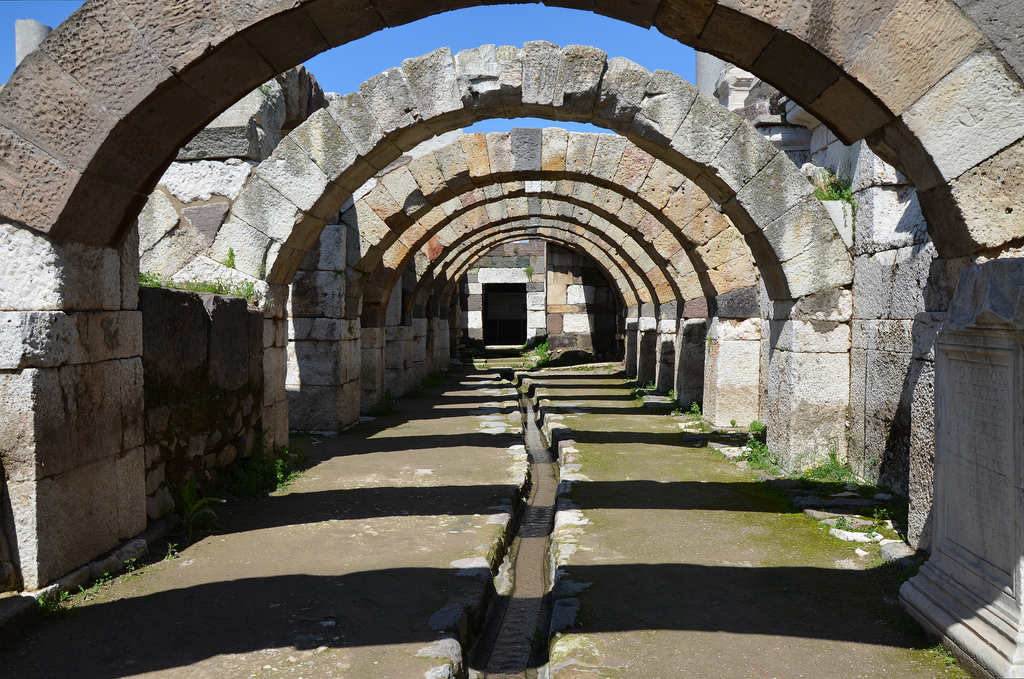
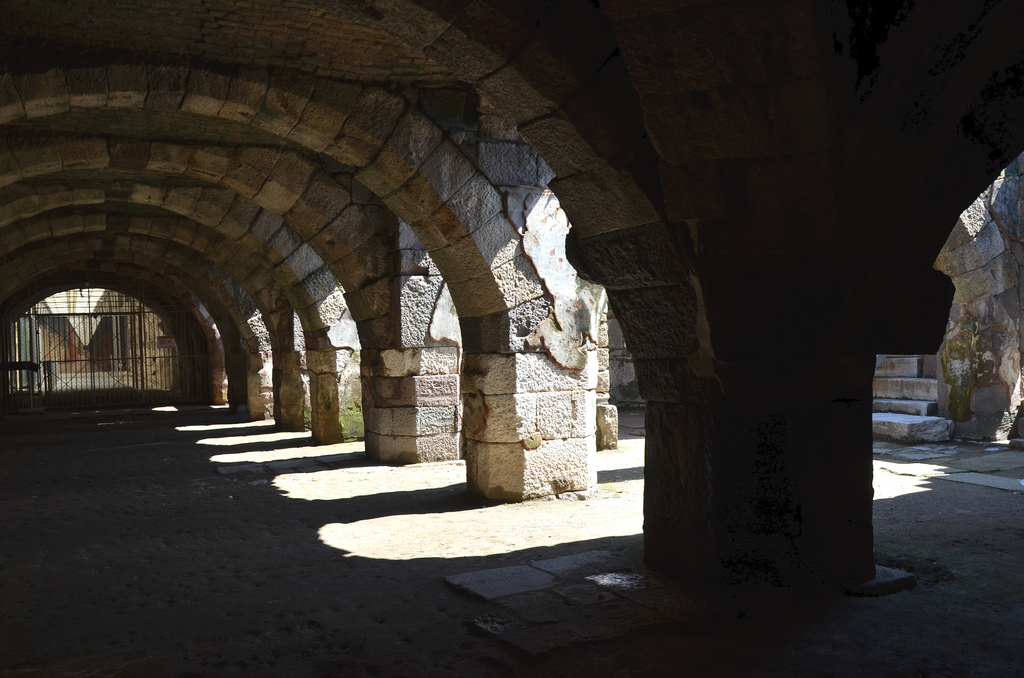
The basement of the Western Portico was constructed by using arches and consisting of three galleries.
The Bouleuterion, built in the 2nd century AD during the reign of Marcus Aurelius, over an earlier late 1st century BC Bouleuterion. With 16 rows of seats, it had a capacity of approximately 950 people.
The Mosaic Building, most likely used for social and cultural events and political meetings. It is thought to have been built at the end of the 2nd century after the AD 178 earthquake, with major repairs in the 4th century AD.
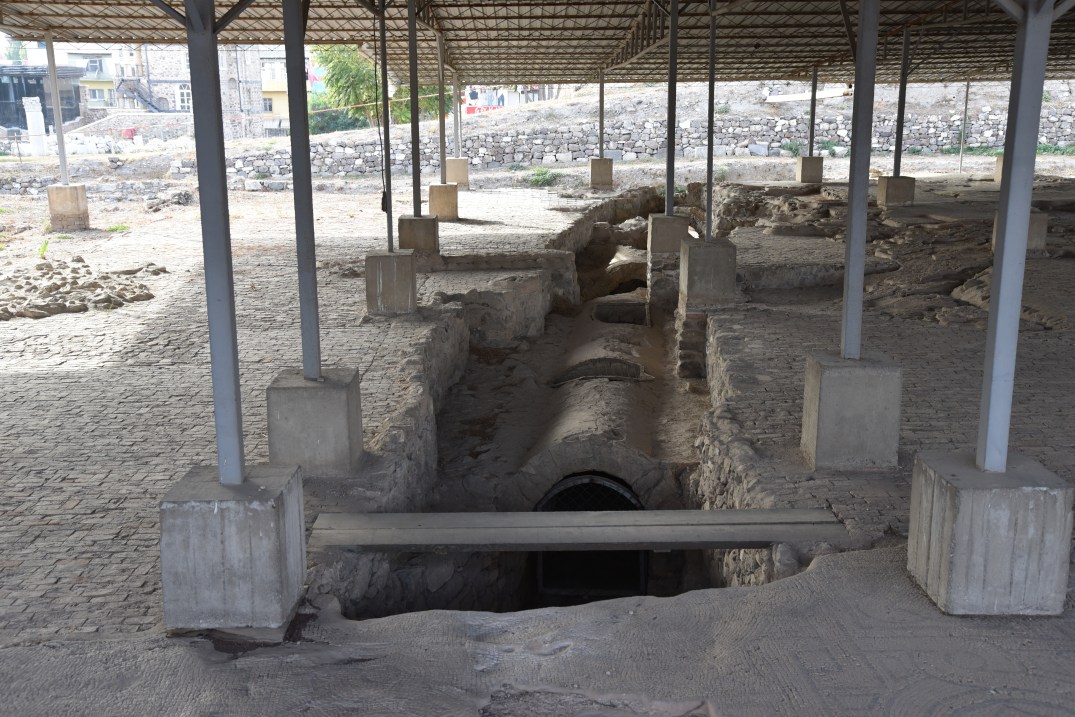
A water channel underneath the floor of the Mosaic Building.
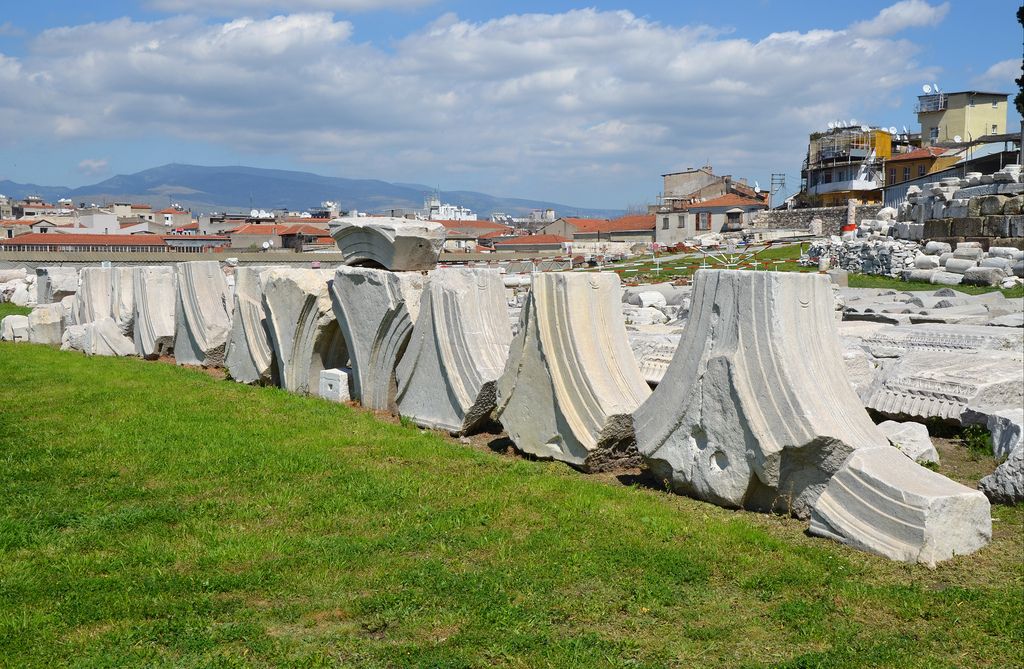
Architectural fragments of the Agora’s porticoes.
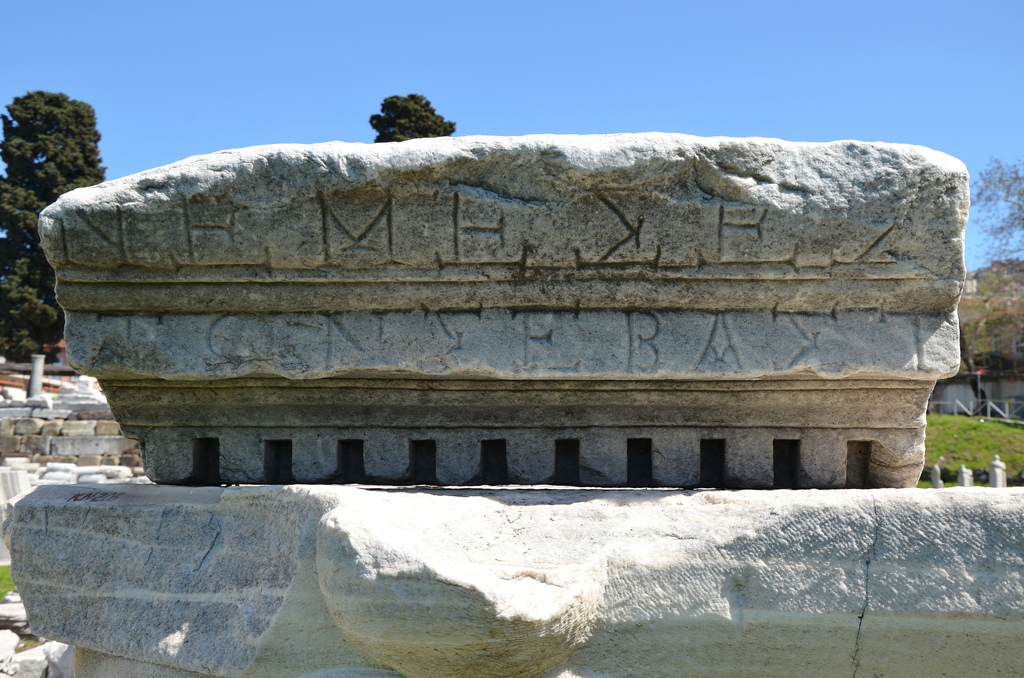
On this architrave of the first storey of the western Portico was engraved a 35m-long inscription dedicated to the two Nemeses and to other gods.
Architectural fragments of the Agora.
Architectural fragments of the Agora’s porticoes.
The western section of the portico basement was made a part of the water system in late Antiquity.
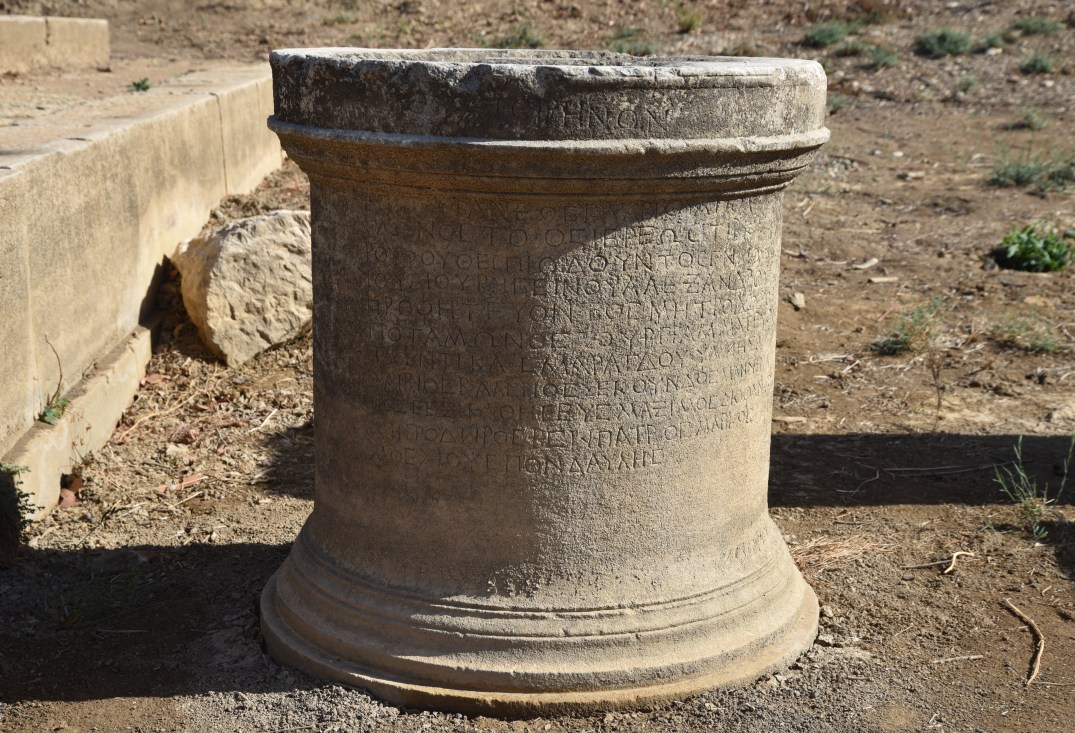
Honorary inscription for Hadrian by the initiates (mystai) of the great Breiseus Dionysos, dated AD 129/132. ISmyrna 622
Inscribed statue base (SEG 47-1637) of Claudius Aristophanes Aurelianus, neocoros of the cult of the Emperor at Smyrna, Severan period. The title “neocoros” is used for an elite person who was honoured to officiate at the imperial cult temple at Smyrna.
A marble sculptural group of three deities, Artemis, Poseidon and Demeter. The statues were used in an altar complex located in the central part of the Agora. Dated to the Antonine Period. Izmir Museum of History and Art.
The well-preserved basement of the Basilica comprised 4 galleries, each measuring 4.40 m in height and 5 m in width. The first and second galleries on the south were covered by 55 arches and connected by passages or doorways.
Cross vaults located at the western end of the first and second galleries of the Basilica were added after the earthquake of AD 178.
Architectural fragments of the Basilica. White marble was used for the columns, while reddish conglomerate was used inside the building for the columns on both storeys.
Agora of New Smyrna.
The Theatre of Smyrna, built in the 2nd or 1st century BC, expanded during the reign of Trajan or Hadrian and repaired after the AD 178 earthquake.
The Theatre of Smyrna had a capacity of around 16,000. It had a three-storey stage building and a three-tiered cavea with a diameter of 152 m, divided by two diazomas rising 30 m above the semicircular orchestra.
Smyrna’s streets were broad, well-paved and laid out at right angles. The main street, called the Golden Street, ran across the city from West to East, probably beginning at the temple of Zeus Akraios and ending at the temple of Cybele.

Links & references:

  • SMYRNA (Izmir) Turkey – The Princeton Encyclopedia of Classical Sites
  • Smyrna Antik Kenti (official site)
  • oldsmyrna.org (official site)
  • Ruscio Caterina, “Smyrna (Antiquity)”, 2008, Encyclopaedia of the Hellenic World, Asia Minor URL: <http://www.ehw.gr/l.aspx?id=12483>
  • Burrell, Barbara. Neokoroi: Greek Cities and Roman Emperors. Leiden, The Netherlands: BRILL, 2003.
  • Bagnall, Roger S., et al. Graffiti from the Basilica in the Agora of Smyrna. NYU Press, 2016.