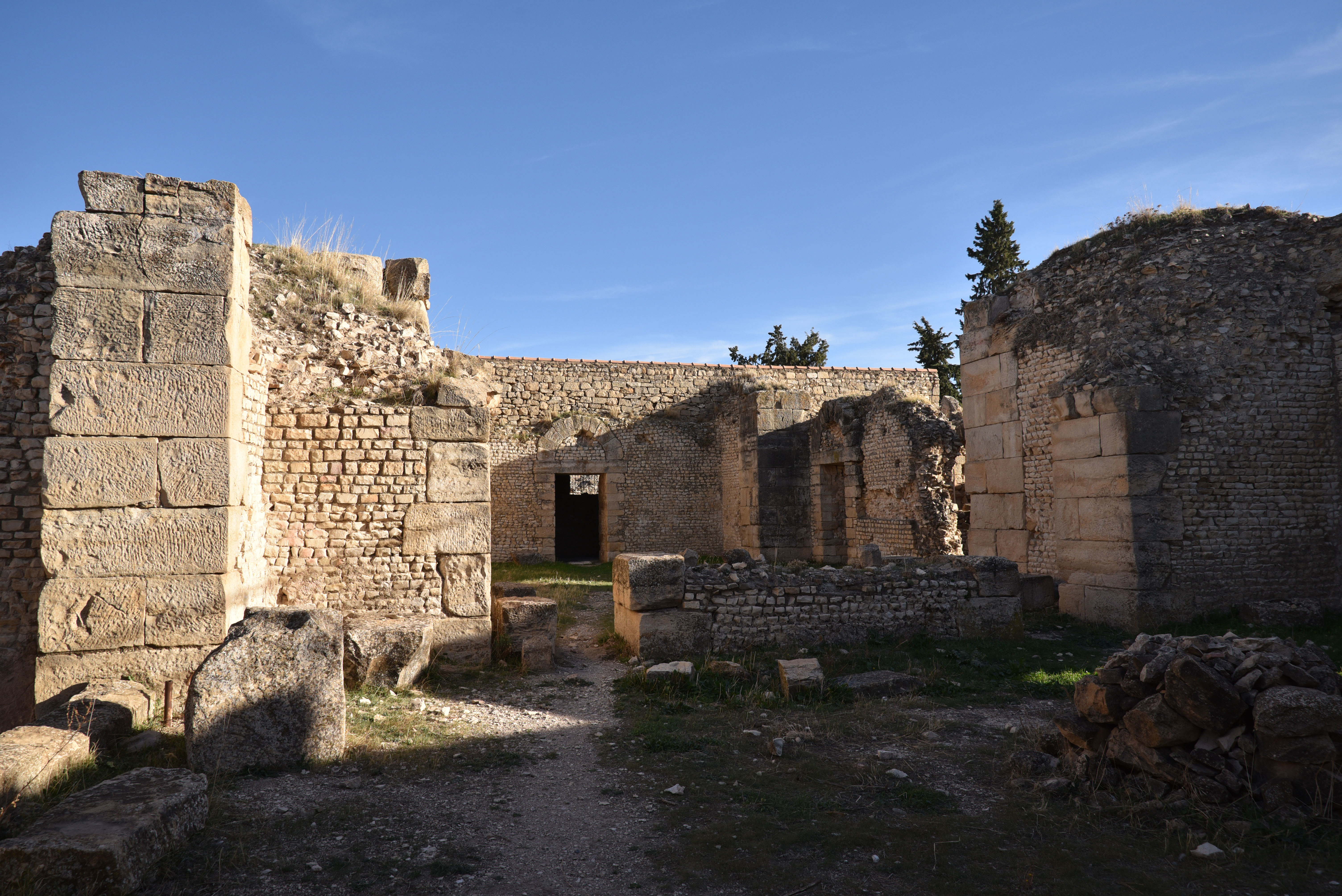
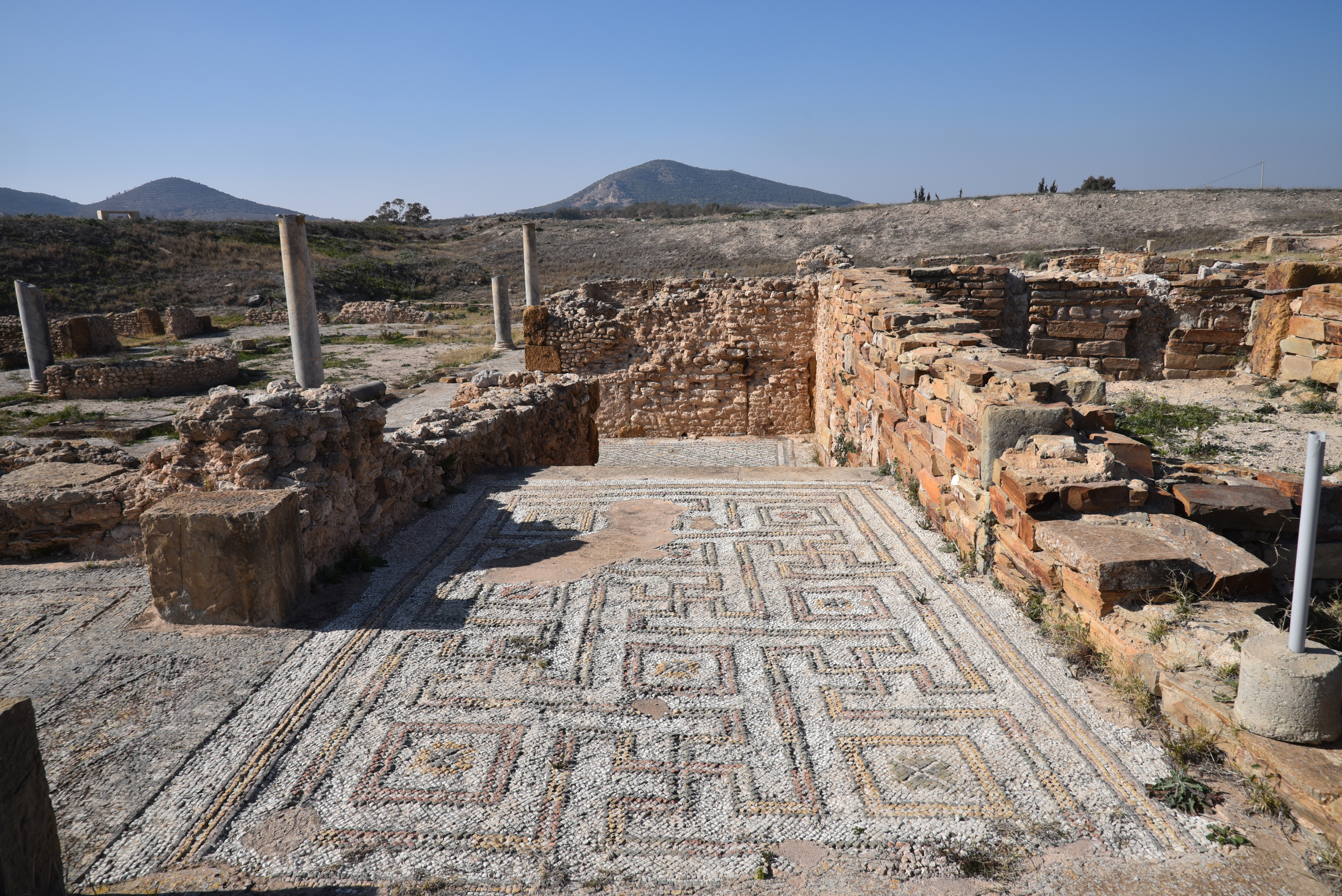
Madauros was an ancient Roman-Berber city and a former diocese of the Catholic Church, situated in the Roman province of Africa Proconsularis (formerly Numidia). It is located approximately 7 kilometres east of the modern village of M’Daourouch in present-day Algeria. Originally of Numidian origin, this settlement later became a Roman colony during the Flavian period. Among the visible monuments at Madauros are the Roman forum, theatre, two bath complexes, numerous houses, churches, a Byzantine fortress, and significant oil-pressing facilities.
Madauros was a Numidian city ruled successively by African kings Syphax (r. 215-203 BC) and Massinissa (r. 202-148 BC). During the Flavian period, a colony of veterans was established there, known as Colonia Flavia Augusta Veteranorum Madaurensium, as indicated by an inscription found in the forum (ILAlg. 2152).
The Platonist philosopher and rhetorician Lucius Apuleius (circa 124-170), best known for his work The Golden Ass, was born in Madauros. The city was a centre of learning in the region and was particularly famous for its educational institutions. Saint Augustine of Hippo studied at the “schola” at Madauros in the 4th century AD.
In the said marketplace [of Madauros], Mars is represented in two images, the one unarmed, the other armed, and a statue of a man placed over against these restrains with three extended fingers the fury of their demonship from the injuries which he would willingly inflict on the citizens.
Saint Augustine, Letter 17, tr. P. Schaff
Madauros became the see of a Christian diocese in the 4th century AD. Several notable bishops hailed from Madauros, including Antigonus, who presided over the 349 Council of Carthage, Placentius, and Pudentius, who was forced into exile alongside others present at the Synod of 484 due to the Vandal king Huneric.
PORTFOLIO
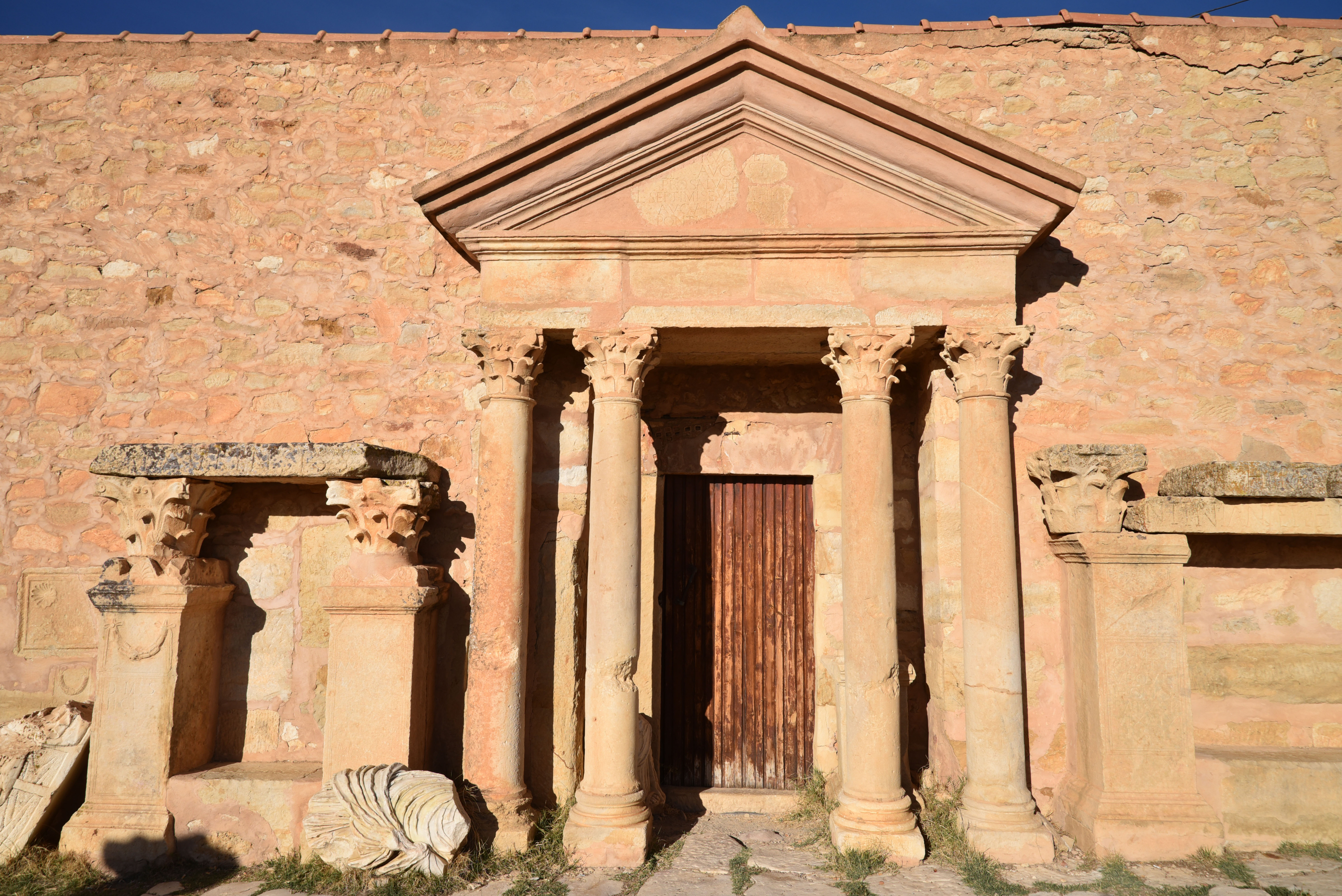
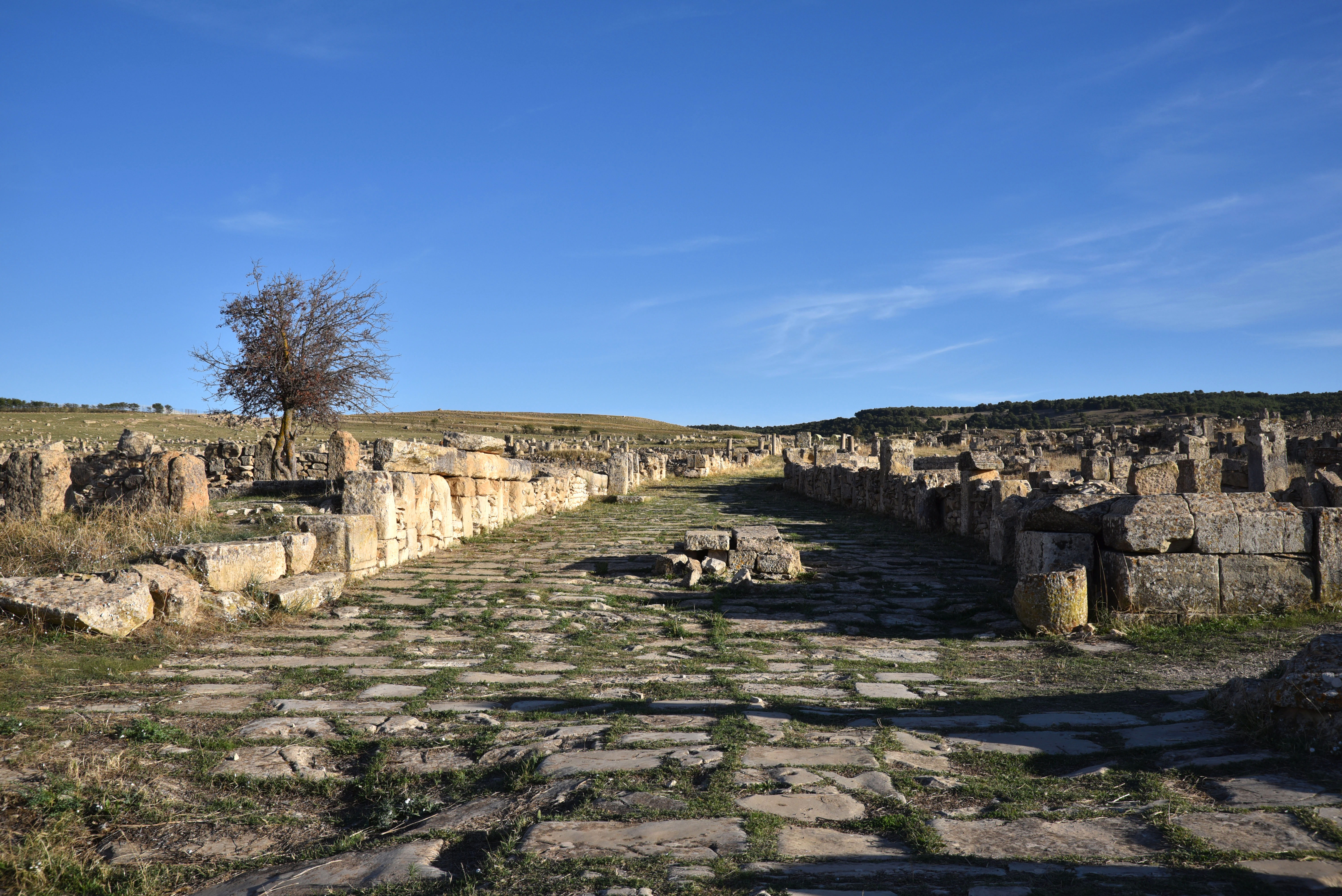
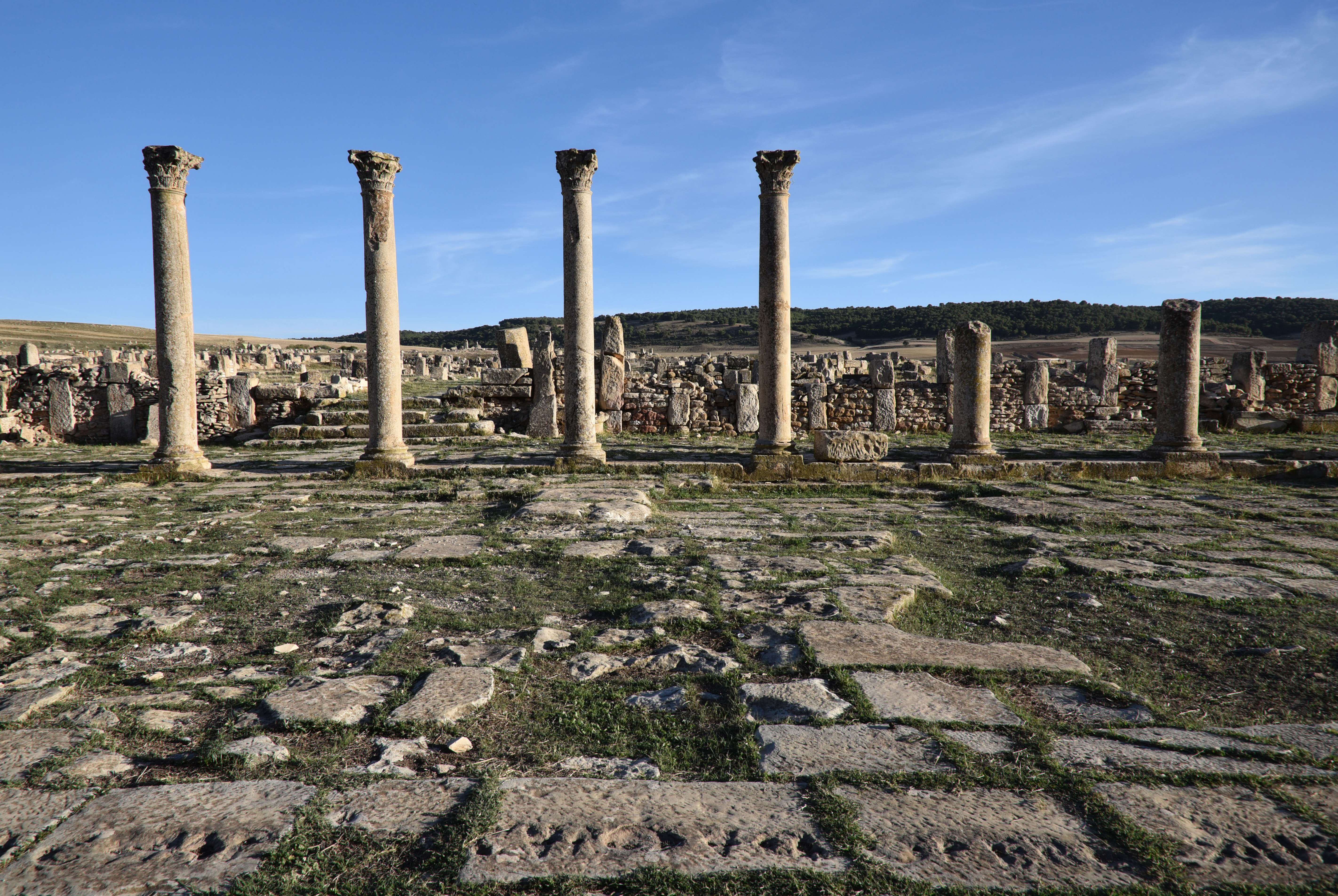
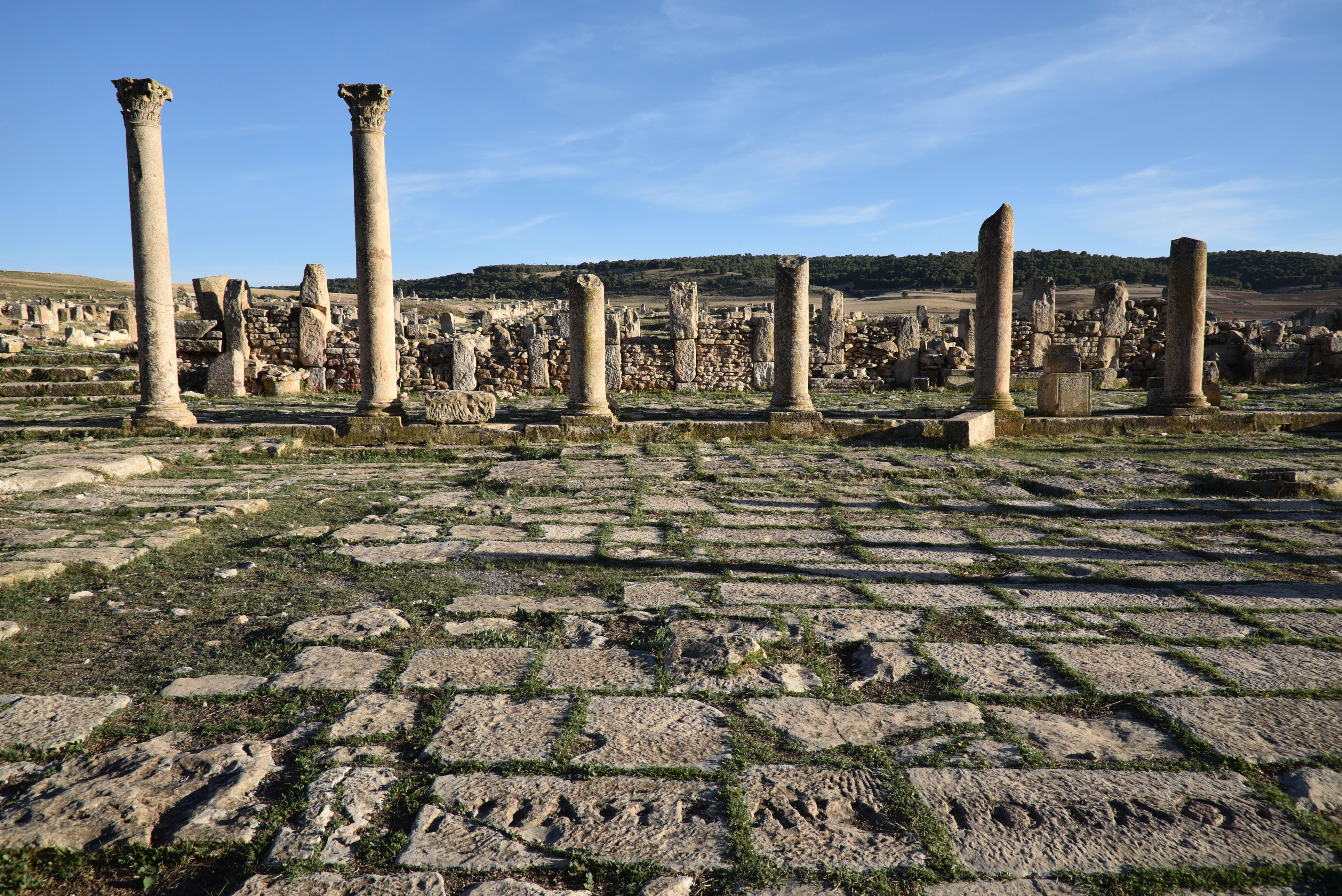
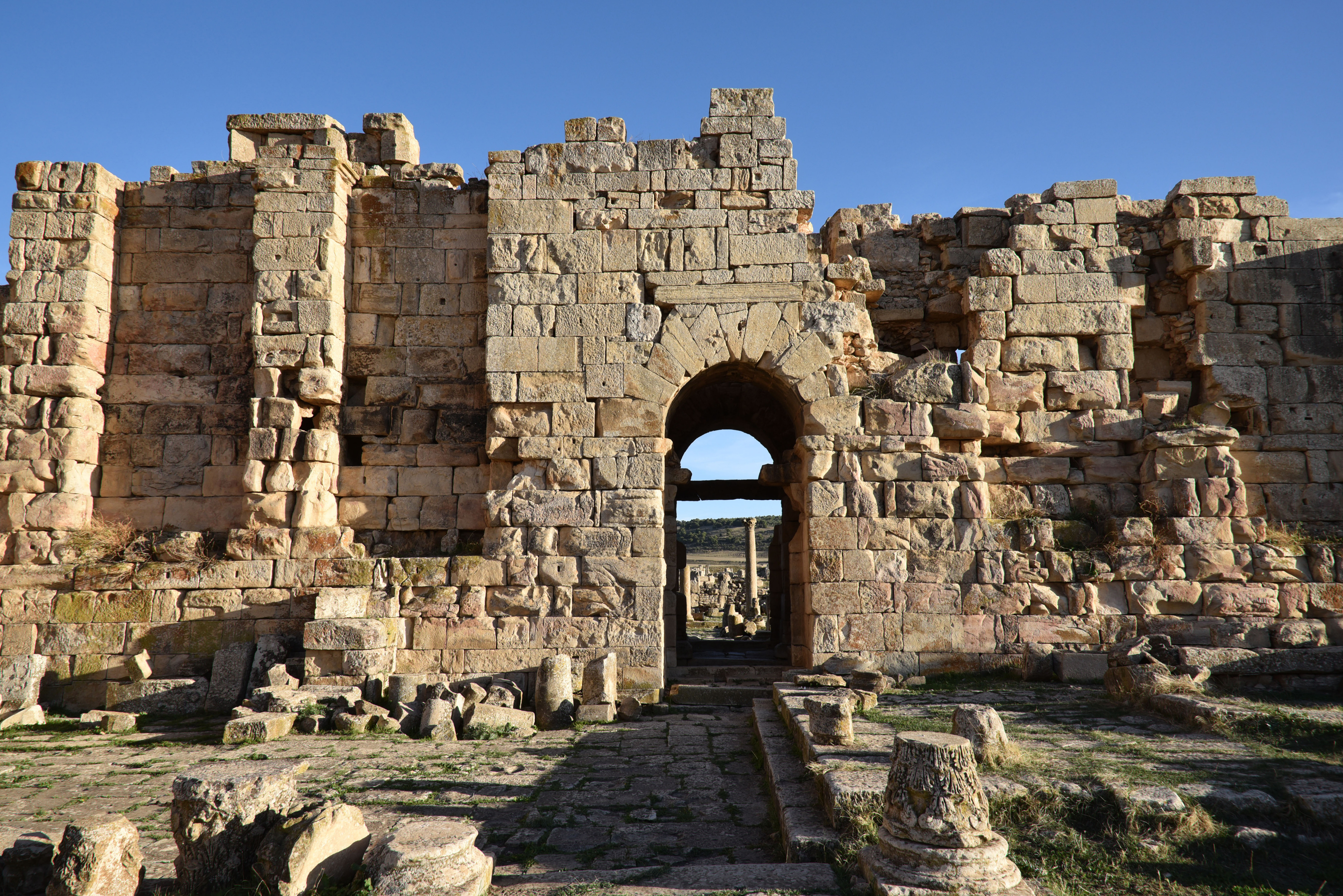
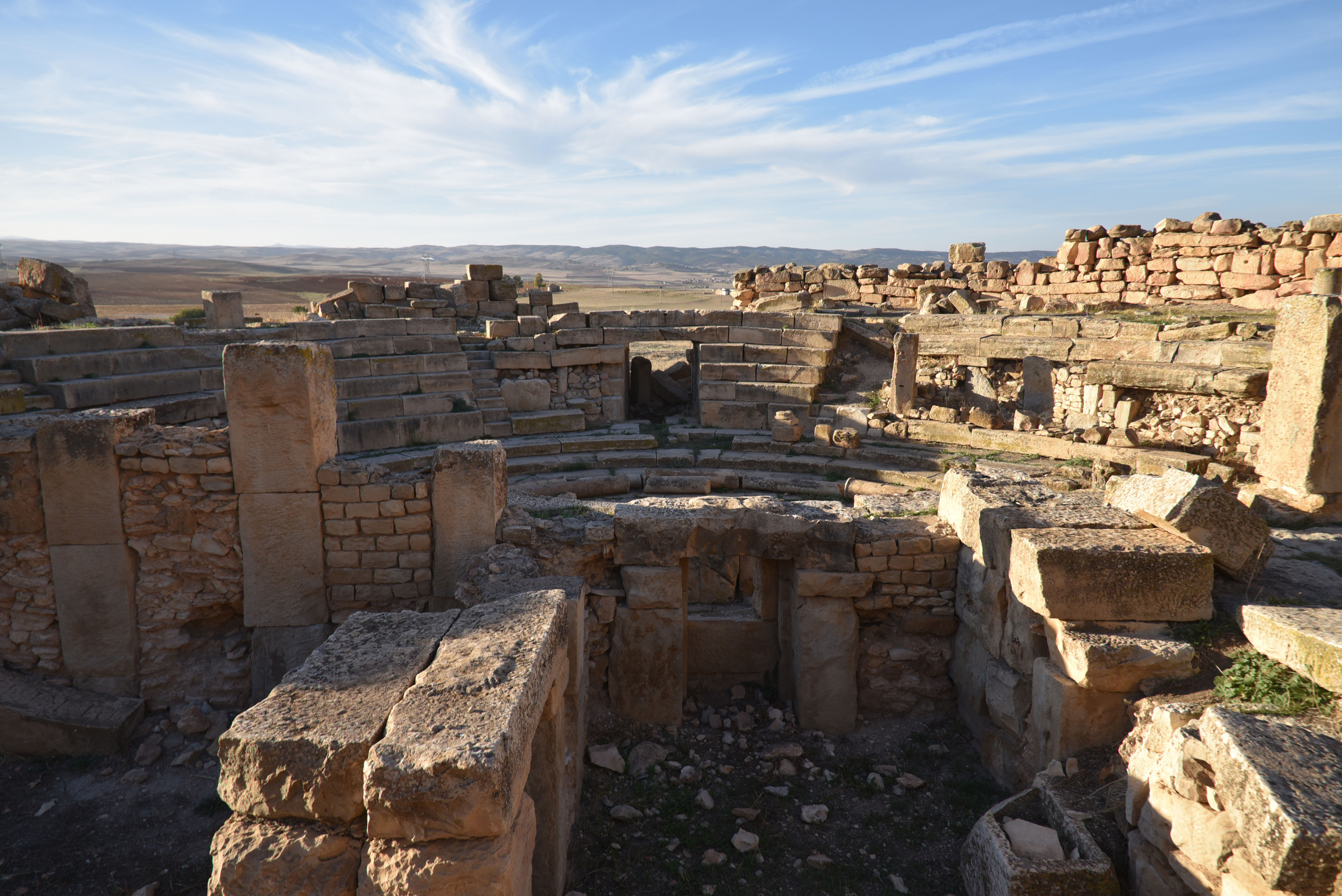
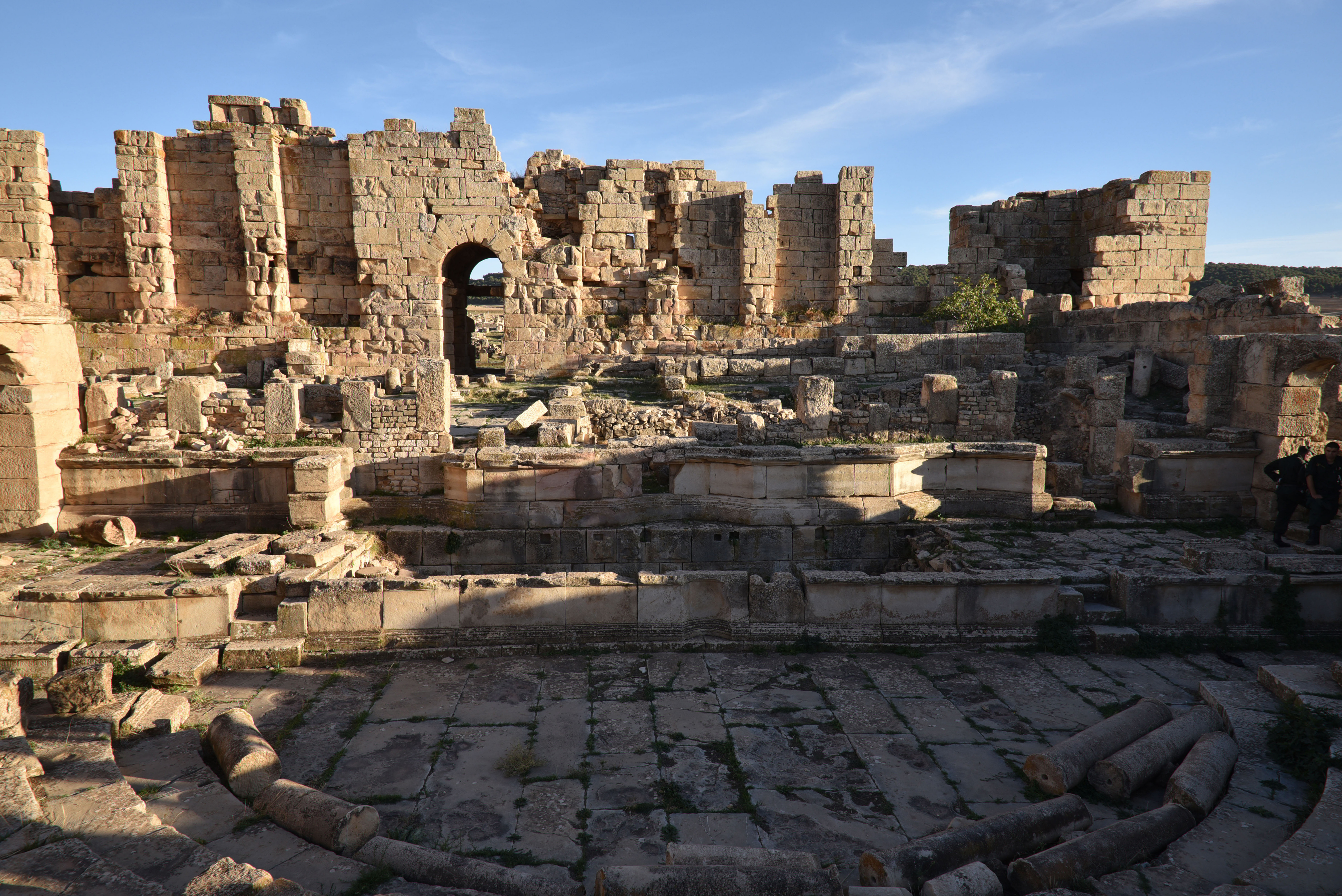
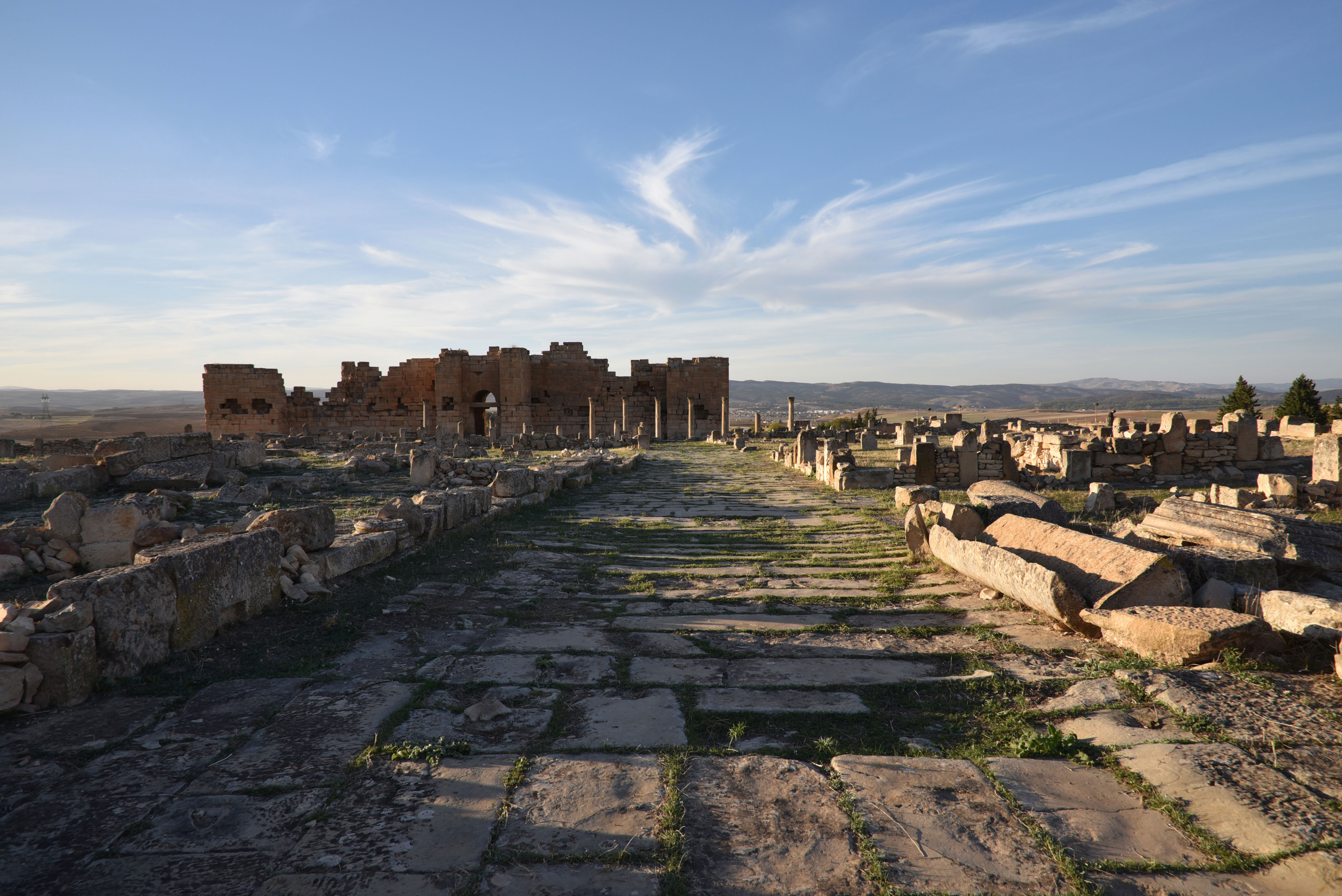
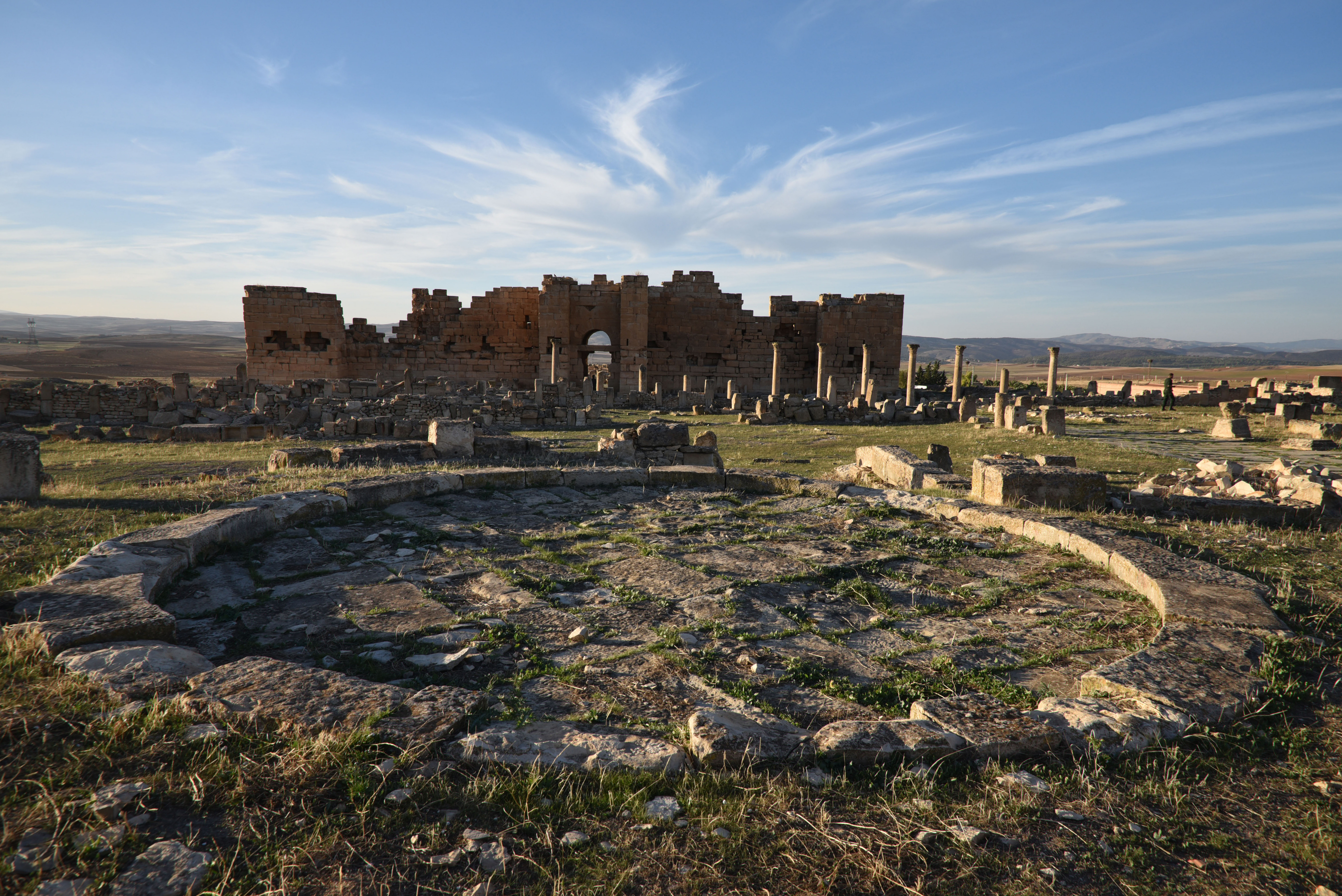
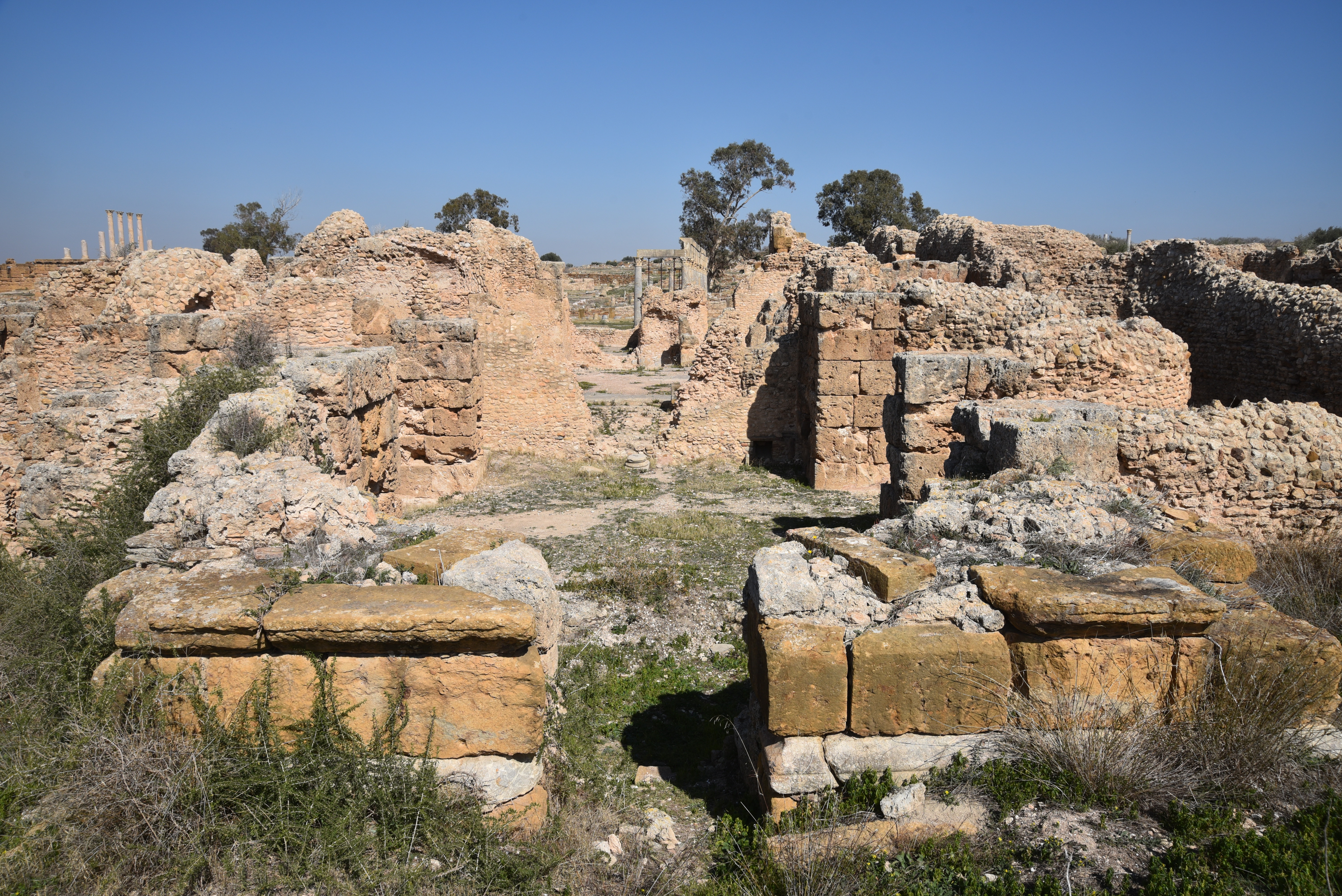
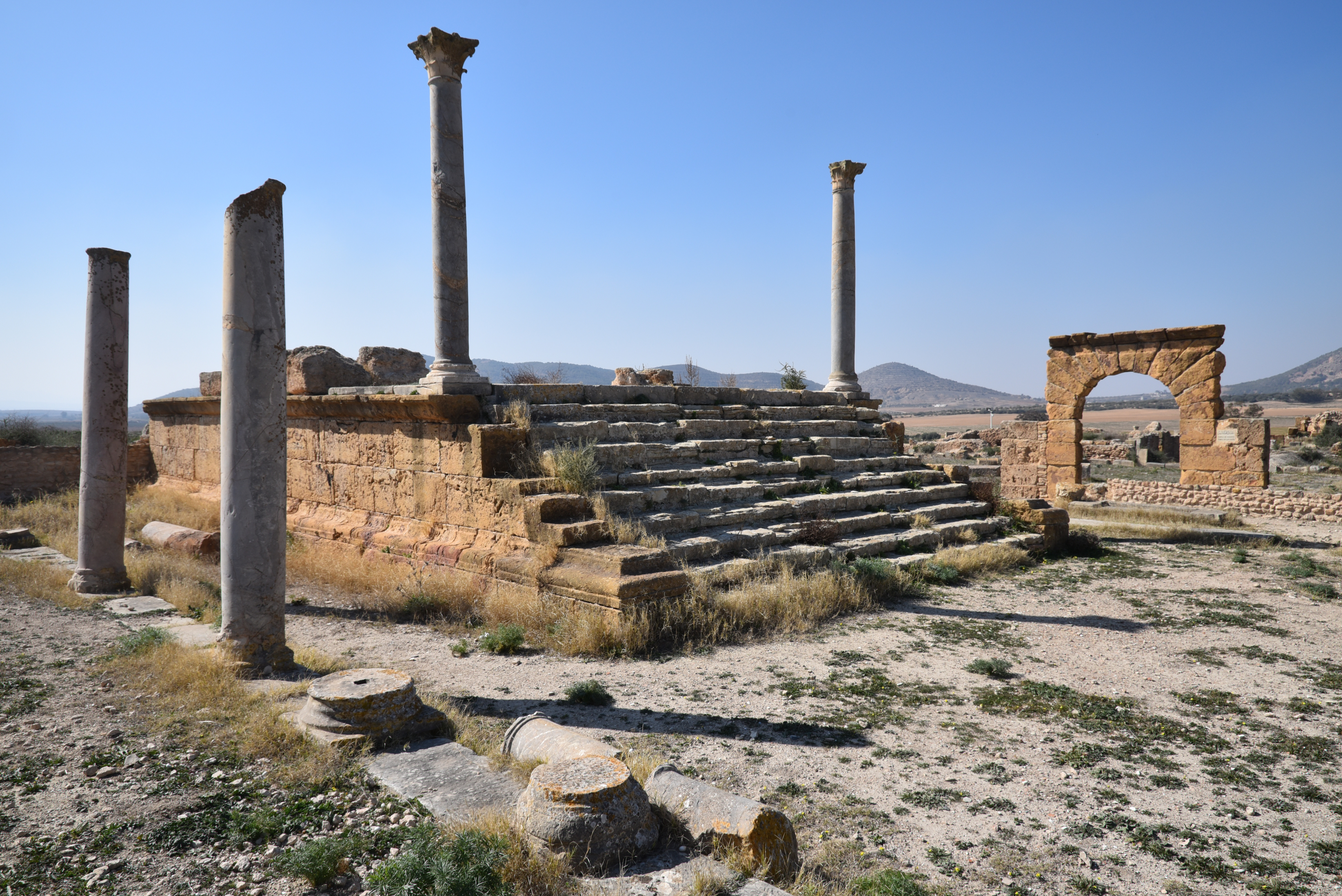
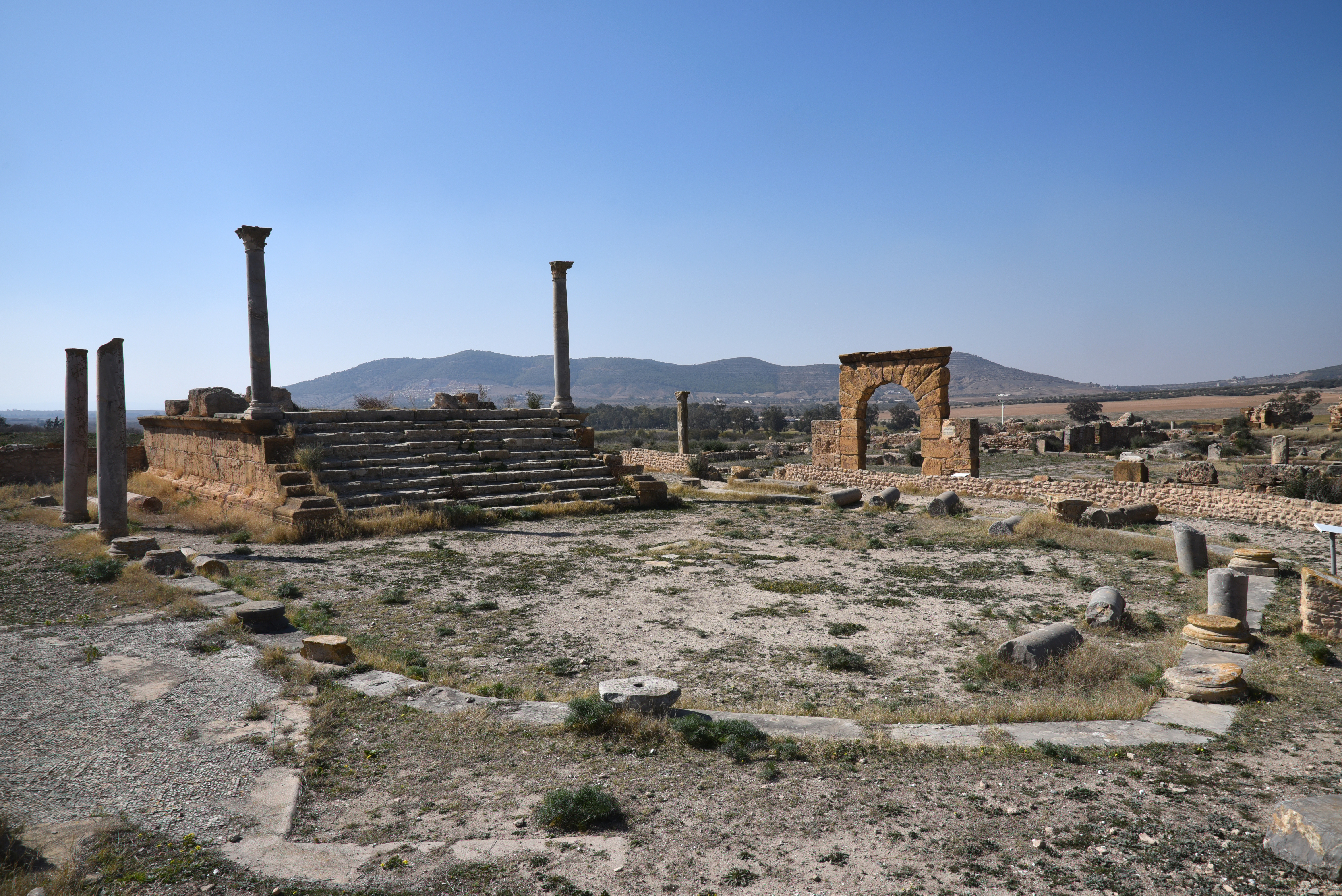
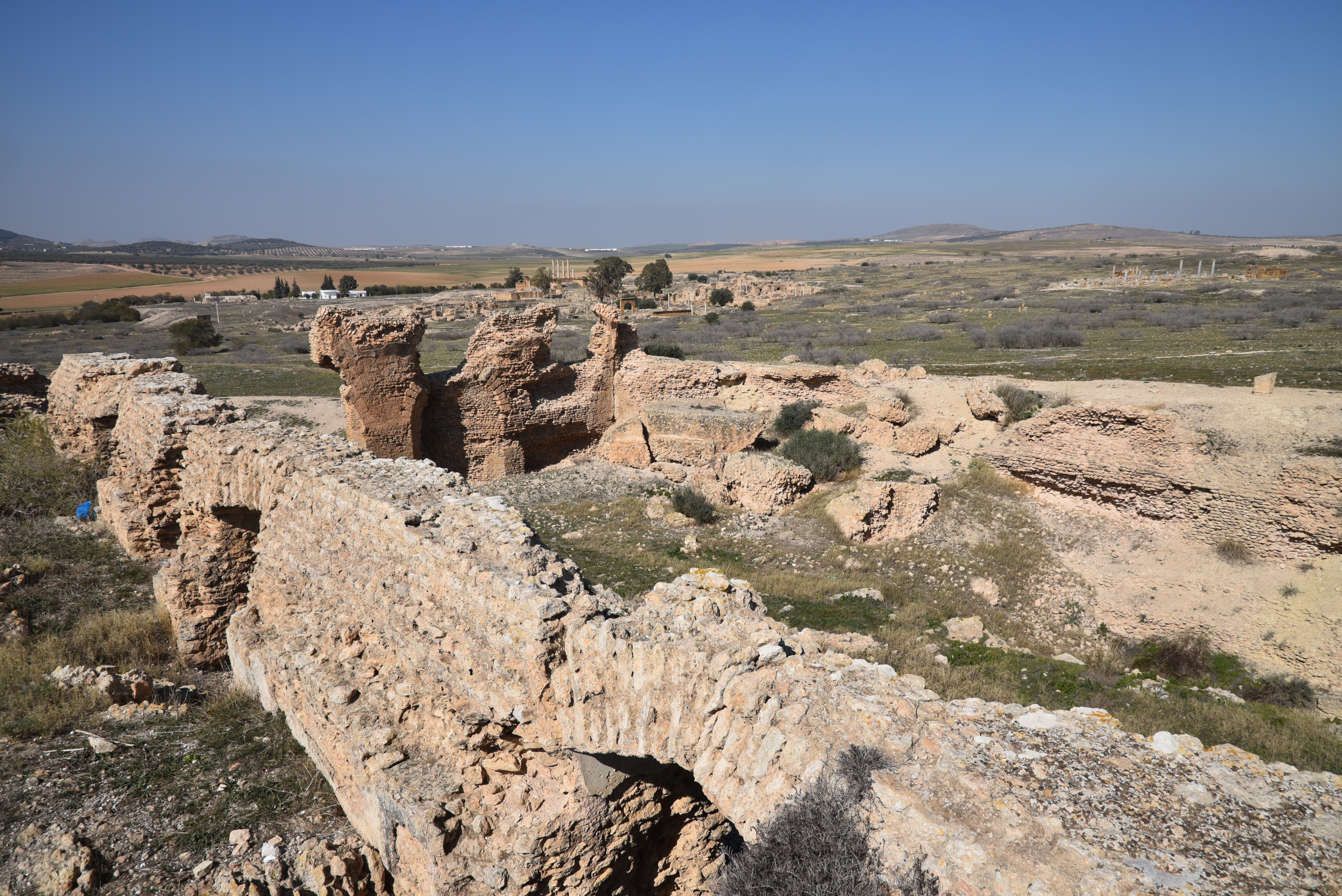
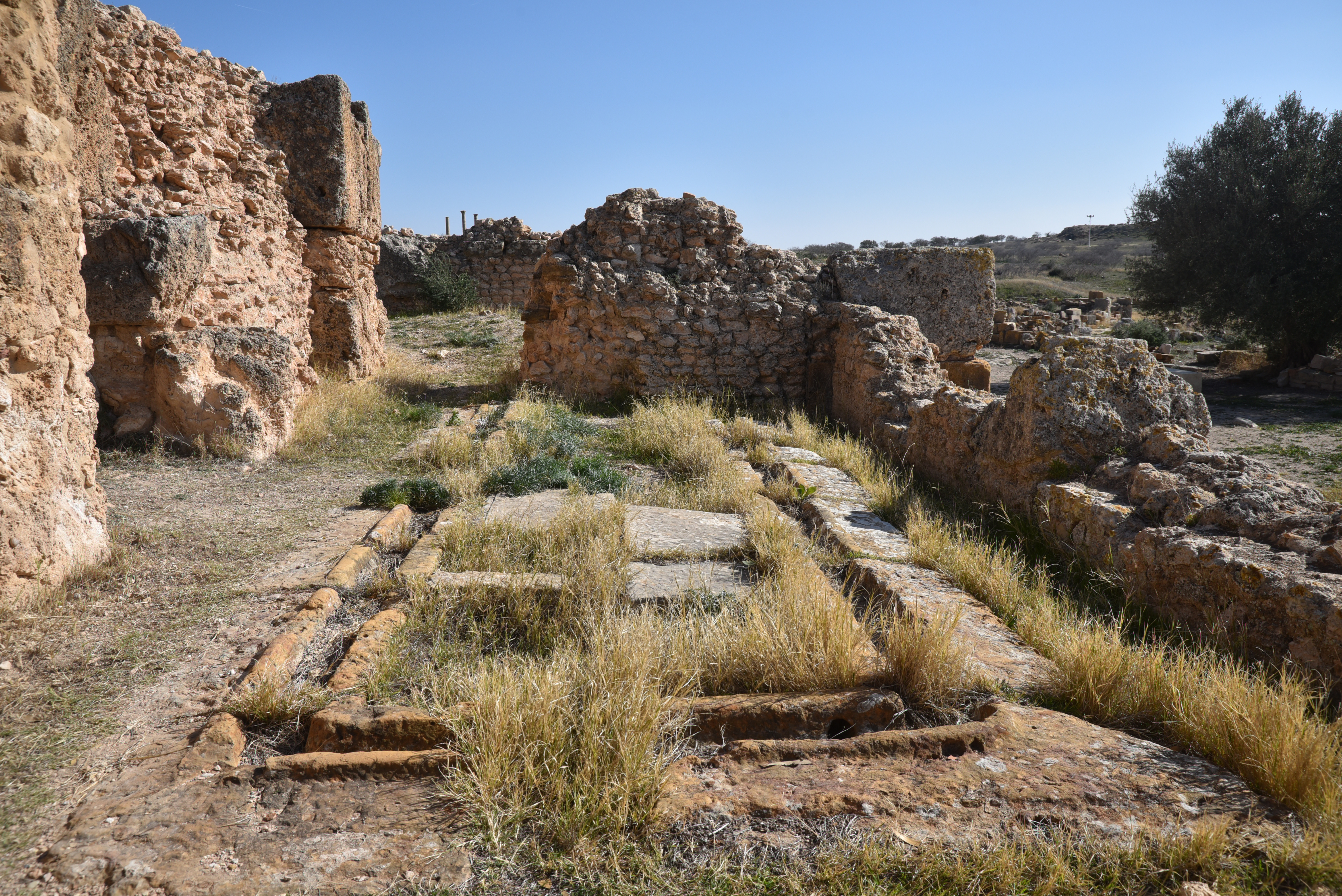
A paved street running north-south through the city.Architectural fragments lining the paved street leading from the baths.Architectural fragments lining the paved street leading from the baths.The Winter Baths of the 3rd century AD located at the north edge of the site.The larger Summer Baths (39 x 41 m) are set only 20 metres from the Winter Baths. They possess the usual sequence of cold and heated rooms, as well as a large, semi-circular latrine.A church dating to the second half of the 5th century AD, adapted from an earlier building.An oilery among the houses, featuring pressing stones and receiving tanks.Receiving tank for oil in one of the oileries.The southern section of the street leading from the baths.Overview of the ruins of Madauros in the southern part of the site.The paved Forum, built on a terrace and surrounded by porticoes. The forum is rectangular, almost square (32.4 x 27 and 28.5 m).A refurbishment of the Forum’s paved surface was marked by an inscription that ran across its width in bronze letters. These letters have since been removed, leaving corresponding hollows in the paving slabs. The work, which cost 200,000 sesterces, was funded by a certain M. Aurelius (not the emperor).The bases of statues found in the Forum remind us of those mentioned by Saint Augustine. One appears to have supported a statue of the writer Apuleius: “To the Platonic philosopher, their ornament, the citizens of Madauros set this up by decree of the decurions at public expense.”The walls of the Byzantine Fortress, constructed over the Forum in AD 535 as a rectangular building with square corner-towers and a central gate-tower.The small theatre was built during the Severan period, thanks to the generosity of the flamen M. Gabinius Sabinus, at a cost of 375,000 sesterces.The theatre was built in the immediate vicinity of the forum, against its west portico, and had a seating capacity of 1,000.View towards the Forum and the Byzantine Fortress.The Macellum (market), with the Forum and the Byzantine fortress in the background. This market had a circular, paved central space, surrounded by a portico sheltering radial market stalls.
Blas de Roblès, Jean-Marie; Sintes, Claude; Kenrick, Philip. Classical Antiquities of Algeria: A Selective Guide (p. 127). Society for Libyan Studies. pp. 527-537
Thuburbo Majus is a well-preserved Roman site in northern Tunisia, located on a fertile plain just 60 kilometres southwest of Tunis. The city was founded as a Roman veteran colony by Augustus in 27 BC and features impressive ruins, including a forum, capitolium, amphitheatre, temples, baths, and houses.
The city, whose name Thuburbo indicates Berber origins, experienced a period of Punic occupation from the 3rd to 2nd centuries BC. The Romanisation process started during Augustus’ reign when he established a Roman veteran colony. This allowed military veterans to begin their post-army lives with land of their own. Hadrian elevated the city to the status of a municipium, known as Municipium Aelium Hadrianum Augustum, which encouraged an urban boom. A few decades later, Commodus declared the city a colonia, which was given the more impressive title of Colonia Julia Aurelia Commoda.
The town’s elevated status led to further construction projects, including the Forum and the Capitolium. Thuburbo Majus thrived and developed into a significant provincial metropolis with around 10,000 inhabitants. Luxurious residences adorned with intricate mosaics and a variety of public monuments were built.
Several ruins in Thuburbo Majus indicate the presence of Christianity, including a temple that was converted into a church in the late 5th century AD. The city began to decline in the early 6th century AD and appears to have been gradually abandoned during the 7th century AD.
The site has been partially excavated, with the initial work carried out by French archaeologist Charles Joseph Tissot in 1857. The significance of the discoveries was so great that excavations continued for another century (1936). Many mosaics were unearthed and removed from the site, now housed in the Bardo Museum in Tunis.
PORTFOLIO
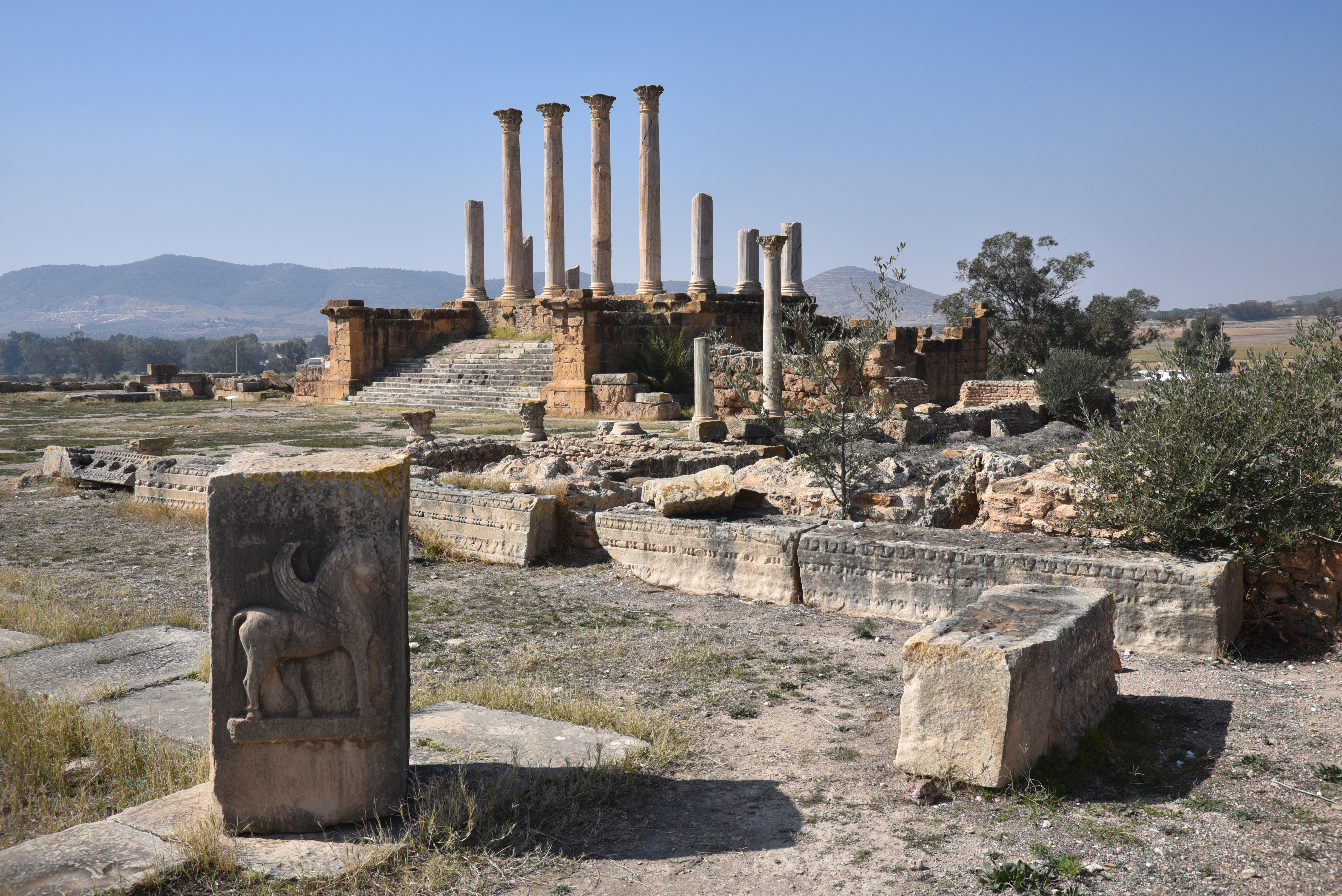
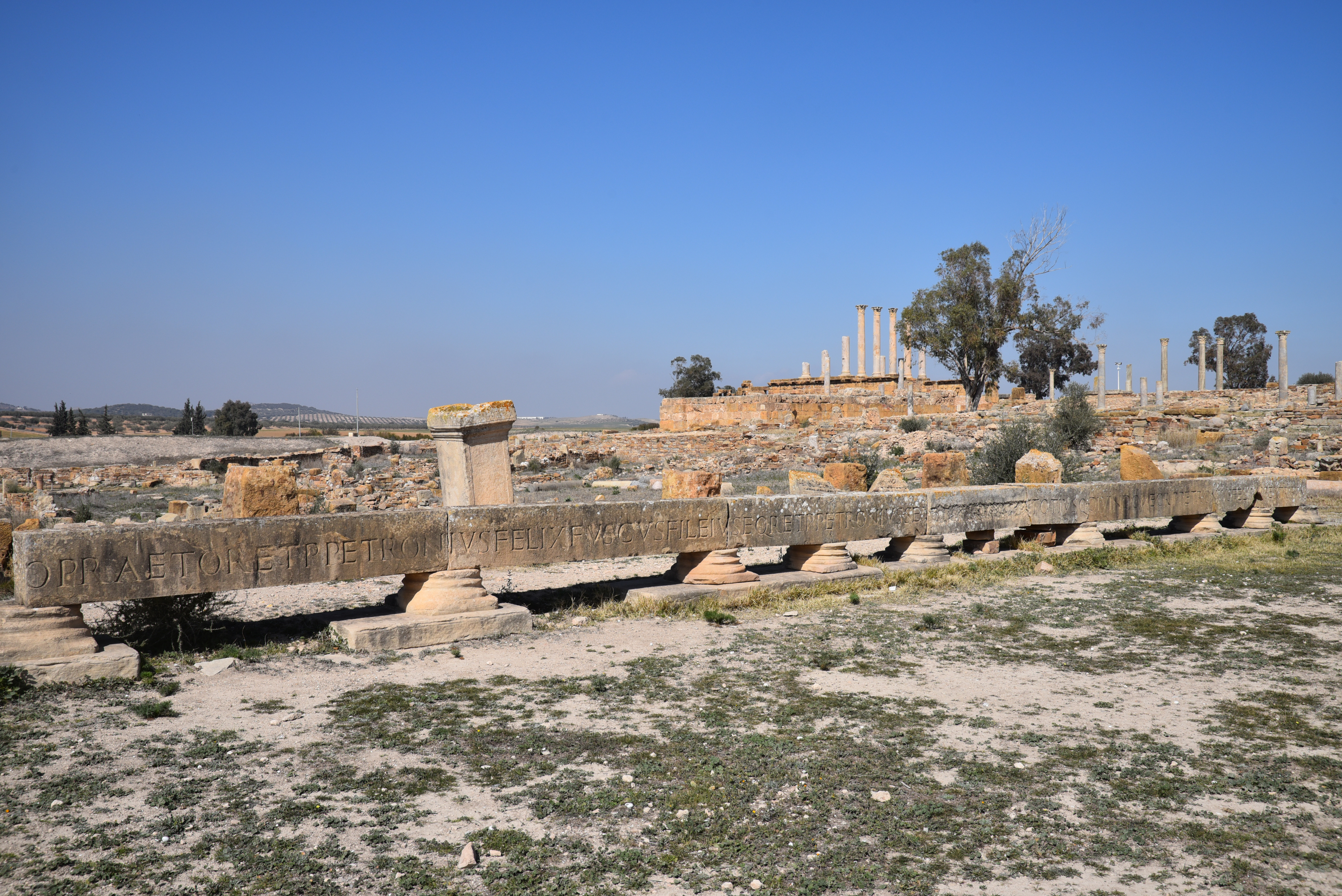
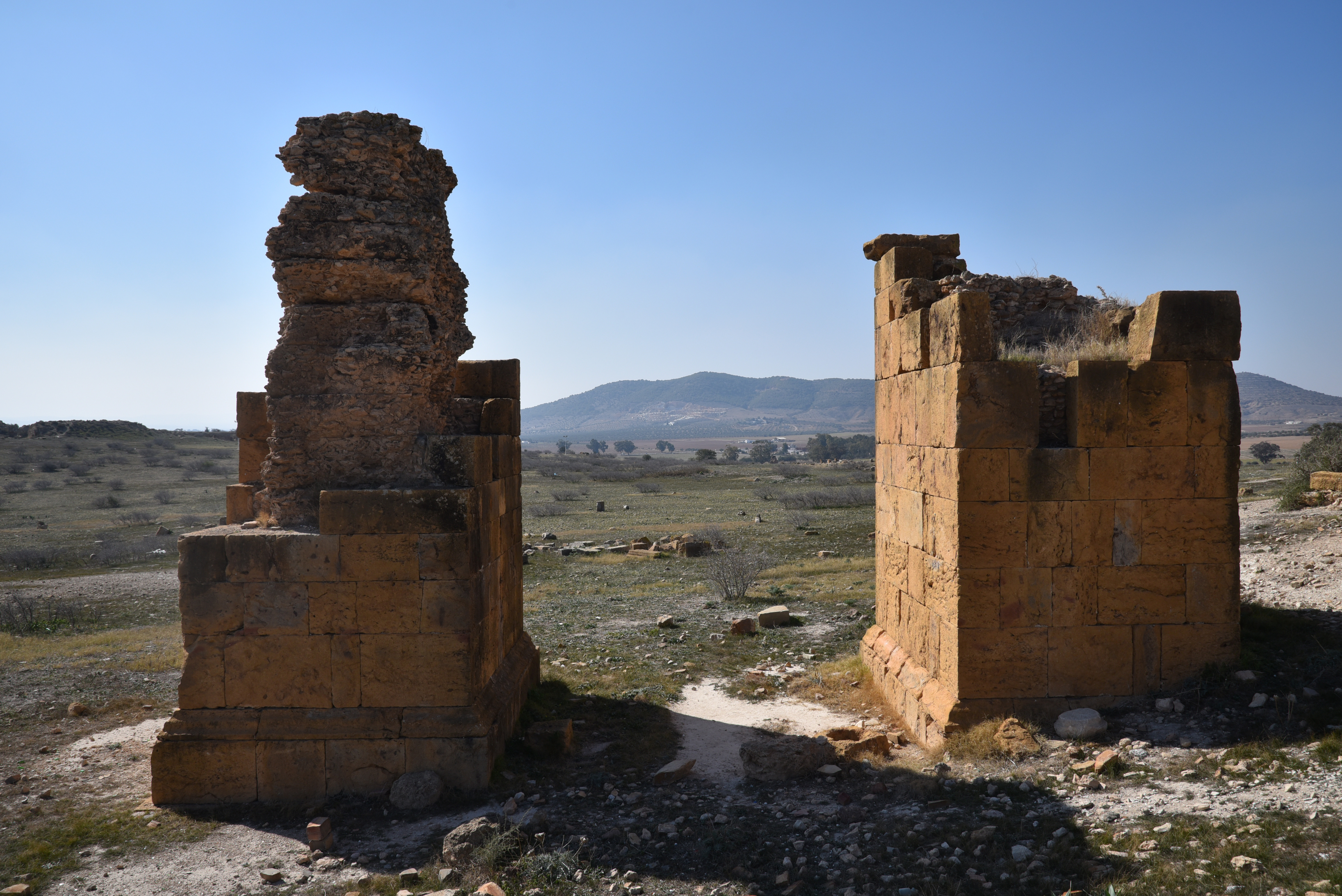
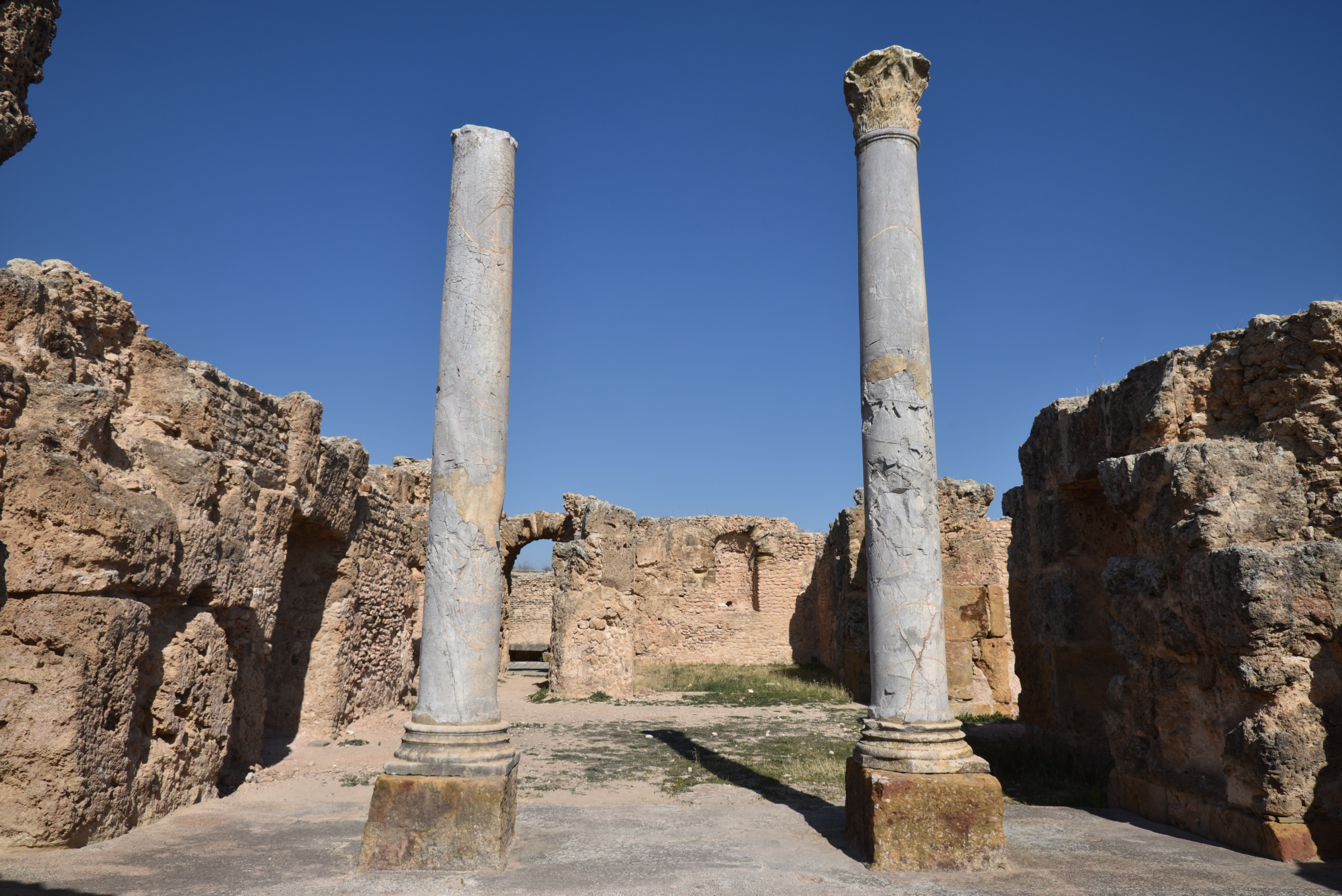
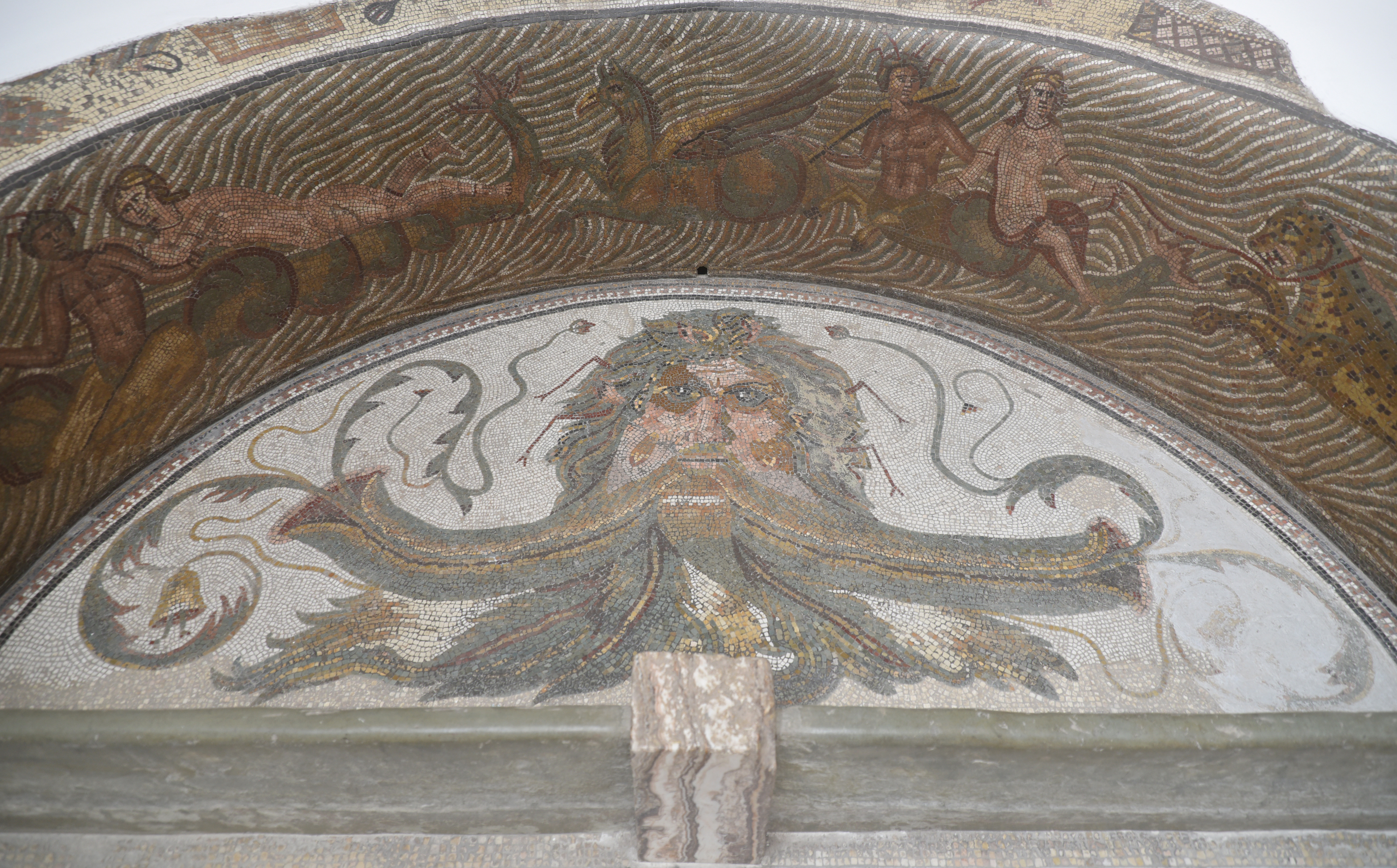
The House of the Trussed Animals, the Baths of the Capitol and the Capitolium.The House of the Trussed Animals. The house was laid out around a peristyle (9 x 1.80m) that enclosed a garden bounded by eight columns. A large triclinium, an oecus and a cubicula opened toward the garden.The well-preserved Forum was built between AD 161 and 192. It was a vast square covering an area of about 1,400 m², surrounded by porticoes of cipollino green columns on three sides. The northwest side of this square is occupied by the Capitolium, in front of which a large masonry altar was erected.The Forum.The Capitolium was built on a massive podium in AD 168 and was dedicated to the Capitoline Triad of gods: Jupiter, Juno and Minerva.The Capitolium stood on a high podium with then fluted Corinthian columns of pink limestone. The building included carved Latin dedications to Marcus Aurelius, Commodus and the triad of Jupiter, Juno and Minerva. It was reached by a wide flight of stairs leading up from the Forum.The Capitolium’s vaulted basement rooms were converted into cisterns, while the basement of the cella was transformed into an oil mill. The pressing platform, counterweight, and settling basins of the oil mill still remain.The Temple of Peace, northeast of the forum. The temple had a marble-paved courtyard and a peristyle leading to a large marble hall. A statue of peace is thought to have once stood here.Stone relief of Pegasus in the Temple of Peace with the Capitolium in the background.View towards the Macellum (market), the Temple of Mercury and the Capitolium.The House of Bacchus and Ariadne. This large house, occupying most of an insula, dates to its current form from the early 5th century AD. The rooms were arranged around a peristyle garden. The mosaic depicting Bacchus and Ariadne in the large room that opens off the northwest portico gave the house its name. The southwestern part of the house was dedicated to business activities, including the production of olive oil.The Palestra of the Petronii, built in AD 225 at the expense of Petronius Felix and his sons.The Palaestra of the Petronii was a square courtyard surrounded by a Corinthian portico located between two baths. It was used for games and gymnastic activities (wrestling, boxing, pankration) before bathing.The Corinthian portico of the Palaestra of the Petronii with a relief depicting a Maenads, a female follower of Bacchus.Part of the dedicatory inscription that stood on the portico. It indicates that the construction of the palaestra was also financed by the decurions. ILAfr 00271The Summer Baths. They covered an area of approximately 2800 m² and were restored in AD 136.The Summer Baths had cold, warm, and hot rooms, fed from three large cisterns. The rooms were all lavishly decorated with marble, mosaics, and fountains.The Temple of Caelestis (Tanit). Very little remains of the Temple of Caelestis, originally the Carthaginian goddess Tanit (the wife of Baal Hammon), except the gate and a Punic column. The temple was turned into a church in the 6th century AD.The Temple of Baalat, a small square temple dedicated to the Punic goddess Baalat, chief goddess of the ancient city of Byblos (Gebal) in Phoenicia.The Temple Baalat, whose plan shows both Roman and Oriental influence, features a semicircular porticoed courtyard with an angular outline, preceded by a small prostyle temple that stands on a podium.The Temple of Ceres, turned into a church. The temple had a 900m2 courtyard decorated with mosaics and a portico with three gateways. Later, this portico became a church, and the cella became the baptistery.The Temple of Ceres, turned into a church. Numerous tombs were placed in the church, one of which revealed jewels.The Eastern Gate. Thuburbo Majus was not fortified, so it had no walls. The entrance to the town was marked by celebratory arches, one of which still stands on a hill to the east of the site.The ruins of the amphitheatre on the outskirts of the site.The south entrance of the amphitheatre.A massive cistern that supplied the town with water. It was once vaulted in concrete.The Western Gate.The Winter Baths, completed between AD 392 and 408. The bathhouse had more than 20 rooms organised around the frigidarium and covered an area of approximately 1600m².A hall in the Winter Baths with columns from Simitthus (Chemtou).Latrines in the Winter Baths, located to the southwest of the frigidarium.The House of Neptune (Maison de Neptune) is one of the best-preserved houses in Thuburbo Majus. It is a large residence in the early 3rd century AD. The house was laid out around a peristyle garden, with four porticos supported by twelve columns. A low wall separated the porticos from the garden.The peristyle garden of the House of Neptune (Maison de Neptune) has a semicircular basin on the east side, originally decorated with a scene showing Oceanus.Fountain basin from the House of Neptune with a scene showing Oceanus surrounded by sea monsters carrying Nereids. National Museum of Bardo.A room paved with polychrome geometric mosaic in the House of Neptune (Maison de Neptune).





















 following hadrian photography