Pont Flavien

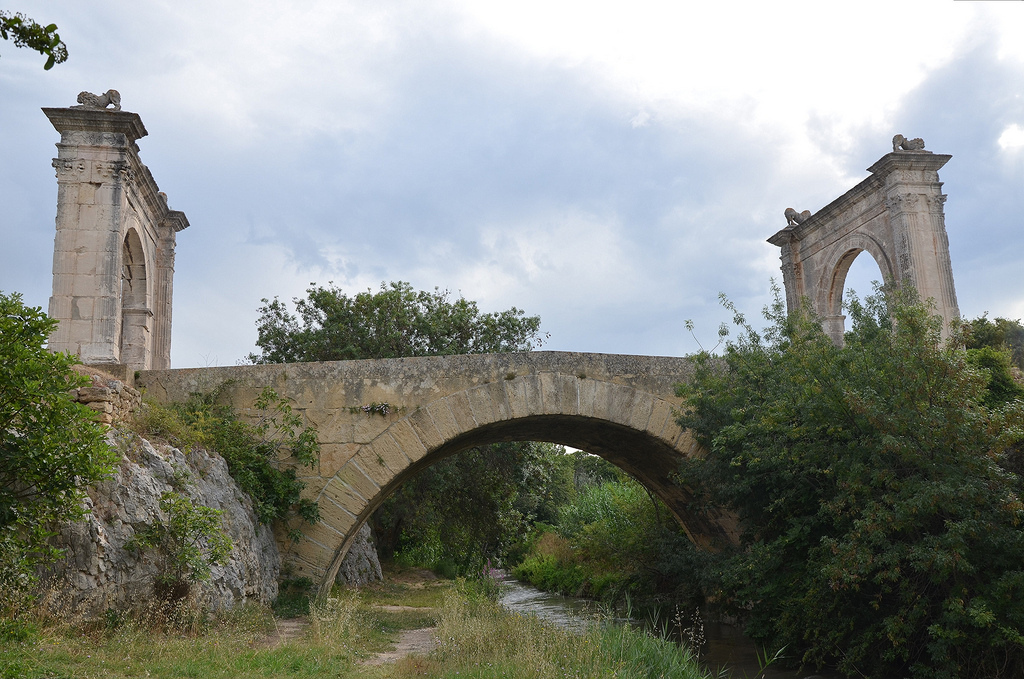
The Pont Flavien (Flavian Bridge), with its triumphal arches at each end, is one of the most beautiful surviving Roman bridges outside Italy. The ancient bridge stands near the modern town of Saint-Chamas in southern France and consists of a single arch spanning the Toulourde River on the Via Julia Augusta.

Coordinates: 43° 32′ 29″ N, 5° 2′ 35″ E

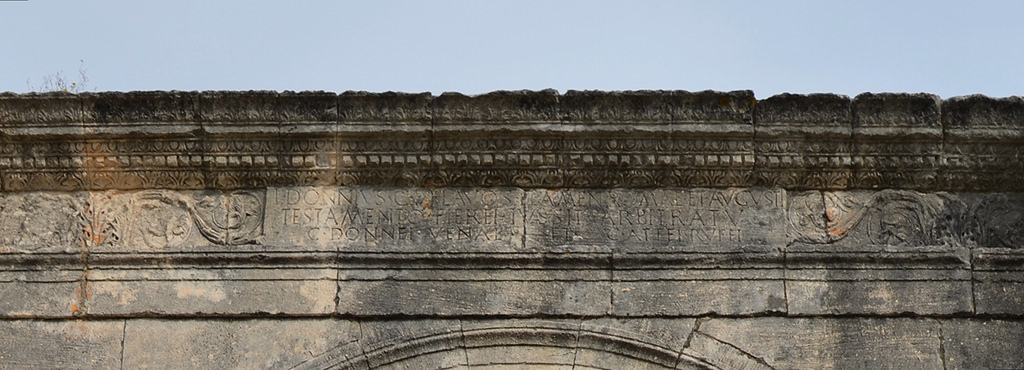
The name “Flavien” refers to a local Roman-Gaul aristocrat called Lucius Donnius Flavius. A Latin inscription on the bridge states that it was built at his instigation.

Lucius Donnius, son of Caius, Flavos, flamen [priest] of Rome and Augustus, has ordained in his will that [this monument] be built under the direction of Cauis Donnius Vena and Caius Attius Rufius.

As the inscription indicates, the bridge was constructed at Flavius’ instigation following his death and completed around 12 BC. It measured 21.4 metres long by 6.2 metres, and the arches at either end stood 7 metres high.

Following excavations, one can see the remnants of the Roman road with ruts worn by chariots and carts. The bridge was heavily used until fairly recently, but it is now reserved for pedestrian use only. The Pont Flavien has been subjected to repetitive damages. In the 18th century, the western arch collapsed, destroying the Roman lions on top of the pediment (the only surviving original lion is on the right-hand side of the eastern arch). Then, the same arch was damaged by a German tank during the Second World War and finally collapsed when it was hit by an American truck. It was rebuilt in 1949 and some years later.

PORTFOLIO

Pont Flavien, late 1st century BC Roman bridge across the River Touloubre in Saint-Chamas, France
The Pont Flavien is a Roman bridge dating to the late 1st century BC. It crosses the River Touloubre in Saint-Chamas, France.
The Pont Flavien was located on a Roman road - the Via Julia Augusta - running between Piacenza (Italy) and Arelate (Arles, France).
The Pont Flavien was located on a Roman road – the Via Julia Augusta – running between Placentia (Piacenza, Italy) and Arelate (Arles, France).
The Latin inscription on the bridge Pont Flavien stating that it was built at the instigation of Lucius Donnius Flavius.
The Latin inscription on the bridge Pont Flavien states that it was built at the instigation of Lucius Donnius Flavius.
Pont Flavien.
The Pont Flavien, Saint-Chamas (France).
Pont Flavien.
Pont Flavien.
The only surviving original lion on top of the Pont Flavien's arches, Pont Flavien, late 1st century BC Roman bridge across the River Touloubre in Saint-Chamas, France
The only surviving original lion on top of the Pont Flavien’s arches in Saint-Chamas (France).
The Pont Flavien, Saint-Chamas (France).
Pont Flavien.

Links:

Hadrianopolis (Epirus)

Hadrianopolis is a Roman city lying in the region of ancient Epirus (in what is now modern-day Albania, south of Gjirokastra) originally inhabited by the Greek tribe of the Chaonians. The city was founded by the emperor Hadrian – who visited the area in AD 125 – on the site of an earlier Hellenistic settlement.

Coordinates: 40° 22′ 37″ N, 19° 41′ 59″ E

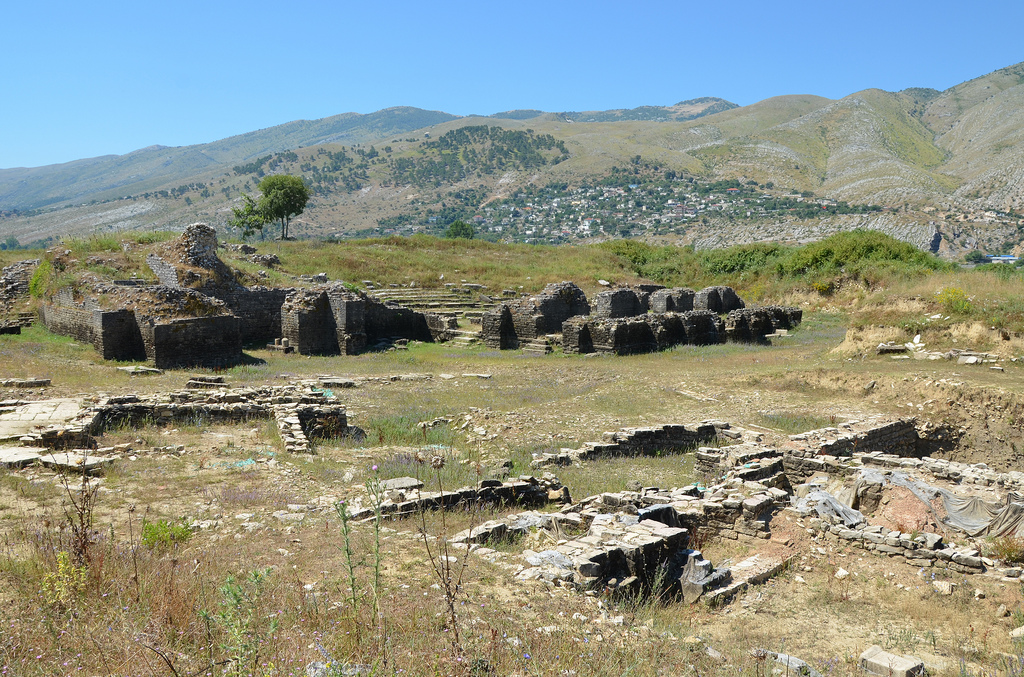
Hadrianopolis 2Ancient sources mentioned a city built during the reign of Hadrian called Hadrianopolis and located between Apollonia and Nicopolis, according to the Tabula Peutingeriana. In the 1970s, a landslide revealed the remains of an ancient theatre in the Drinos Valley, near the village of Sofratikë. It was not until 2002 when subsequent excavations and geophysical research were carried out, that archaeologists realised they had uncovered Hadrianopolis.

The city occupied a square area ca. 400m x 400m in size (about 16 hectares) and was planned following a regular grid pattern with streets crossing each other at right angles. The most prominent archaeological remains excavated so far are the Roman theatre and a large public building which included a bath complex with hot and cold rooms.

Hadrianopolis enjoyed continuous habitation until at least the end of the 5th century AD. During the 6th century AD, the Byzantine emperor Justinian I fortified several outposts throughout the region and is known to have re-founded Hadrianopolis as Justinianopolis.

PORTFOLIO

The Roman theatre built during the reign of Hadrian.
The Roman theatre was built during the reign of Hadrian.
The stage of the Hadrianic theatre, it constisted of a low rostrum (pulpitum) behind which rose the stage wall (scenae frons).
The cavea of the Hadrianic theatre measures 58m in diameter.
The stage (scenae frons) of the Hadrianic theatre.
The stage of the Hadrianic theatre. It consisted of a 26m long rostrum (pulpitum) behind which the stage wall (scaenae frons) rose.
The Hadrianic theatre had 24 rows of seats made of limestone blocks, seating about 3500-4000 spectators.
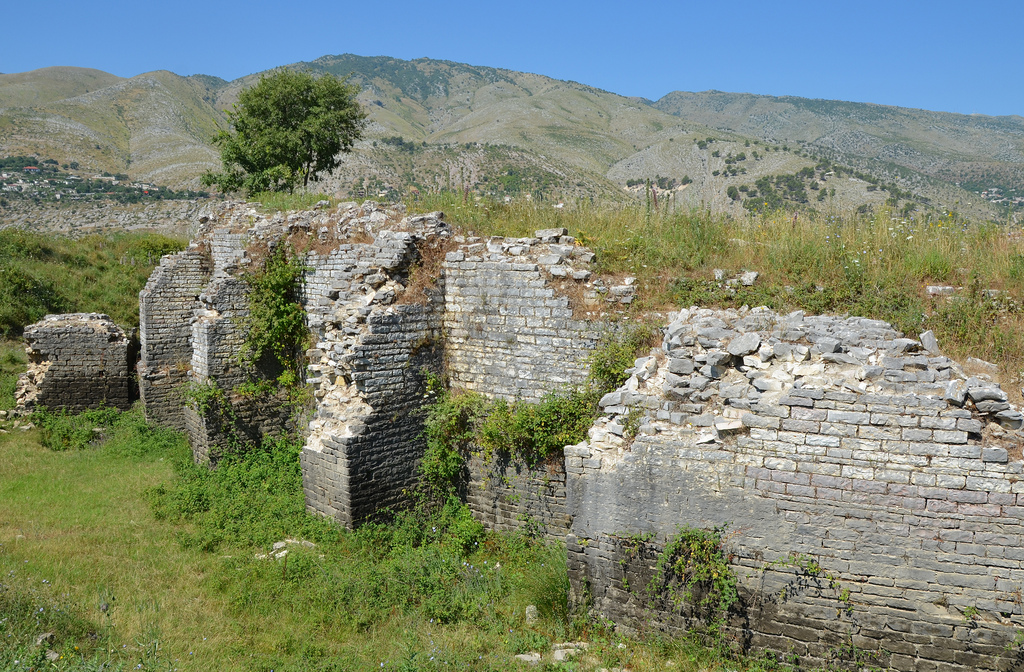
The supporting wall of the Roman theatre built during the reign of Hadrian.
The supporting wall of the Hadrianic theatre.
The remains of a large public building in front of the Hadrianic theatre consisting of a complex of rooms arranged around a courtyard.
Part of the foundations of a Hellenistic monument in front of the Hadrianic theatre and remains of a large public building consisting of a complex of rooms arranged around a courtyard.
Two of the rooms of the large public building in front of the Hadrianic theatre preserve traces of a hypocaust. They were hot rooms of a Roman bath complex.
Two of the large public building rooms in front of the Hadrianic theatre preserve traces of a hypocaust. They were hot rooms of a Roman bath complex.

Links: