Narona was an ancient city located in the Narenta Valley in present-day southern Croatia near the border with Bosnia-Herzegovina. The valley, home to the ancient Illyrian tribe, served as the route for the exchange of goods between the Mediterranean, the Adriatic Sea and the Illyrian hinterland. Narona became a major Roman stronghold and had a Roman temple building dedicated to Augustus known as an Augusteum.
The harbour settlement of Narona began its life in the Late Classical period. It was first mentioned by the Greek geographer Pseudo-Skilak in the 4th century BC, who mentioned an emporion located 80 stadia from the sea.
“And from Nestians is the Naron river: and the voyage into the Narona is not narrow: and even a trireme voyages into it, and boats into the upper trading town, being distant from the sea 80 stades.” – Pseudo-Skylax, 24.
Narona developed into an urban settlement in the Late Roman Republic and remained an administrative centre until its abandonment in the 7th century following the Avaro-Slavic invasion. It served as a centre for several Roman military campaigns against the Delmatae and other Illyrians whose trading community was established there in the late 2d century BC. Narona became part of the Roman province of Dalmatia and reached its peak of prosperity and strategic importance in the Augustan age when it became a major Roman stronghold and received the status of Colonia (Colonia Iulia Narona).
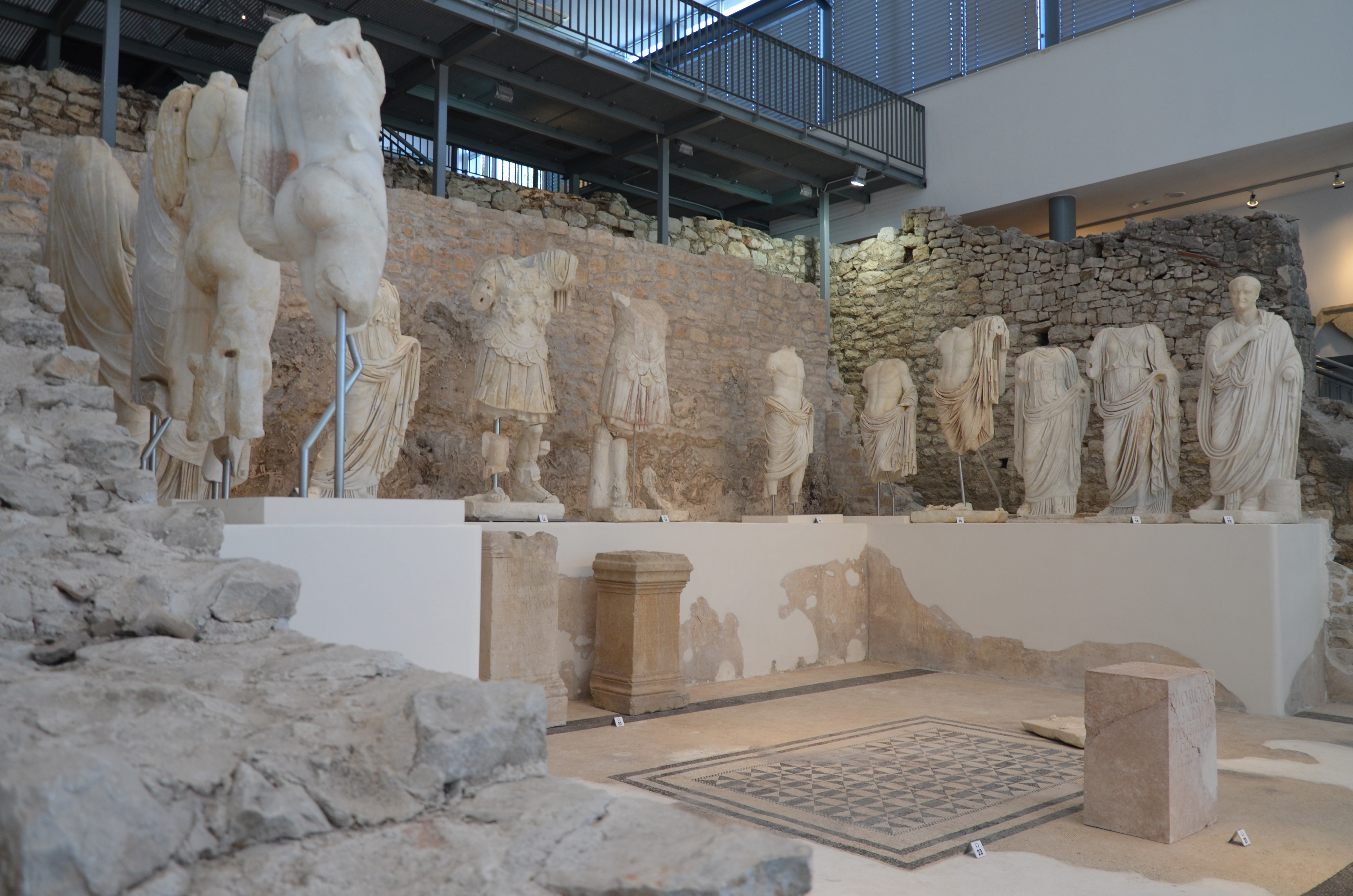
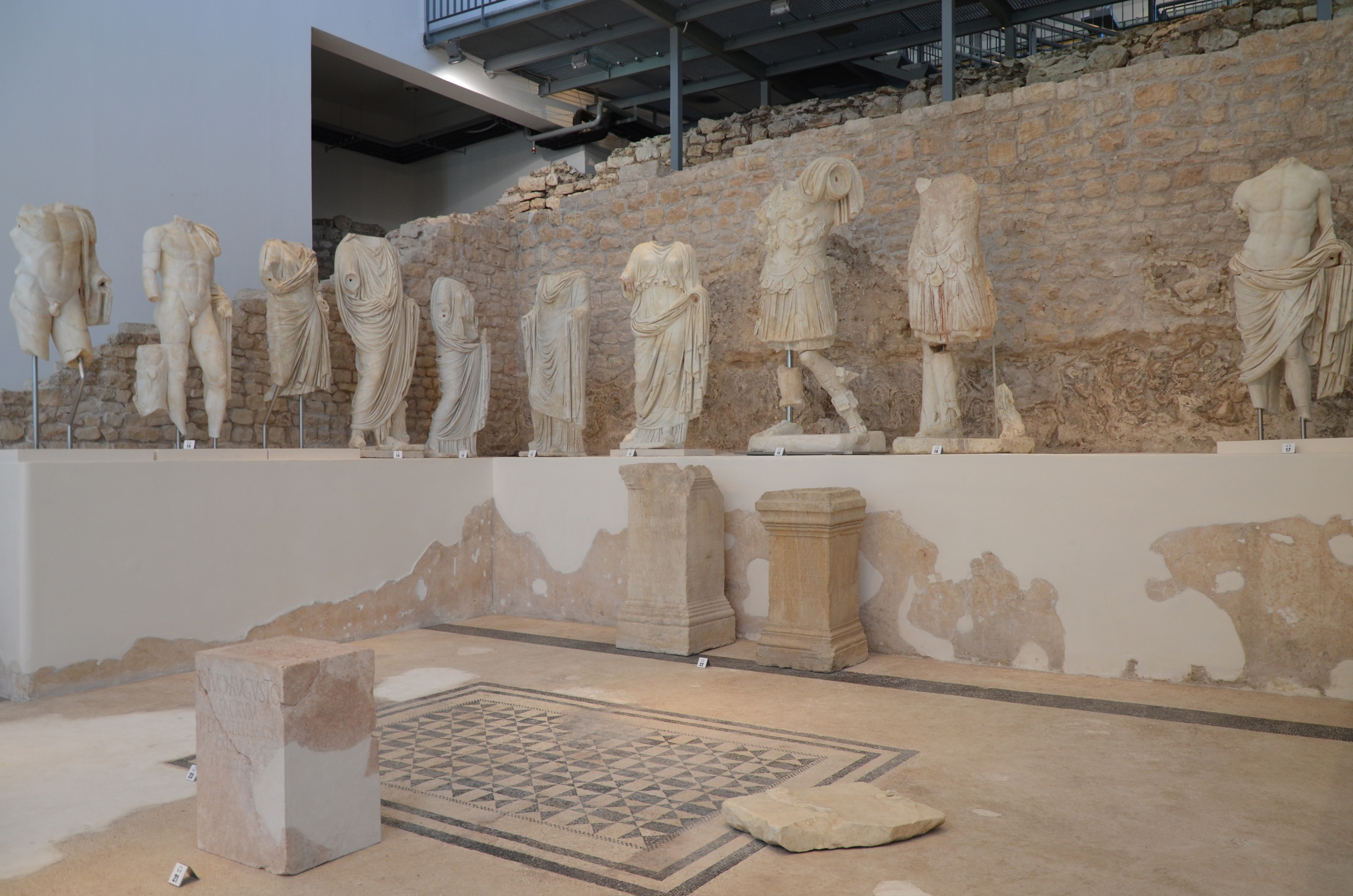
Archaeological research conducted in 1995 and 1996 led to a sensational discovery of the remains of a Roman temple – the Augusteum – and seventeen monumental marble sculptures of Roman emperors and their family members. The Augusteum seems to have been built in about 10 BC and was later dedicated by Publius Cornelius Dolabella, the governor of the province of Dalmatia.
Reconstruction drawing of the Augusteum.
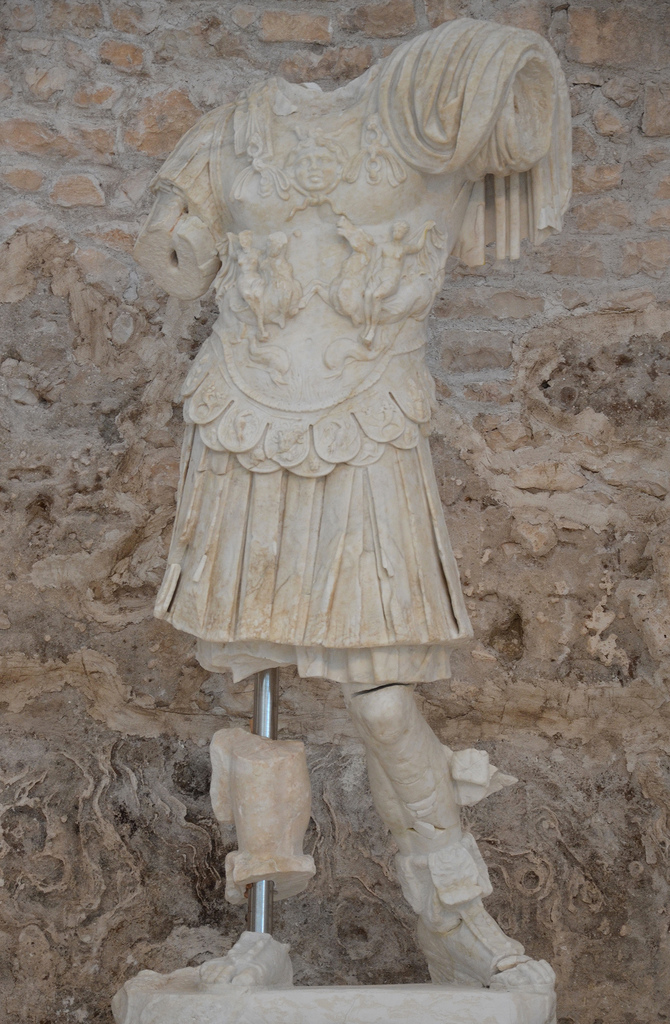
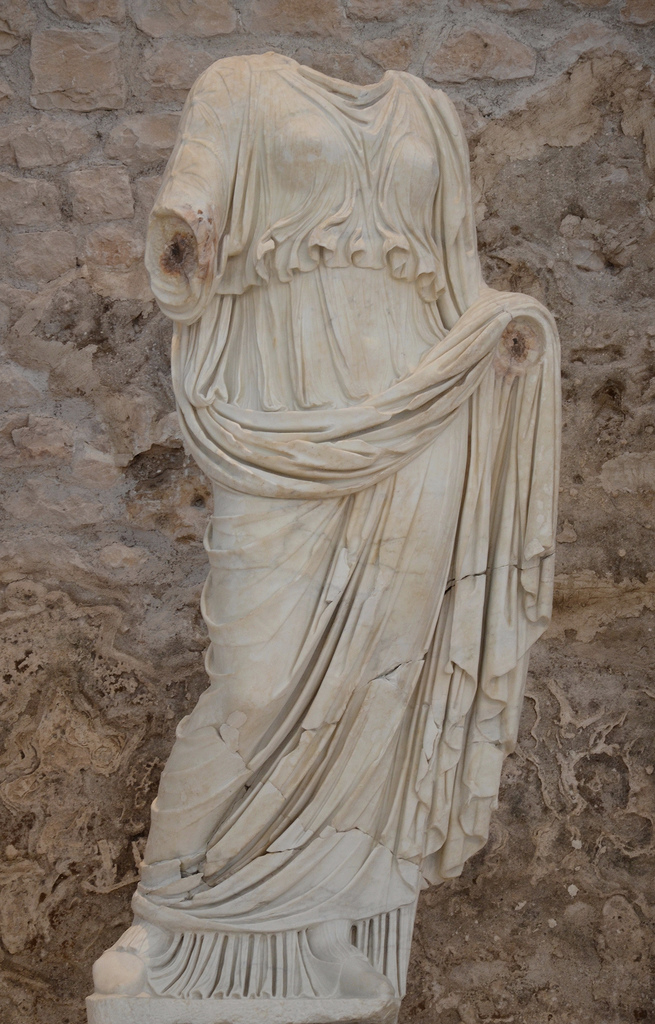
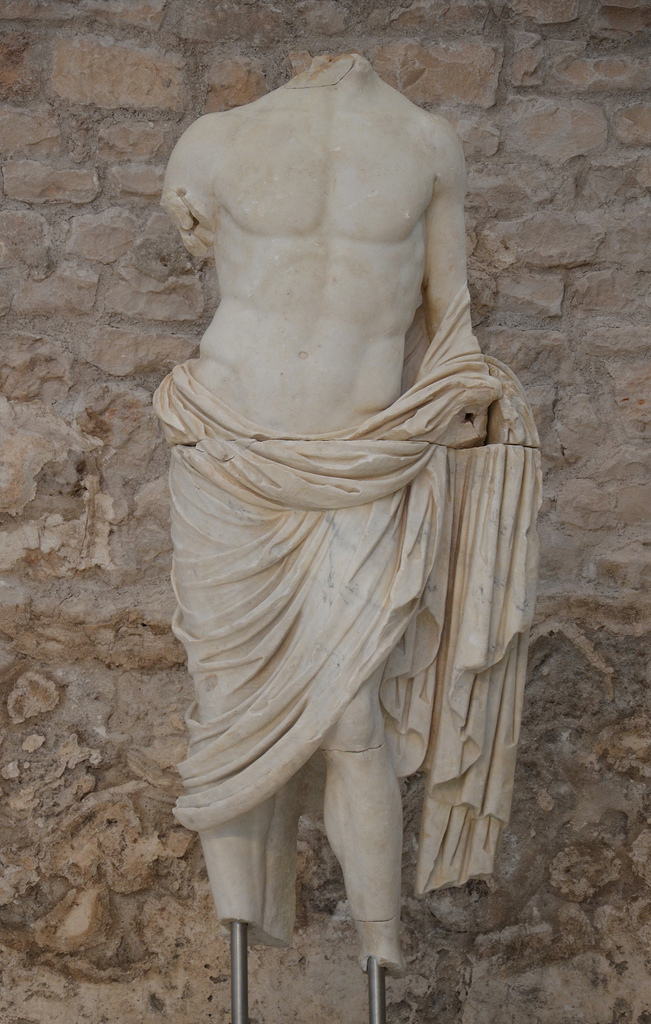
The Augusteum had four columns across the front supporting a triangular pediment and a single chamber (cella) with a mosaic floor. At the beginning of the temple’s history, the Augusteum had only a small podium on which statues of Augustus and his wife, Livia Drusilla (and perhaps Marcus Agrippa, Augustus’ right-hand man) were placed. Following Augustus’ death in AD 14, Publius Cornelius Dolabella, the governor of Dalmatia, added two more statues of the imperial couple and one of Tiberius. There were further additions over the next decades (Claudius, Vespasian), and the podium was extended along two more sides of the cella. Most statues’ heads are missing, but those of Vespasian and one of the Livia still survive. The head of Livia was acquired by British archaeologist Arthur Evans in 1878, who carted it back to the Ashmolean Museum (see picture here). The head was reunited with its body at an exhibition in Oxford in 2004 (source: Guardian). The statues were vandalized in the 4th century AD when Christianity replaced paganism as the Roman Empire’s official religion.
The remains of the Augusteum, with its gallery of imperial sculptures, became the core of the Narona Archaeological Museum. Built on the ruins of the ancient town, the museum opened to the public in 2007 and is the first museum in Croatia located in situ. The museum contains other finds discovered during the excavations in the area around the temple; sculpture fragments, coins, glass, metal and bone artefacts, pottery and oil lamps. The exhibition includes roughly 900 finds, allowing us to track the city’s history from the end of the 3rd century BC through the 15th century AD.
PORTFOLIO
The remains of the Augusteum and fifteen marble sculptures are exhibited on a platform.Statue of Emperor Augustus.Statue of Livia.Statue of Germanicus.Statue of emperor Tiberius.Inscription honouring the emperor Augustus, erected by Publius Cornelius Dolabella, the governor of the province of Dalmatia, 1st half of 1st century AD.
From left to right: Lucius Caesar, Gaius Caesar, Julia, Agrippa and Antonia Minor.From left to right: Germanicus, Drusus, Claudius, Agrippina the Elder, Agrippina the Younger, Vespasian.Honorary inscription for the emperor Vespasian.The mosaic floor of the Augusteum’s cella.The remains of the Augusteum and fifteen marble sculptures are exhibited on a platform.
Archaeological Museum of Narona at Vid, Croatia.Archaeological Museum of Narona.
Lying at the foothills of Mount Tmolus on the banks of the Pactolus River, Sardis was one of the great cities of Asia Minor. Today, its ruins are located about 80 kilometres east of present-day İzmir in western Turkey. As the capital of the flourishing Kingdom of Lydia of the 7th century BC, Sardis achieved fame and wealth, especially under the last Lydian king, Croesus, before succumbing to the Persian conquest in the mid-6th century BC. Sardis fell, in turn, to the Athenians, the Seleucids, and the Attalids until it was conquered by the Romans in 133 BC. The city flourished under Roman peace, became an important centre of Christianity, and was home to a significant Jewish community. Sardis was one of the Seven Churches mentioned in the Book of Revelation.
According to the Greek historian Herodotus, Sardis was the capital of the Kingdom of Lydia in the 7th and 6th centuries BC, when a dynasty of kings from Gyges to Croesus conquered western Anatolia. King Croesus, who ruled Lydia from 560 to 546 BC, was the first person to issue gold and silver coins. Croesus’s legendary wealth led to the expression’ rich as Croesus’.
Sardis was located on a major route connecting the Aegean coast to inland Anatolia. Its wealth and prosperity can be attributed to its strategic location, its ideal location for trade and commerce, and its abundant water and mineral resources, most notably the legendary Pactolus, a small river that contained gold dust. The Persians brought the Lydian monarchy to a final and dramatic end when Cyrus II, King of Persia, invaded Sardis in 547 BC.
Under the Achaemenid Persians (547 – 334 BC), Sardis was the capital of Anatolia’s major satrapy (province). It served as the end station of the Persian Royal Road, which began in Susa, in present-day Iran. During the Persian occupation, the inhabitants of Sardis engaged in industry and commercial trade, making Lydia one of the wealthiest kingdoms of the period. Sardis remained under Persian domination until it surrendered to Alexander the Greatin 334 BC.
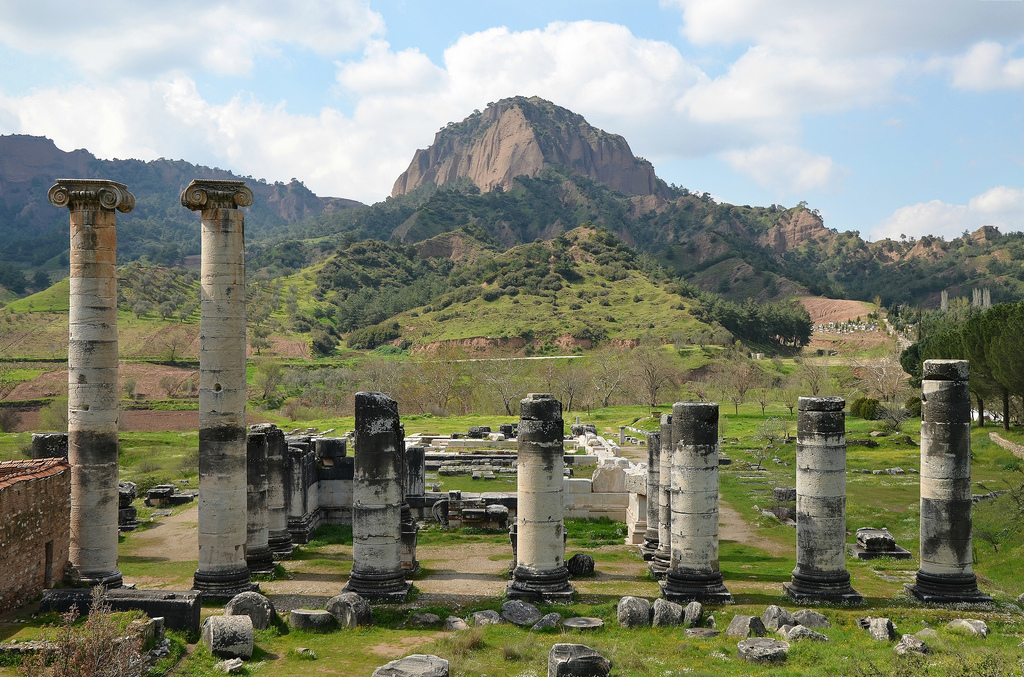
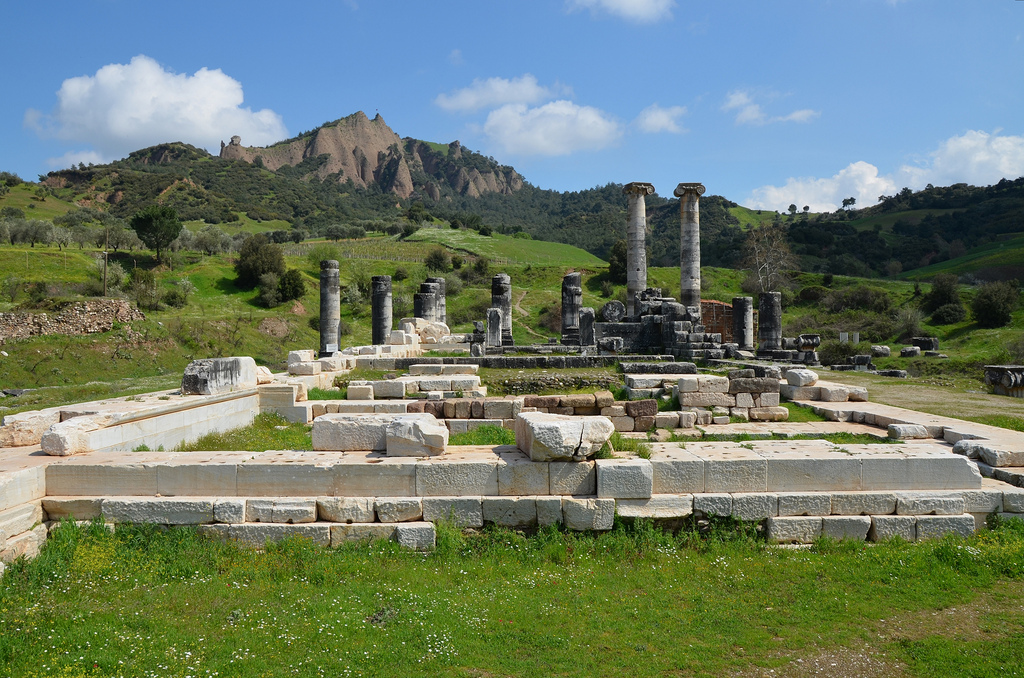
After Alexander the Great’s conquest, Sardis was incorporated into the Hellenistic kingdoms and became the western capital of the Seleucid empire when it was granted status as a Greek city-state. The monumental temple to the goddess Artemis on the site dates to this period. The theatre of Sardis, now sadly in ruins, was also built during this period.
In 133 BC, Sardis came under Roman rule when the last king of Pergamon, Attalus III Philometor, died and bequeathed his kingdom to the Romans. The city became the metropolitan capital and centre of judicial administration of the Roman province of Lydia. The city was rebuilt after being destroyed by an earthquake in AD 17. According to Tacitus (Annals 2.47), Tiberius awarded ten million sesterces for its reconstruction and agreed to waive all taxes due from Sardis and the other cities for five years after the earthquake. Hadrian visited Sardis in AD 123/124 and 128 as “new Dionysos“, whilst an inscription seems to mention a Hadrianeion (Temple of Hadrian).
Excavations in Sardis have uncovered more remains of the Hellenistic, Roman and Byzantine city than of the Lydian town described by Herodotus. Since 1958, Harvard and Cornell universities have sponsored annual archaeological expeditions to Sardis. The major Roman bath-gymnasium complex has been excavated and restored as part of these works. The Synagogue was also discovered in 1962. Some of the important finds from the archaeological site of Sardis are kept in the Archaeological Museum of Manisa in Turkey.
PORTFOLIO
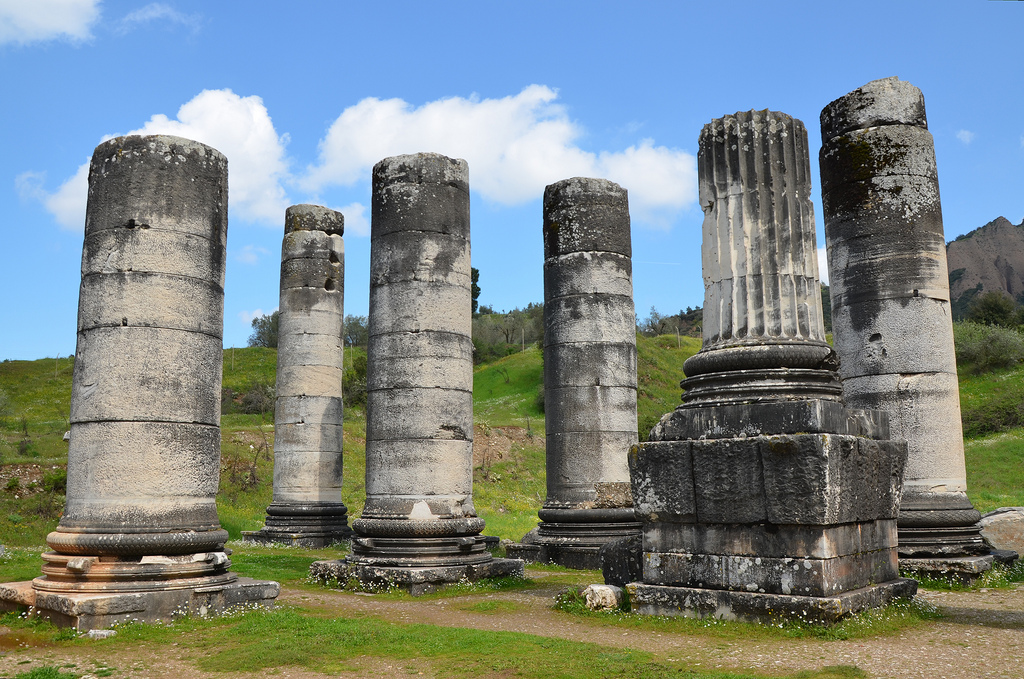
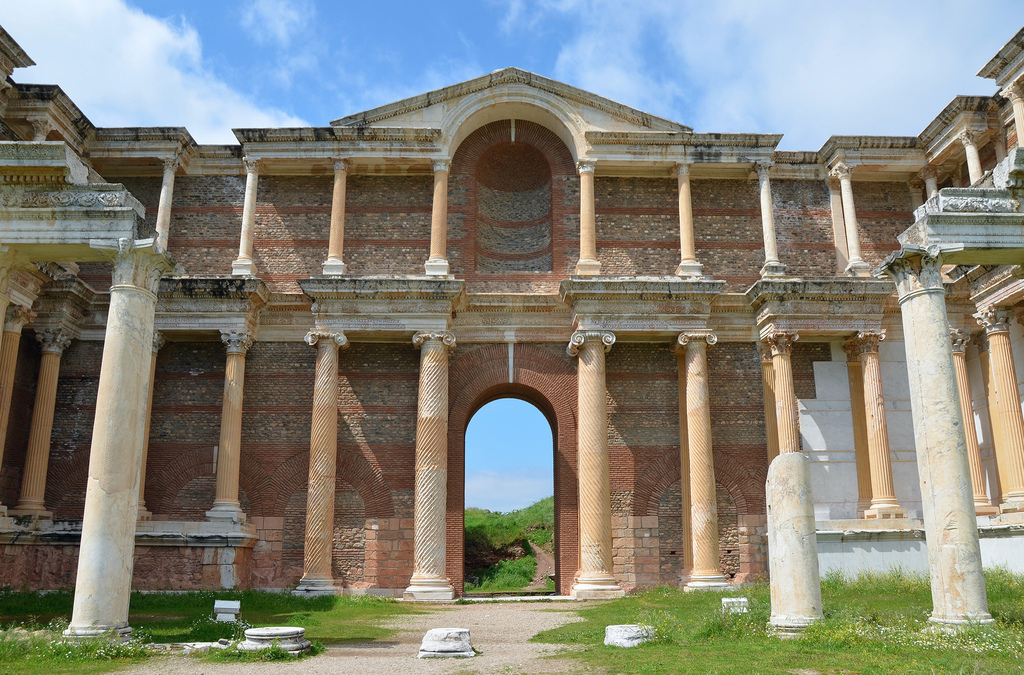
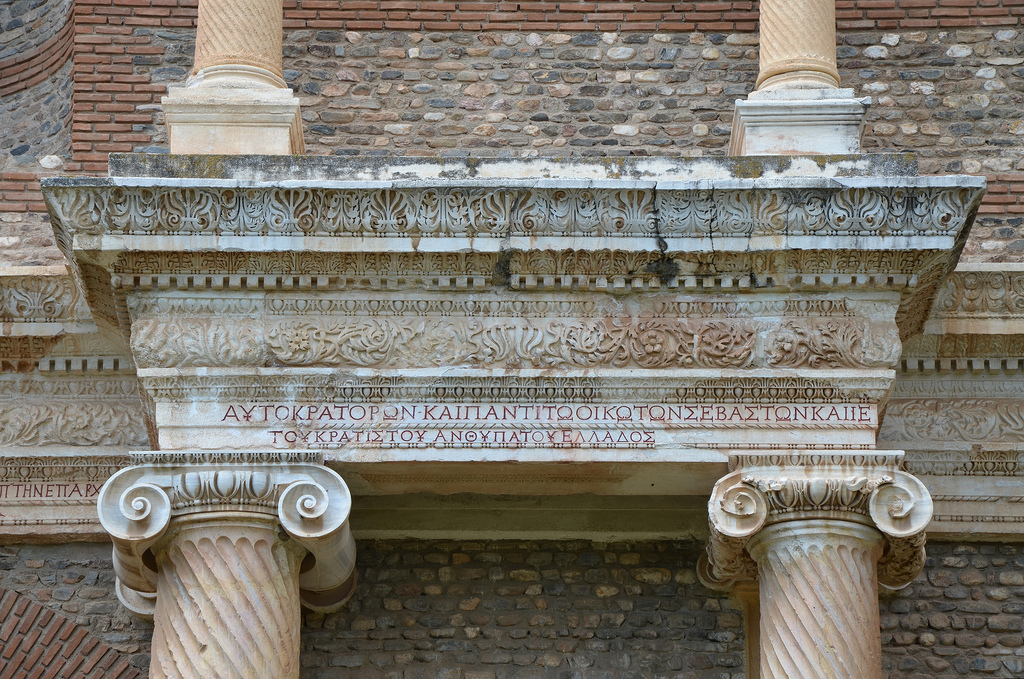
The ruins of the great Ionic Temple of Artemis are one of the largest in the world. Construction of the temple began during the Hellenistic era in the 3rd century BC on the location of a sanctuary of Artemis dating to the late 6th or 5th century BC.The underground foundations of the Lydian Altar of Artemis, the oldest preserved building in the sanctuary of Artemis (500-400 BC), where animal sacrifices, libations, and other offerings were made. The building above, which may have been much more finely made, has been entirely destroyed.View of Lydian Altar and Temple of Artemis.The altar was a stepped limestone tufa foundation. A set of marble stairs across the front of the building led to the higher level. The travertine stair blocks are modern replacements for the original marble stairs, protecting the ancient foundations. The altar was restored in 2010-2012.The Temple of Artemis was renovated in the 2nd century AD by dividing the cella into two equal chambers. The temple incorporated the Imperial Cult. Both shrines were dedicated to Antoninus Pius and his wife Faustina (as Zeus and Artemis). The colossal head from a statue of the empress Faustina the Elder is now part of the British Museum collection.The Temple of Artemis was fronted on each end by eight columns, almost 17.8 m high; twenty such columns were on each side. The extant columns are predominantly Roman replacements.The two complete Ionic columns have stood intact since antiquity and have never been restored. Most columns were unfluted as the Temple was never finished.Hellenistic column base on a Roman pedestal with Greek verse around the bottom of the column.The Temple of Artemis was abandoned with the coming of Christianity, and a small church was erected at the southeast corner.The Bath-Gymnasium complex was probably completed in the late 2nd-early 3rd century AD. This complex is a relatively common architectural type in Asia Minor, combining a Roman bath with vaulted halls and a colonnaded palaestra, such as Ephesus and Ancyra.The two-storey colonnaded Marble Court of the Bath-Gymnasium complex. It was originally separated from the baths and was used for special ceremonies.Southwest corner and west ambulatory of the two-storey colonnaded Marble Court.The first storey of the Marble Court carried Ionic capitals, the second a type known as “acanthus-and-fluting”.The inscription on the first-storey architrave, in red-painted letters, dedicates the Marble Court to the Roman Imperial family: Emperors Caracalla and Geta, and their mother, Julia Domna (Geta’s name is erased). It also records that two prominent citizens, Antonia Sabina and Flavia Pollitta, helped the city to pay the expenses of this project.The Palaestra of the Bath-Gymnasium Complex covers a total area of 6650 m2. It consisted of a large square peristyle court of 100 columns, bordered on the north and south by ranges of rooms.The Frigidarium (cold bath) has a long rectangular pool in its centre. The side walls are articulated by alternating semicircular and rectangular niches containing pools, basins and fountains.The monumental Synagogue was the centre of Jewish religious life in Sardis during the Late Roman period. Discovered in 1962, the building and its decorations have been partly restored.View of the Main Hall of the Synagogue ending in an apse. It was over 50 m long and large enough to hold nearly a thousand people.The Main Hall of the Synagogue with a marble table and lions and three tiers of marble-covered benches which served as seats for the synagogue elders The table and the lions are older than the Synagogue itself; they were moved from their original locations and reused here.The Peristyle Forecourt of the monumental Synagogue. It was roofed along the sides but left open to the sky in the centre.The Peristyle Forecourt of the Synagogue was paved with geometric mosaics, and the walls were covered with painted plaster. Floor mosaics constituted the most extensive part of the Synagogue’s decoration, covering some 1400 square metres.View of the Byzantine Shops and the Bath-Gymnasium Complex.The Byzantine Shops. The streets of Late Roman Sardis were flanked by buildings serving various residential, commercial, and industrial purposes. The shops formed part of a lively commercial district in the 5th-6th centuries.A short segment of the Roman main street paved with marble blocks and flanked by covered porticoes.